Writing Where Intelligence Meets Strategy
Too Big to Decouple
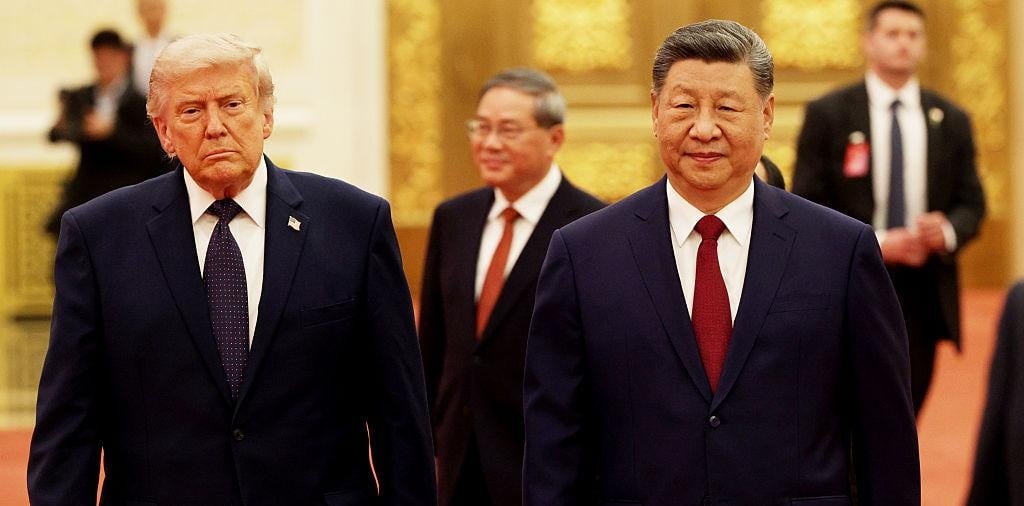
U.S. President Trump Meets With China's President Xi And Attends State Banquet (Kyodo News via Getty Images)
America and China want to become less dependent on each other. The world may discover that neither can afford to succeed completely.
When Xi Jinping arrives in Washington this week, the meeting will be described as a summit about trade. It is better understood as something larger. Donald Trump and China’s president are expected to discuss tariffs, semiconductors, artificial intelligence, Taiwan, Iran and other strategic questions. These may look like separate disputes. They are not. Each is part of the same contest: over technology, supply chains, raw materials and, ultimately, the rules of the global economy and international security. The central problem is simple to describe and difficult to solve. America and China want to depend less on one another. The rest of the world still depends heavily on both.
For years, relations between America and China were discussed mainly in terms of tariffs and trade deficits. That now looks like the easier part of the dispute. The contest has shifted to semiconductors, critical minerals, batteries, data centres and artificial intelligence. America wants to reduce its exposure to China in sectors it considers strategically important. Beijing is pursuing much the same objective with regard to American technology. Yet economic separation has proved harder than political rhetoric suggests. China remains an export powerhouse, while American firms and consumers remain deeply connected to Chinese manufacturing and supply chains. The relationship is therefore defined by an awkward contradiction: interdependence without trust. Both governments are trying to reduce vulnerability without destroying the economic ties from which they continue to benefit.
The contest is increasingly about control over the critical nodes of the global economy. America retains important advantages in advanced technology, particularly in parts of the semiconductor ecosystem. China, by contrast, has substantial influence over the processing and supply of critical minerals and rare earths used in electronics, electric vehicles, defence equipment and data centres. This gives both sides coercive tools. Washington can restrict access to advanced chips and technology. Beijing can limit exports of strategic materials. What was once seen as mutually beneficial economic integration can therefore become a source of leverage. Interdependence no longer merely restrains confrontation. It can also be weaponised.
Artificial intelligence may prove the most consequential part of the rivalry. AI is not simply another technology sector. It is likely to affect intelligence, cyber operations, military systems, scientific research, manufacturing and productivity. Leadership in AI therefore carries both economic and strategic value. America has sought to limit Chinese access to some of the most advanced chips and technologies. China, meanwhile, is investing heavily in reducing its dependence on foreign suppliers. But the race also creates a shared problem. Technologies powerful enough to transform warfare and decision-making also create new risks of miscalculation. That is why discussions about AI increasingly concern not only competition, but guardrails: safety mechanisms, communication channels and limits on the most dangerous applications. This is not cooperation between friends. It is risk management between rivals. Indeed, the absence of trust may be precisely what makes rules necessary.
Tariffs can be negotiated. Purchases can be increased. Export restrictions can be adjusted. Taiwan is different. China regards the island as part of its territory and has not ruled out the use of force to achieve unification. America does not recognise Taiwan as an independent state, but provides it with arms and supports its ability to defend itself. Any change in language or policy is therefore scrutinised closely in Beijing, Taipei, Tokyo and Washington. The stakes extend far beyond security. Taiwan sits at the heart of the global semiconductor industry. A confrontation in the Taiwan Strait would therefore not remain a regional military crisis for long. It could become a global technological, industrial and financial shock. That makes Taiwan the clearest example of how a bilateral rivalry could produce worldwide consequences.
Iran may seem far removed from the contest between America and China. In fact, it illustrates how global that contest has become. China depends heavily on stable energy flows from the Middle East while maintaining close ties with Tehran. America, meanwhile, remains deeply at odds with Iran and would like Beijing to use whatever influence it possesses to restrain it. The result is an unusual relationship. China is America’s principal strategic competitor, but in some crises it is also a power that Washington cannot simply ignore. That reflects a broader change in China’s role. Beijing is no longer merely the world’s manufacturing centre. It increasingly seeks influence over the diplomatic and strategic rules of the international system itself.
The temptation to describe the rivalry as a new Cold War is understandable, but misleading. America and the Soviet Union presided over largely separate economic systems. America and China operate within the same one. They compete, but they trade. They seek greater autonomy, but remain deeply connected. Their companies, financial systems and supply chains are entwined with the same global economy. Nor is the rest of the world eager to divide neatly into two camps. Europe, India, the Gulf states and countries across Asia, Africa and Latin America generally want room to deal with both powers. Many rely on America for security, China for trade, or both for different reasons. The emerging order is therefore not simply bipolar. It is a system in which states hedge between rival centres of power. The struggle is not only over alliances or territory. It is over technical standards, infrastructure, semiconductors, energy, currencies and supply chains.
Trump and Xi may leave the summit with agreements on tariffs, purchases, minerals or artificial intelligence. Those will make the headlines. But the more important question is whether America and China can construct a framework for managing their rivalry over time. Neither friendship nor trust is necessary. What is necessary are clearer red lines, reliable channels of communication, and a shared understanding that uncontrolled escalation would hurt both sides, and much of the rest of the world. This is what makes the summit important.
The real story is not that America and China are trying to defeat one another. It is that each is trying to become less dependent on the other while the global economy remains heavily dependent on both. The question is whether that contradiction can be managed. If it can, the world may enter a long period of intense but contained competition. If it cannot, the rivalry between the two powers may eventually begin to split the system around them.