
Where history exposes power and moral failure
Touchdowns, Railroad Barons, and Blood Atonement
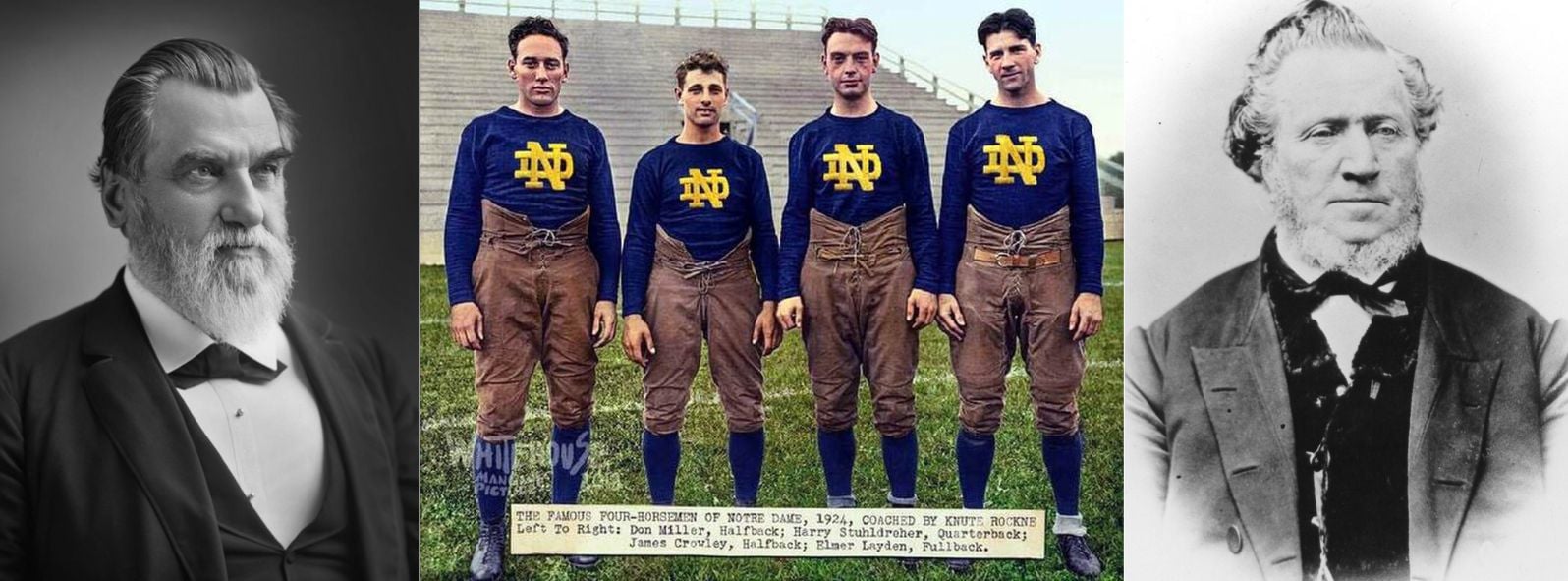
Leland Stanford Sr. (1890), Notre Dame’s Four Horsemen (1924), and Brigham Young (pre-1877); historical photographs by unknown creators, public domain, via Wikimedia Commons; collage assembled by Kelsey Maurine Brickl in Canva.
Outlined against a blue-gray October sky, the Fighting Irish rode again. In dramatic lore they are known as Famine, Pestilence, Destruction, and Death. On October 10, 2026, they wore gold helmets, and… they kicked Stanford’s teeth in, 58–7.
Grantland Rice was considerably more elegant when he wrote about Notre Dame’s Four Horsemen in 1924. I am a Notre Dame alumna, a historian, and considerably less charitable when it comes to nineteenth-century American villains.
Notre Dame’s next opponent is Brigham Young University, meaning that within eight days, America’s preeminent Catholic university will have played two schools whose names are associated with some of the ugliest chapters of American history.
Meanwhile, Netflix has just released Zoe Kazan’s adaptation of John Steinbeck’s East of Eden, starring Florence Pugh as Cathy Ames. Steinbeck’s 1952 novel examines the moral inheritance of American families in California’s Salinas Valley, where extraordinary fortunes were accumulated alongside extraordinary human suffering. Its renewed popularity has brought the novel to audiences who may never have read it, and returned some uncomfortable California history to public discussion.
I am not opposed to the coincidence.
Stanford University was named in memory of Leland Stanford Jr., who died of typhoid fever in 1884 at fifteen. His parents founded the university in his honor. The boy had nothing to do with his father’s politics, and the family’s grief was genuine. I’m not writing now to slight him. But his father?
His father, Leland Stanford Sr., was a railroad magnate, California governor, United States senator, and one of the wealthiest men of the American Gilded Age. He was also an extraordinarily vigorous anti-Asian racist.
In his January 10, 1862 inaugural address, Stanford told California’s legislature that Asian immigration threatened the state’s future. He described Chinese immigrants as an inferior population, warned that their presence would discourage white immigration, and urged measures to restrict Asian settlement.
Specifically, Leland Stanford described Asian immigrants as the “dregs” of their continent and characterized white Californians as a superior race. He welcomed legislative measures to repress Asian immigration. He got his way. His statements helped lay the political groundwork for the Chinese Exclusion Act of 1882.
This was the governor of California speaking officially to his legislature. The same Stanford subsequently helped build the Central Pacific Railroad, which employed thousands of Chinese laborers to construct the western portion of the transcontinental railroad. Chinese workers blasted tunnels through the Sierra Nevada, endured dangerous conditions, and performed labor indispensable to the fortunes of Stanford and his associates.
Apparently, Chinese people were sufficiently inferior to be excluded from California but sufficiently competent to build its railroads. Stanford’s opinion of Chinese workers eventually improved, although rather too late to erase what he had already said about them, the laws passed against them, and the violence done unto them.
Steinbeck’s East of Eden also features Lee, a Chinese American character whose intelligence and understanding of human nature challenge the racial prejudices of the California Stanford helped shape. Hoon Lee plays him brilliantly in the Netflix adaptation. There is, I think an additional historical irony to the series’ presence atop Netflix charts and in public consciousness during Notre Dame’s Stanford week as the United States is torn apart by anti-immigrant rhetoric and action and led by a billionaire baron.
And then Notre Dame beat Stanford by fifty-one points.
Freshman Jonaz Walton rushed for 181 yards, including a 97-yard touchdown run. Notre Dame led 37–0 at halftime. Stanford managed seven points. For a university whose name is inseparable from the fortunes of a nineteenth-century anti-immigrant railroad baron, it was quite a public demolition.
I recognize that a football score cannot correct historical injustice. I enjoyed it anyway, especially after spending the afternoon considering whose names Americans have chosen to immortalize on their universities.
And Notre Dame isn’t finished with that particular historical exercise.
Next Saturday, October 17, the Fighting Irish travel to Provo, Utah, to play BYU. The schedule takes us from the California railroad empire of Leland Stanford to the Mormon theocracy established by Brigham Young. The two men were contemporaries who helped shape the American West, governed neighboring territories during the nineteenth century, and defended racial hierarchies while accumulating extraordinary political power.
Young succeeded Joseph Smith as leader of the Latter-day Saint movement, led Mormon settlers westward to Utah, which he envisioned as Zion, and became territorial governor. He also married numerous women and exercised extraordinary religious and political authority.
I have previously examined Joseph Smith’s changing accounts of his First Vision. His 1832 account describes one divine figure; by 1838, there are two, including God the Father. As I wrote then, “The dead are especially uncooperative.” Young inherited Smith’s prophetic office, and with it the considerable convenience of claiming divine authority for his own pronouncements.
Fortunately, Brigham Young left behind sermons in which he explained himself quite plainly. On February 8, 1857, he delivered one at the Great Salt Lake City Tabernacle explaining what Jesus meant when he commanded his followers to love their neighbors.
His explanation included the following: “Will you love that man or woman well enough to shed their blood? That is what Jesus Christ meant.”
He continued: “He never told a man or woman to love their enemies in their wickedness, never.”
Young then described people who had departed from his inherited church: “I have known a great many men who have left this Church for whom there is no chance whatever for exaltation, but if their blood had been spilled, it would have been better for them.”
Finally, he explained his personal interpretation of Christian charity: “This is loving our neighbour as ourselves; if he needs help, help him; and if he wants salvation and it is necessary to spill his blood on the earth in order that he may be saved, spill it.”
I have encountered some creative biblical exegesis in my academic work. Brigham Young’s interpretation of loving one’s neighbor is certainly memorable.
These passages appear in volume four of the Journal of Discourses, pages 219–220. Young’s doctrine of blood atonement remains controversial among historians, particularly regarding its relationship to actual violence. The contemporary Church of Jesus Christ of Latter-day Saints rejects blood atonement as a practice.
Young also defended racial restrictions excluding Black men of African descent from priesthood ordination. Those restrictions endured until 1978, long after his death. The modern LDS Church has repudiated the racial theories previously used to justify them. The university still bears his name and is bedecked with decorations of him, including a prominent twelve foot tall statue.
BYU is owned and operated by the Church of Jesus Christ of Latter-day Saints, and the overwhelming majority of its students are Latter-day Saints. Brigham Young’s prophetic authority remains part of the Church’s religious history, even where particular teachings have subsequently been repudiated.
Individual BYU students bear no personal responsibility for Brigham Young’s conduct, any more than Stanford students bear responsibility for Leland Stanford’s anti-Asian racism. Nor would I suggest that the University of Notre Dame, its religious traditions, or its student body are historically or presently free from prejudice, including antisemitism. All three institutions have histories that deserve scrutiny, regardless of which football team I happen to support.
Instead, I am interested in the peculiar American willingness to preserve certain men’s names as monuments to greatness while treating their documented beliefs, words, and actions, however horrific, as historical inconveniences.
Am I being absurd by making these connections through college football?
I have considered the possibility. A fifty-one-point victory over Stanford and an upcoming game against BYU would ordinarily invite discussion of rushing yards, defensive formations, and playoff rankings. Instead, I have spent my Saturday evening reading gubernatorial addresses and nineteenth-century Mormon sermons.
But I do not think the connections are absurd, particularly when a major American political movement has organized itself around the promise to “Make America Great Again.” Again when?
The Gilded Age is frequently romanticized for its industrial expansion, spectacular private fortunes, railroad construction, and entrepreneurial ambition. It was also a period in which extreme wealth and extreme poverty coexisted, Native Americans were dispossessed and killed, women lacked the national right to vote, and systemic antisemitism confronted growing numbers of Jewish immigrants from Eastern Europe.
Those immigrants encountered employment discrimination, housing restrictions, nativist hostility, and social institutions that excluded them from much of respectable American society. American prosperity was considerable. Its distribution, and the terms upon which newcomers could participate in it, were considerably less impressive.
The 1950s, another popular target for alleged American “greatness,” is another questionable decade when examined. Children practiced hiding beneath school desks during atomic attack drills. Black Americans endured legally enforced segregation, racial terror, and lynching. Disabled Americans were confined to institutions, frequently under appalling conditions. Julius and Ethel Rosenberg were executed in 1953 following their conviction for conspiracy to commit espionage, amid the political hysteria of the Cold War. Women faced extensive professional and economic restrictions, while suspicion of religious, sexual, and political nonconformity shaped public life.
The decade also brought genuine economic growth, scientific achievement, and rising living standards for millions of Americans. Those accomplishments deserve recognition. So do the people systematically excluded from their benefits.
The modern movement toward white Christian nationalism raises a related question about which historical social arrangements its adherents hope to recover. Its proponents do not all describe their objectives identically, but those seeking a more explicitly Christian national identity must confront the American history of religious exclusion, including the treatment of Jews, Catholics, Asians, Disabled people, Mormons, and other minorities.
Brigham Young’s Utah offers one example of the extraordinary authority that can accumulate when religious leadership and civil government become intertwined. Leland Stanford’s California offers another example of how economic development can coexist with racial exclusion and exploitation.
Their histories are different, and their institutions have changed enormously since their founding. Nevertheless, the original words survive. We can read what these men believed, what they proposed, and how they exercised their political and religious authority.
The American past contains genuine greatness. It also contains atrocities, exploitation, and men who sincerely believed that their authority entitled them to determine which other human beings deserved equality, freedom, or even life. If we are going to restore some supposedly “great” historical America, I would like a precise date and an explanation of who gets to enjoy the restoration. Perhaps this is too much history for sports commentary. Perhaps not.
Grantland Rice saw four football players beneath an October sky and imagined the Horsemen of the Apocalypse. I saw Notre Dame obliterate Stanford, looked at next week’s schedule, and opened the historical archives.
Go Irish. Beat Cougars.
Related Topics