
PhD | Sr. Change Leadership and Crisis Management Expert
Toward the Cyrus Accord: Cyrus the Great’s Legacy and Solidarity in Canada
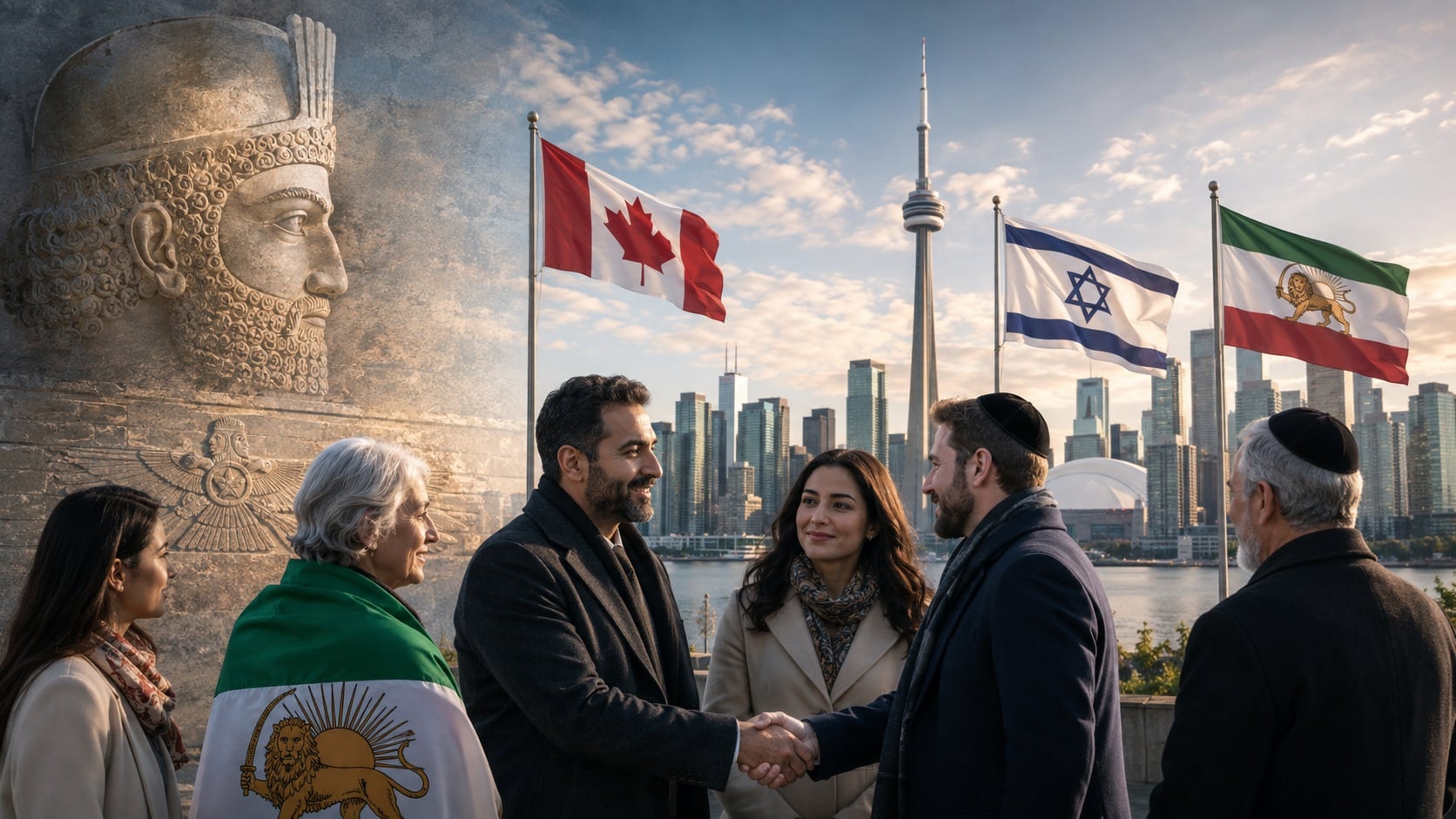
Toward the Cyrus Accord: Cyrus the Great’s Legacy and Iranian-Jewish Solidarity in Canada
At Iranian rallies across Canada calling for an end to the Islamic Republic, Jewish Canadians increasingly stand in the crowd. At Toronto’s Walk with Israel, Iranian Canadians march too, not as onlookers but as formal participants. Neither is a coincidence, and neither is a government policy. It is a pattern built by people: Jewish Canadians show up for Iranians demanding freedom, and Iranians show up for the Jewish community and for Israel and the fight against anti-Semitism.
They come to us; we go to them.
What looks local is not small. A relationship the Islamic Republic has spent more than four decades trying to sever is being rebuilt, person by person, in Canada.
We Were Never Meant to Be Enemies
That rebuilding starts with something 2,500 years old and shared by both peoples. Cyrus the Great is not an Iranian symbol imposed on a Jewish audience. He holds a genuine place in Jewish memory as the Persian king who enabled the return of Jewish exiles from Babylon and the rebuilding of the Temple in Jerusalem. For Iranians, he represents a founding figure remembered for a tolerance the Islamic regime in Iran has spent nearly half a century inverting. That shared history is evidence that Iranian-Jewish hostility is not inevitable, and that the Islamic regime in Iran is one ugly chapter, not the whole story.
In April 2023, Crown Prince Reza Pahlavi became the most prominent Iranian in decades to visit Israel, arriving during the period of Holocaust Remembrance Day and visiting the Western Wall. The visit put a modern face on an old idea: that a different relationship between Iranians and Israelis is possible, and that it does not have to wait for governments to declare it first.
A Civic Home for an Old Idea: Cyrus Accord Day
That is the spirit a civic initiative in Canada has tried to give a permanent home. Cyrus Accord Day, marked each April 19 in recognition of Prince Reza Pahlavi’s 2023 visit, was built to give the Iranian-Jewish relationship a shared historical language and a forward-looking purpose, rather than leaving it to a single news cycle. It is organized around the values Cyrus is remembered for on both sides of that history: human dignity, religious freedom, coexistence, and solidarity between peoples.
Cyrus Accord Day connects an ancient memory with a modern act of reconciliation and a future relationship.
It is worth being precise about what this is and is not. Cyrus Accord Day is a civic and social initiative focused on remembrance and public education carried out by community members, allies, and, where willing, elected officials. It is not the Cyrus Accord itself: the broader strategic vision for what a future Iran-Israel relationship could look like once the regime in Iran is gone. The two are very connected but should not be confused. One is the human foundation; the other is what that foundation will support.
What We Have Actually Done in Canada
Over the past several years, we have tried to move that idea from conversation into Canada’s civic institutions. Some of it has been about memory: recovering pieces of Persian-Jewish history that had been neglected, because a relationship cannot be rebuilt on an absence. Some of it has moved directly into civic space.
In Barrie, Ontario, the pre-1979 Lion and Sun flag has flown over City Hall with the visionary Mayor Alex Nuttall’s support, even as the City of Toronto has repeatedly declined the same request. And Jewish Canadian allies have stood alongside Iranian Canadians.
In Barrie, that civic recognition has gone beyond flag-raising: the city and its mayor have formally proclaimed Cyrus Accord Day (April 19), giving the Iranian-Jewish story an official, recurring marker on Barrie’s civic calendar.
And in April 2026, the idea reached the floor of the Ontario Legislature (Provincial Parliament), when a tireless champion, MPP Laura Smith, rose to mark April 19 as Cyrus Accord Awareness Day and welcomed Jewish and Iranian community representatives to Queen’s Park. What began with historical memory had, by then, acquired a strong voice inside one of Canada’s democratic institutions.
Additionally, Iranian Canadians have formally taken part in Walk with Israel, the biggest annual Jewish rally in Canada. Jewish community members and leaders have shown up at Iranian rallies of 200,000 and 500,000 attendees in Toronto calling for freedom and regime change in Iran. These are not one-off photo opportunities; they are relationships built through repeated engagement.
Perhaps the most important accomplishment is this: we have learned to show up for one another.
Why These Actions Matter
You may ask what flag-raising events, recognitions, or attendance at each other’s events has to do with the future of Iran-Israel relations. Formal diplomacy can, in principle, be restored quickly by governments once the Islamic regime is gone. But governments cannot manufacture lived social relationships. A future Iran-Israel normalization cannot be treated only as a diplomatic switch that will simply be turned on after regime change in Iran. Preparing for that future means rebuilding historical familiarity and human trust before they are urgently needed.
That work has to start somewhere. In Canada, that work has already begun in a meaningful way.
Toronto and What Comes Next
Toronto has played a deliberate role in this story. Prince Reza Pahlavi used the city to give this vision its most public articulation yet, describing the Iranian-Jewish relationship as older than modern diplomacy and pointing toward a future of shared peace and prosperity between a free Iran and Israel.
On September 19, 2026, Toronto will host the next chapter of conversation around Cyrus the Great, evidence that this is an ongoing civic dialogue, not a single event.
We Are Practicing the Future
When Jewish Canadians stand beside Iranians demanding freedom, and Iranians stand beside Canadian Jews in solidarity with Israel and Jewish Canadians, none of this is a diplomatic agreement. No government has signed anything. But these are early expressions of a relationship that could, one day, become normal again. The way it once was, before 1979, and long before that, in the time of Cyrus.
Cyrus Accord Day gives that relationship a historical and civic language. Canadian institutions, from a city hall to the floor of the Ontario parliament, have begun to give it public recognition. The Cyrus Accord itself represents where it will ultimately lead. It will eventually be signed on paper, but its deeper foundation has to be written first into public memory, relationships, and trust.
Before governments can sign the future, people have to believe in it. In Canada, we have begun practicing that future already.
We believe in it.
By Dr. Alan Bostakian
Related Topics