
Writing on Jewish life, relationships, trauma, and resilience
Trapped in the Stories of Palestine
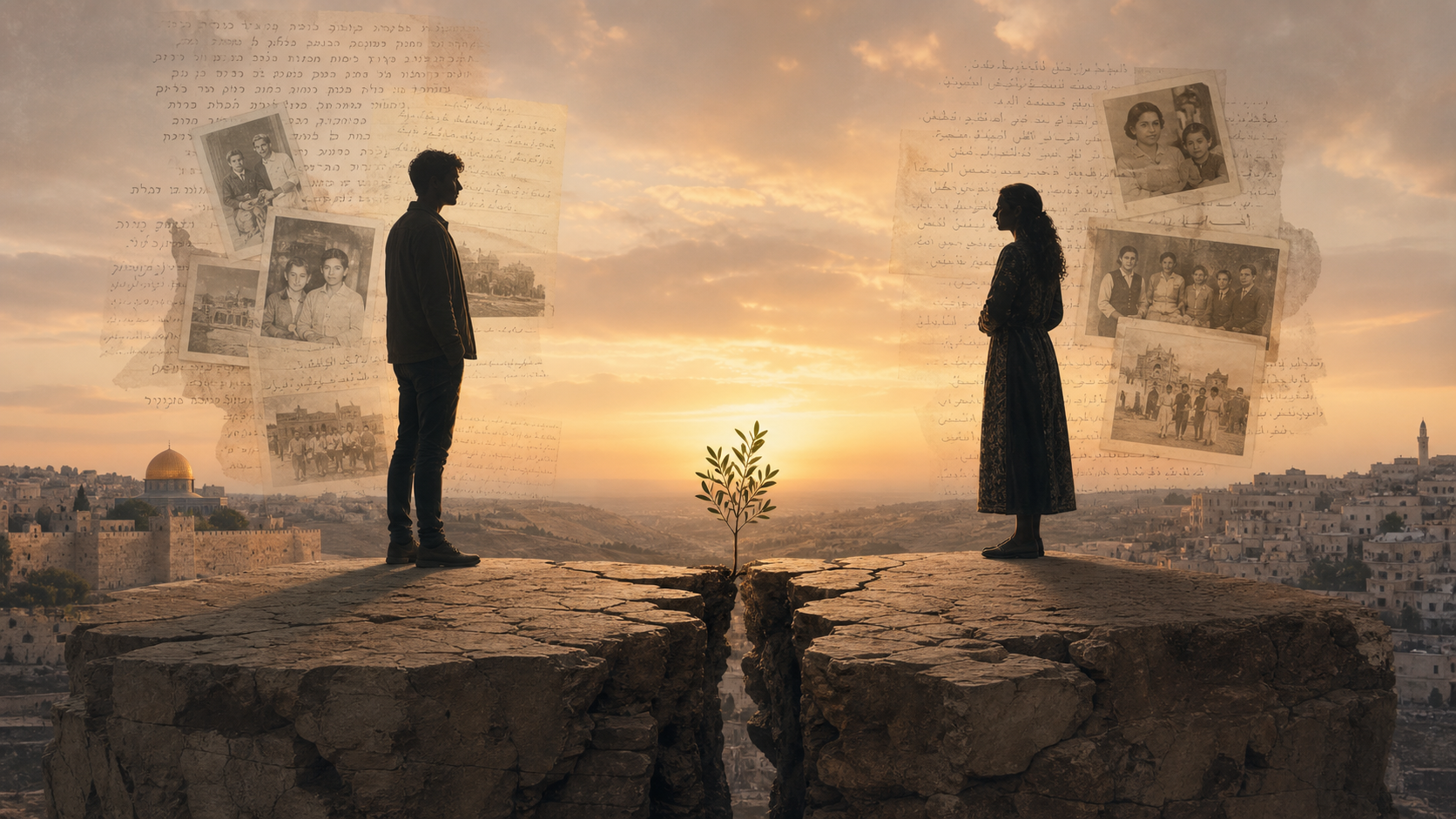
Illustrative. AI image created by the author.
What if one of the greatest barriers to peace is not only what the sides want, but what their deepest wounds have taught them to fear losing? As the region begins to look beyond the immediate Iran crisis toward broader questions of order and reconciliation, this essay asks what happens when injury becomes identity — and what that means for any serious attempt at Israeli–Palestinian peace.
As the international focus begins to shift from the narrow question of Iran’s nuclear program toward broader questions of regional stability and peace, calls for a renewed Israeli–Palestinian process will likely return to the center of diplomatic conversations. The Abraham Accords showed that Israel can make peace with Arab states even without resolving the Palestinian issue; the harder question is whether the psychological and political infrastructure of the conflict itself is ready for anything that deserves to be called peace.
In nearly four decades of teaching relationship skills, I have sat across from people who could not accept repair — not because the injury was too great, but because the injury had become indispensable. Their identity had been built inside the wound. To release the grievance was to risk losing themselves. The relationship on the other side of healing was less knowable, and therefore more frightening, than the pain they already understood.
I have thought about those people while reading Hussein Aboubakr Mansour’s remarkable essay, A Metacritique of Palestine. Mansour’s importance lies not only in his conclusions, but in his vantage point: he critiques the symbolic politics surrounding “Palestine” from within a cultural and intellectual world that shaped him.
What PAIRS Teaches About Wounds
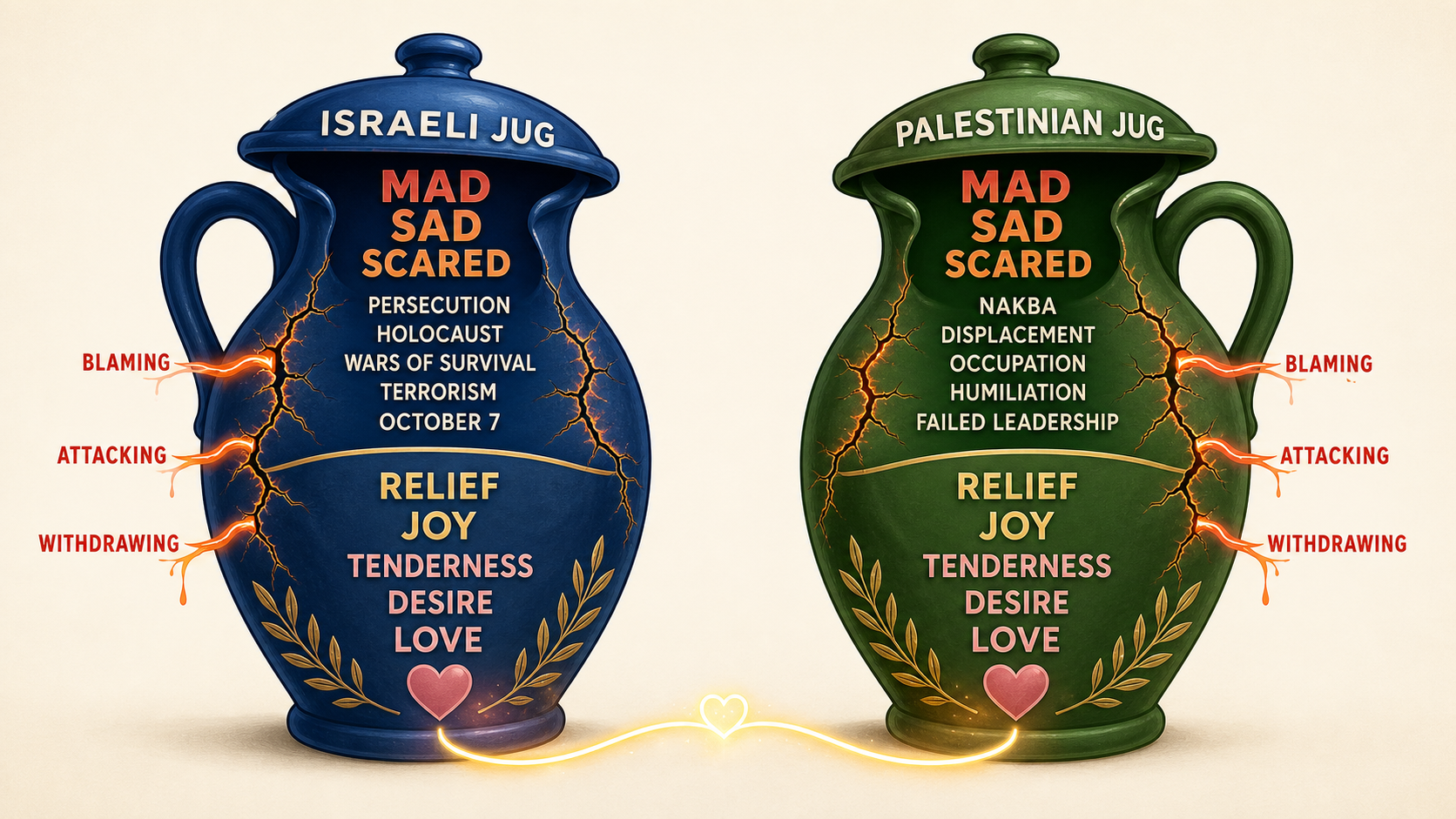
The mission of PAIRS Foundation, since its founding by my mother and stepfather, Dr. Lori Heyman Gordon and Rabbi Morris Gordon, in 1983, has been to teach the attitudes, emotional understandings, and behaviors that nurture and sustain healthy relationships. At the center of that work is a distinction that sounds simple but is among the hardest things we teach: the difference between grief and grievance.
Grief moves. It acknowledges loss, processes pain, and — when supported by emotional safety and honest communication — finds its way toward integration, and sometimes reconnection.
Grievance does not move. It circles. It returns to the injury not to process it, but to confirm it — to draw from it identity, status, and meaning that cannot easily be found anywhere else.
Grievance is grief weaponized: pain converted from a wound that might heal into a wound that must not. As my late mother said, “Healing begins when pain becomes something we feel rather than something we become.”
The Emotional Jug
A central concept in PAIRS is the Emotional Jug — the idea that unprocessed feelings accumulate until they overflow in ways that damage rather than repair our closest relationships. The work is to empty the jug honestly, to name what is actually felt, and to discover whether the other person can receive that truth. What blocks this, in couple after couple, family after family, is the terrifying possibility that releasing the grievance will leave nothing to justify who they have become.
When Stories Become Walls
Over years of workshops, I have watched how people who have lived with long-term threat or humiliation understandably come to rely on protective stories that once kept them safe but later make it hard to imagine alternatives. Narratives that originally helped them survive begin to function like walls: they keep danger out, but also keep possibility from getting in.
That pattern is not unique to any people. Jewish history gives ample reason for vigilance, and Palestinian history contains its own deep wounds, but even justified vigilance can become constricting when it leaves no room for curiosity, moral self‑examination, or the possibility that the future need not perfectly resemble the past. The distinction I am pointing to here is not between peoples. It is between responses to pain that any person, family, or society can fall into.
The System That Mines the Wound
Mansour’s analysis operates at a structural level — looking at institutions, narratives, and incentives — but it arrives at a concern that feels familiar to anyone who works with wounds and grievance.
He argues that “Palestine,” understood as a political symbol, functions as a generative site: a word‑symbol that produces usable currency in multiple ideological markets — Marxist, Islamist, liberal, postcolonial, conservative — without requiring translation between them. Each framework reads the symbol differently and produces its own meaning from it.
Not all suffering associated with Palestinians generates the same symbolic force. Suffering at the hands of Arab governments, Hamas, or the Palestinian Authority receives far less sustained international attention than suffering that can be attached to Israel. Mansour suggests that this imbalance creates a system in which certain forms of pain are amplified while others are minimized, depending on who can use them.
The challenge, of course, is that every conflict community risks building identity around injury. Israelis, Palestinians, Armenians, Serbs, African Americans, Native Americans, and countless others face versions of this temptation. The Palestinian arena is one place where this dynamic is especially visible because historical grievance has become intertwined with political institutions and international narratives.
Who benefits when suffering remains permanently available as political currency?
One concrete example is the Palestinian refugee question, which Mansour discusses. The original displacement was real, traumatic, and morally consequential. But unlike most refugee crises, Palestinian refugee status has been transmitted across generations, leaving millions of descendants defined politically by an unresolved wound they did not personally experience. Whatever one believes about borders, return, or compensation, the result is a system in which the injury is not only remembered but administratively preserved. The wound becomes an inheritance, and the inheritance becomes identity.
Recognizing this dynamic does not invalidate claims of injustice or erase historical responsibilities. It does, however, raise questions about how much power is held by those who can decide which stories get told, which wounds are kept open, and which paths toward healing are blocked.
For a relationship educator, this echoes a familiar pattern. In some families, pain becomes the organizing principle of the household — every member’s role defined in relation to the wound, attempts to introduce healing experienced as betrayal, the system invested in the wound’s continuation in order to preserve its coherence. That does not mean the wound is invented. Often it is very real. But the system built around it has interests of its own.
Before Peace, Imagination
Standard tools of political negotiation — land swaps, security guarantees, economic incentives, diplomatic frameworks — have repeatedly fallen short. Those tools matter. Territory, security, dignity, sovereignty, and law all matter. But they are not the whole problem.
Some readers may argue that unresolved power imbalances, not grievance, are the central obstacle to peace. The argument here is not that grievance replaces politics, but that it shapes what politics can achieve.
You cannot negotiate people out of a story that gives their suffering meaning. You cannot offer a future to someone whose identity requires the past to remain an open wound. Before peace becomes politically possible, a different relationship with memory must first become imaginable.
None of this diminishes Palestinian suffering or denies legitimate grievances. It does not absolve Israeli policy from scrutiny. Both peoples carry real wounds. The question is not whose pain is real. The harder question — which Mansour forces us to consider, and which decades of relationship work have taught me to take seriously — is: who benefits from the wound staying open?
Not the people living inside it.
Too often, they bear the cost of systems that derive power from keeping grievances unresolved. The same warning applies anywhere trauma becomes politically useful: when leaders, movements, or institutions gain power from keeping people afraid, humiliated, or enraged, healing becomes a threat.
What Healing Requires
In PAIRS, genuine repair requires three things that cannot be faked: honest acknowledgment of what actually happened, real accountability for what was done or left undone, and a shared commitment to a future worth choosing over a past worth avenging.
None of those is available inside stories that are frozen by generations of cultivated grievance. Expanding what is possible — allowing in curiosity, dignity, and the possibility of genuine security — requires questioning narratives that are not merely beliefs. They are identities. They are the architecture through which millions of people understand who they are and why they matter.
I have watched people discover that capacity in PAIRS workshops. In unexpected rooms, after painful revelations, something opens. The walls that once felt immovable begin to shift. A person who came in defended and certain leaves uncertain and, paradoxically, more whole.
That possibility — witnessed hundreds of times at the individual level — is what grievance systems work to prevent at any collective level. Understanding how those systems function is not pessimism. It is the beginning of the only kind of hope that means anything: hope rooted in an honest account of what we are actually dealing with.
In PAIRS, we say that the goal is not the absence of pain. It is the presence of something worth choosing instead.
That something — for Israelis, for Palestinians, and for everyone caught inside systems that profit from their suffering — has a name. It is a future. And futures, unlike wounds, have to be built.
The Questions That Remain
What stories would Palestinians have to release? What stories would Israelis have to release? What identities become possible when survival is no longer the organizing principle?
Those are not abstract questions. As the region cautiously explores life beyond an all‑consuming Iran crisis, any serious conversation about Middle East peace will have to grapple with them. Borders and treaties matter, but unless the stories on both sides begin to shift, even the best‑drafted accord will rest on a fault line.
A follow‑up essay will look at what it would take emotionally for peace agreements to hold.
Related Topics
Related Posts