
Owner of the world's largest Herzl collection
Treasure Trove: Pin the Pickle on the Jewish People
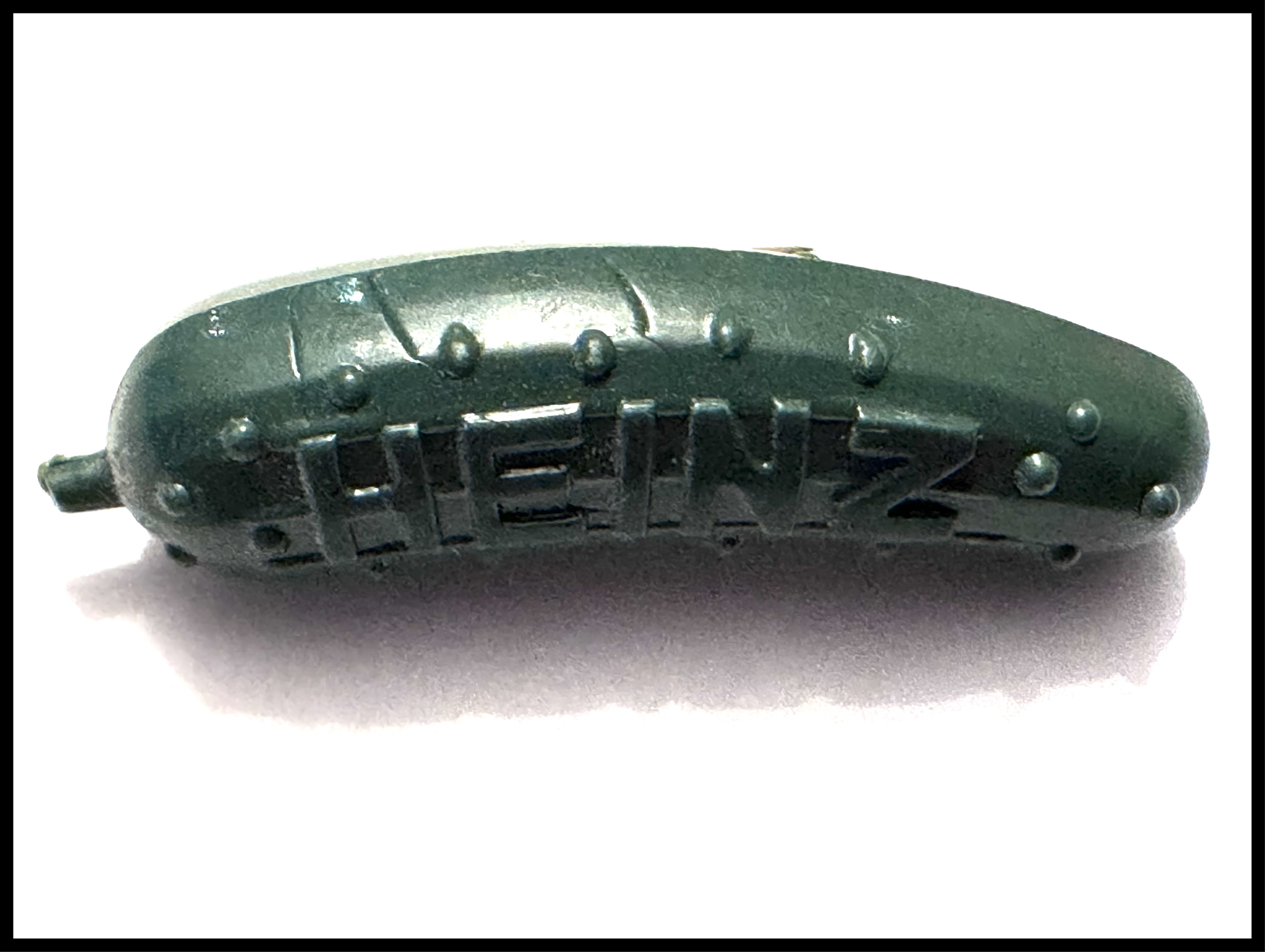
From the Herzl and Zionism Collection of David Matlow, Toronto (www.herzlcollection.com). Photograph by David Matlow.
Over 100 million plastic pickle pins have been handed out by the H. J. Heinz company since they were first introduced as a marketing promotion at the World’s Columbian Exposition held in Chicago in 1893. This particular pin was distributed at the 1939 World’s Fair in New York.
Although H. J. Heinz was not Jewish, the company he founded was the first major company that included kosher certification on its products.
In the early 1900s, the combination of industrial food systems and the development of new food ingredients made it difficult for Jewish consumers to know which foods were kosher. This changed when Abraham Goldstein, a New York based chemist who worked for the Orthodox Union (or OU, a national organization of Orthodox synagogues), spearheaded a division whose objective was to inspect food production processes to give assurances to the public that the foods produced were kosher.
In 1927, Goldstein approached the Heinz company which at the time was the largest producer of pickles, ketchup and vinegar in the United States (with a facility in Leamington, Ontario). Mr. Heinz himself was a descendant of German immigrants and sympathized with the difficulties that European immigrants had in adjusting to life in North America. He agreed to Goldstein’s inspections with the result that Heinz became the first nationally marketed brand that permitted kosher certification on its products.
Heinz requested that instead of putting the OU’s Hebrew seal on the product label, a simpler logo be developed. Heinz and the OU developed the symbol that is used to this day, the letter U within a circle, which is now found on over 800,000 products produced in 100 countries. Heinz marketed the kosher status of its products, going so far as to say that its vegetarian beans were a “mechaya” (a delight). Once Heinz signed on, other food manufacturers did the same.
As a chemist, Goldstein relied on science in making his determinations on what was kosher. This regularly placed him at odds with the leaders of the Orthodox Union of Rabbis who felt reliance on secular knowledge undermined rabbinic authority. In 1935 he started Organized Kashrus (OK) Laboratory to research the chemical composition of food. OK became a strong competitor to OU which led to great animosity between the two organizations. Over time, Goldstein’s use of scientific methods in kosher certification became widely accepted, but the controversy resulted in his critical role in our knowing which foods are kosher being forgotten.
I asked an expert, fourth generation pickle maker Marty Strub, whether pickles were a Jewish food and why some are called “kosher pickles”. He responded:
“Pickles are inherently kosher! Pickles are mentioned in the Torah as a food the Israelites craved for back in Egypt while they were traveling through the desert on their way to Eretz Yisrael. Pickled cucumbers, peppers, tomatoes and other vegetables became synonymous with Jewish food culture in New York and the rest of North America along with pastrami when they were brought over by Jewish German and Romanian immigrants in the 19th century. This is why these foods are considered “Jewish”.
Pickles are clearly an important contribution to civilization that you can pin on the Jewish people.
_____
Treasure Trove is a program of The Herzl Project. Another program is The #Herzl100. 100 Herzl artefacts will be posted over 100 days on Instagram, FaceBook and TikTok. Search #Herzl100 on any of these platforms to see the first 24 artefacts, with 76 still to go! Here is number 77: https://www.facebook.com/share/v/1EGRkt3HKu/
For more treasures from the Herzl and Zionism Collection of David Matlow, which has appeared weekly in the Treasure Trove column in the Canadian Jewish News (www.thecjn.ca) since February 2021, see https://herzlcollection.com/treasure-trove
Related Topics
Related Posts