
Owner of the world's largest Herzl collection
Treasure Trove: There is Much More in the UN Partition Resolution Than We Know
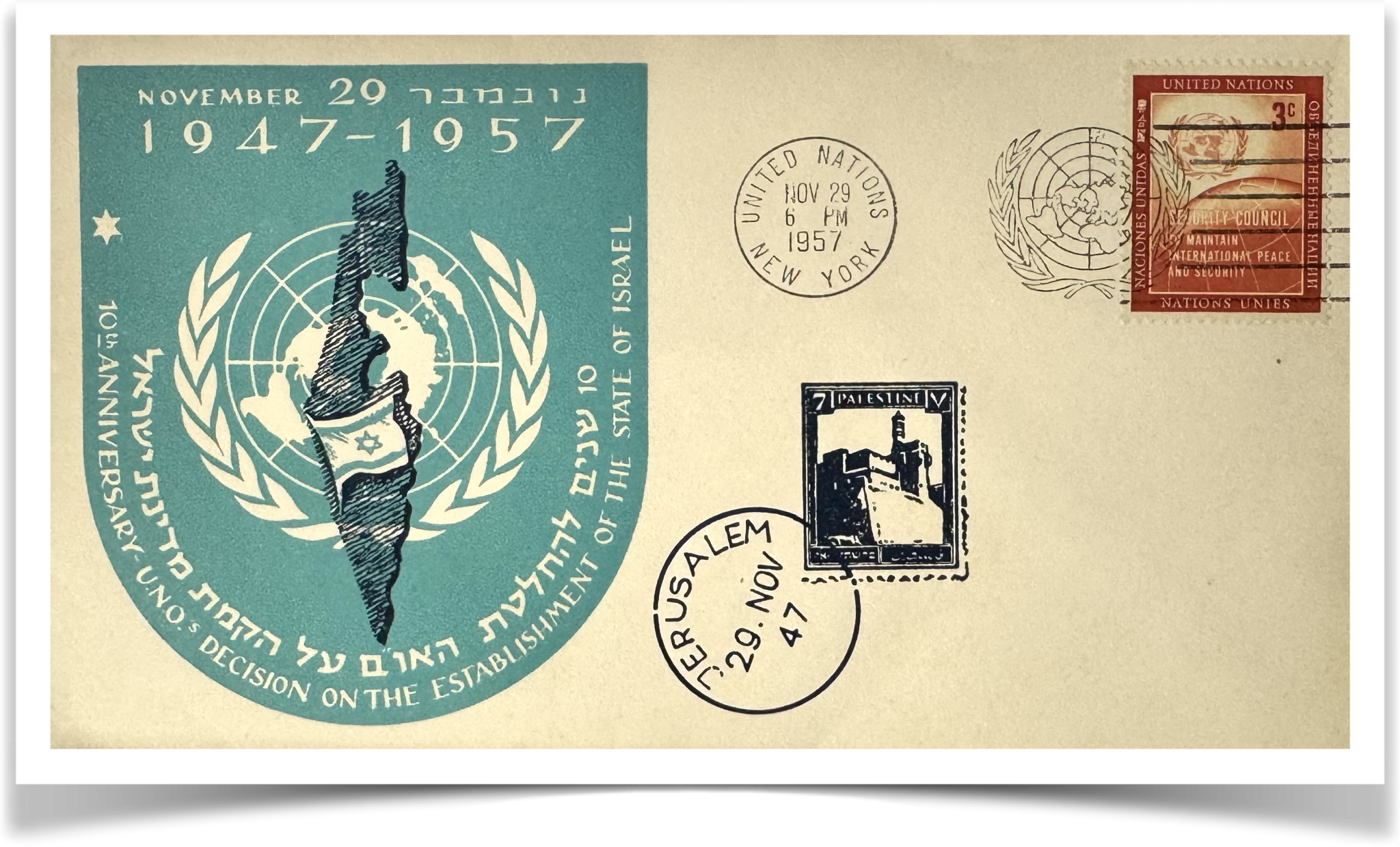
From the Herzl and Zionism Collection of David Matlow, Toronto (www.herzlcollection.com). Photograph by David Matlow
There is much more to the United Nations Partition Resolution of November 29, 1947 than we talk about.
The Resolution called for the creation of a Jewish state and an Arab state and for the City of Jerusalem to be under an international administration. The Jewish state was declared on May 14, 1948 by David Ben Gurion at a ceremony held in Tel Aviv. An Arab state was never declared. Instead, armies from seven Arab countries attacked Israel. As a result of the new State’s victory in the War of Independence, the Jewish State became 37% larger than what the UN Resolution contemplated, and the western part of Jerusalem became part of Israel (East Jerusalem including the Old City was only reunited into Israel in 1967).
The UN Partition Resolution was 22 pages long. You can read it here: https://www.un.org/unispal/wp-content/uploads/2016/04/ARES181II.pdf. Often discussion of the Resolution is limited to the borders of the two states it envisioned. However, the Resolution is much broader and contains many operational details relating to the two states including free access to Holy Sites, religious and minority rights, citizenship, the establishment of a customs union and a joint currency, and freedom of inter state transportation.
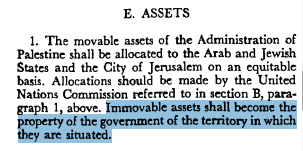
Importantly, the Resolution states in Chapter 4, Section E1 that “immovable assets” (meaning land and the structures on it) that were administered by the British “shall become the property of the territory in which they are situated.” It is estimated that at the time of the Resolution the British administered between 70 to 76% of the land of what was then called Palestine (being land that was state-owned, public, desert or uncultivable), which it inherited from the Ottoman Empire.
This is a critical yet little known point about Israel and the land that is included within its borders.
Under the Resolution, when the State of Israel was created it became the owner of the immovable assets in its territory previously administered by the British, being land that was effectively “crown land” (ie not privately owned by Jews, Arabs or others). This land was not taken from anyone. It was part of the arrangement set out by the United Nations when it resolved to bring the Jewish state into existence. The same would have been the case for land in what would have been the Arab state, had one been declared.
This commemorative philatelic cover was created in 1957 to celebrate the 10th anniversary of the Resolution. It features a silhouette of the map of Israel at the time over top the logo of the United Nations. The envelope features a three cent UN stamp honouring the Security Council with the text “To Maintain International Peace and Security”, postmarked in New York, as well as the image of a seven mil Palestine stamp postmarked ten years prior.
Supporters of Israel have many valid reasons to be critical of the United Nations. The criticisms have a long history. See https://thecjn.ca/arts-culture/treasure-trove-explores-israels-treatment-at-the-united-nations/ However, it cannot be denied that the United Nations played a critical role in the creation of the country, and as such Israel’s legitimacy under international law is incontestable. It also cannot be denied that much of the land of the State of Israel was previously administered by the British and, under the UN Resolution, became part of Israel as successor when the British left.
For more treasures from the Herzl and Zionism Collection of David Matlow, which have appeared weekly in the Treasure Trove column in the Canadian Jewish News (www.thecjn.ca) since February 2021, see https://herzlcollection.com/treasure-trove
Treasure Trove is a program of the Herzl Project. Another program is the #Herzl100 where 100 Herzl videos were posted in 100 days between June 6 and September 9, 2026. You can watch all of the videos here: https://herzlcollection.com/%23herzl100 They are available for viewing individually by searching #Herzl100 on Facebook, Instagram and TikTok. Also check out #Herzlbreak on these platforms.
Related Topics