Tristan Cormier Interview | Alexandre Gilbert #296
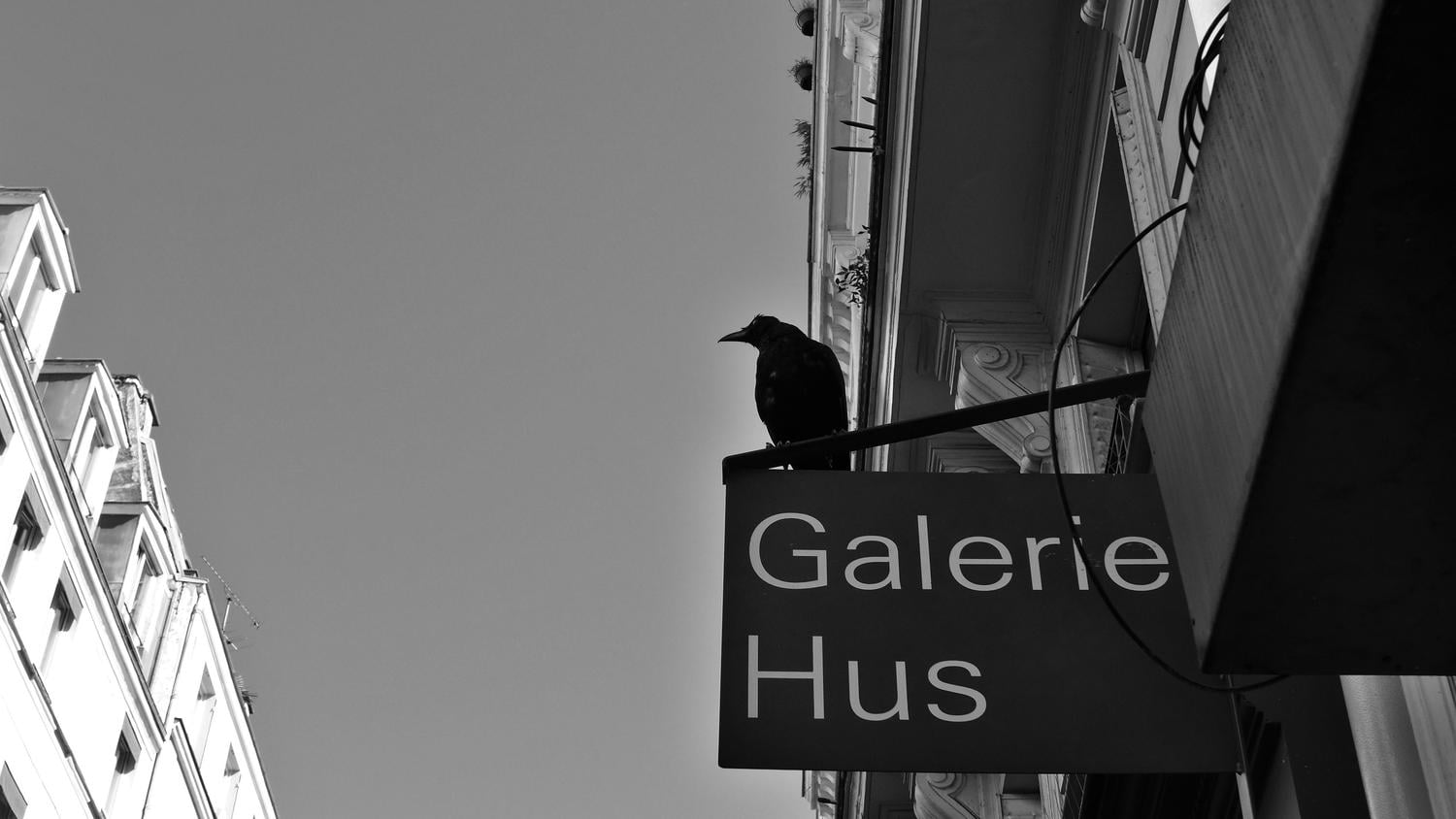
Tristan Cormier is the founder of Galerie Hus in Montmartre. The following text is inspired by his essay on Bram van Velde, “The Lair of the Phenomenon”.
The Phenomenality of Bram van Velde: Painting at the Edge of Vision
Introduction
In the constellation of twentieth-century art, Bram van Velde occupies a paradoxical yet luminous position. Neither embraced by the mainstream of abstraction nor assimilated to the historical avant-gardes, his work traces a path that resists classification. To many of his contemporaries, including Samuel Beckett, he was the painter of the “absence of rapport,” a figure whose canvases embodied the silent persistence of the unseen. If Marcel Duchamp advanced a revolution through objects, concepts, and irony, Bram van Velde unfolded another, quieter but no less radical: a revolution of passivity, patience, and fidelity to what does not appear until it must.
Van Velde’s paintings cannot be reduced to style or school. They are less about producing forms than about waiting for forms to arrive. They testify to a mode of seeing where the visible emerges from the invisible, where every figure is at once familiar and unidentifiable, and where the task of the painter is to resist fabrication until something genuinely unforeseen imposes itself. To understand this “phenomenality” of his work, one must travel through philosophy as much as through art history. Phenomenology, particularly as articulated by Husserl, Heidegger, and Merleau-Ponty, provides a language to think through what it means to see — and what it means when seeing fails. Van Velde’s oeuvre stands as a radical meditation on that failure, a refusal to force appearance, and an acceptance of painting as the site where the invisible becomes momentarily visible.
Two Revolutions: Duchamp and Van Velde
The twentieth century gave us at least two revolutions in art. Duchamp, with his ready-mades and conceptual provocations, enacted a revolution of the object. He challenged painting and sculpture by replacing them with thought, by declaring ordinary objects as art, and by historicizing every gesture. His was a revolution productive of narratives, of history, of ruptures inscribed in cultural memory.
Van Velde, by contrast, performed a revolution without object, without rapport. His canvases rarely stabilize into representation, and when they do, the forms are already dissolving. His is a revolution of the inobjective: not the shock of the urinal, but the persistence of a gesture that circles back to beginnings. If Duchamp manufactured history, Van Velde dissolved it, bringing painting back to its most elemental struggle with visibility itself. One revolution aimed at the bull’s-eye of culture, the other wandered in the mineral underground of experience. Both changed the landscape of modern art, but in opposite directions.
Vision and Non-Vision
At the heart of Van Velde’s practice lies a strange solidarity between seeing and not-seeing. To look at his paintings is to encounter both recognition and disorientation: figures emerge, almost take shape, then recede into color and gesture. Beckett captured this paradox when he described Van Velde’s work as “without rapport.” What appears does not correspond to objects, nor to stable meanings, but to the phenomenon of appearing itself — fleeting, unstable, ungraspable.
Philosophically, this resonates with a long meditation on vision. Husserl had hoped phenomenology would return us to the immanence of pure perception, stripping away presuppositions. Heidegger, in turn, questioned the destiny of being in an age dominated by technology, insisting that truth emerges in concealment as much as in revelation. Merleau-Ponty went further, showing how perception is always partial, embodied, and caught in the paradox that the world reveals itself only through horizons of absence.
Van Velde enacts these philosophical intuitions in practice. His canvases embody the truth that seeing is never pure; it is always shadowed by blindness. As he once said: “What is this phenomenon we call seeing, when in fact we never see?” To paint, for him, was not to impose vision but to remain faithful to that tension between the visible and the invisible, to let forms arrive out of nothingness, fragile and provisional.
The Discipline of Passivity
If Van Velde is revolutionary, it is not by action but by restraint. He often declared that the most difficult task was “not to want.” For him, painting could not be forced; when nothing appeared, the painter had to put the brush down. Unlike the artist-as-producer, tirelessly fabricating canvases to fill galleries, Van Velde insisted that true painting only happened when necessity appeared. “The horror is fabrication,” he said, “to paint without necessity.”
This discipline of passivity sets him apart not only from the productive rhythms of modern art markets but also from traditions of mastery. Painting, for Van Velde, was never a craft to be perfected, never the application of skills to surfaces. It was instead the readiness to receive. “I have done nothing, therefore I have worked intensely,” he remarked. His work exemplifies what philosophers like Jean-Luc Marion later called the logic of the gift: the phenomenon comes when it gives itself, not when it is demanded.
Such passivity is not idleness. It requires vigilance, patience, and the courage to remain in emptiness. To resist the temptation to fabricate is to endure the abyss where nothing appears. Yet out of this abyss comes the rare event: a figure, a relation of colors, a rhythm of forms that could not have been planned. Van Velde’s greatness lies in his fidelity to that event.
Abstraction and Contingency
Though often associated with abstraction, Van Velde’s work cannot be assimilated to it without qualification. Abstraction, especially as theorized by Kandinsky or Malevitch, was often accompanied by manifestos, principles, and a belief in universal forms. Van Velde belonged to no such program. For him, abstraction was not a choice but the inevitable result of staying true to what appeared.
Each of his canvases emerged through accidents, corrections, and erasures. Paintings frequently passed near destruction, saved only by new gestures that reoriented their trajectory. They were not smooth ascents from invisibility to form but precarious journeys across breakdowns. The final figure — always provisional — condensed the memory of these failures. Hubert Lucot described this process as “continuity within accident,” a phrase that captures how Van Velde’s paintings embody contingency rather than transcend it.
To see his work is to witness assemblages of heterogeneous elements: shifting lights, fragments of transparency, sudden articulations. They coalesce into a unity, but one that trembles, always on the verge of dissolution. The “same” only emerges through the play of difference, and the figure is never secure from a return to the night of non-vision. His paintings are thus less about stable abstraction than about the precarious balance of appearing itself.
The Role of Language and Criticism
One of the central difficulties in approaching Van Velde lies in language. To describe his paintings is to risk betraying them. Beckett warned that to translate the singularity of a work into words often results in “verbal assassination.” Philosophical or critical discourse tends to impose categories, whereas Van Velde’s paintings resist them.
Yet some writing can approximate the rhythm of the paintings. Beckett himself, in essays and fragments, used circular, stammering syntax to echo the contingency of Van Velde’s images. Likewise, phenomenological analysis must learn to write in the contingency of movement, resisting the temptation to freeze appearance into concept. The task is not to explain but to testify — to offer another form of attention that mirrors the painter’s own.
Vertical Dialectics
If traditional dialectics reconciles opposites into synthesis, Van Velde’s work suggests another mode: a vertical dialectic. As Merleau-Ponty proposed, vision can be vertical rather than horizontal — not accumulation of memories or judgments, but a sudden gathering of experience into a singular moment. Van Velde’s paintings embody this. They are not narratives of progress but vertical eruptions, leaps into the unknown.
Each painting is a “jump into the void,” as Van Velde described it. This verticality contrasts with the horizontal labor of language and history. While Duchamp’s objects inserted themselves into cultural time, Van Velde’s figures pierce through time, appearing as events rather than as historical statements. They belong less to history than to the instant where the invisible becomes briefly visible.
Between Philosophy and Poetry
Van Velde’s work also illuminates the ambiguous relation between philosophy and art. Heidegger often sought truth in poetry, finding in Hölderlin a way to retrieve a lost Greek beginning. Nietzsche turned to music as the measure of tragic truth. In both cases, philosophy clothed its nostalgia in another art form.
Van Velde, however, strips away even this clothing. His paintings refuse nostalgia, refusing even to be “paintings” in the traditional sense. He often said, “My painting is not painting.” Like Bataille’s call to strip words of their garments, Van Velde sought the nakedness of vision itself. His canvases are windows into an appearing that cannot be reconciled with past or future, only received in its moment.
Poets like Beckett and Jean Genet recognized this radicality. Genet wrote that art was not for future generations but for the “innumerable people of the dead,” who would recognize themselves in it. Beckett, too, saw in Van Velde’s work a painting “without rapport,” a phenomenon outside ordinary relations. Both writers intuited that Van Velde’s paintings were less for us than for the void itself, less communication than confrontation with what resists relation.
Conclusion: The Lure of the Invisible
To engage with Bram van Velde is to confront painting as threshold: threshold between vision and blindness, between form and dissolution, between passivity and action. His canvases do not resolve these tensions but sustain them, letting us glimpse what it means to see when seeing is impossible.
In a century crowded with movements, manifestos, and gestures of mastery, Van Velde’s insistence on not wanting, on waiting, on refusing fabrication, remains singular. He reminds us that painting is not production but reception, not mastery but surrender. His revolution, unlike Duchamp’s, does not historicize objects but dissolves them into the event of appearing.
Ultimately, Van Velde shows that art’s task is not to represent the world but to witness its emergence from darkness. His paintings are flames in the night, fragile and fleeting, but luminous. They reveal that vision itself is a phenomenon — one that begins in blindness, that persists only in patience, and that vanishes as soon as we try to hold it.
In this sense, Bram van Velde’s work is not only a chapter in art history but a philosophy of life: an invitation to live without fabrication, to wait for what gives itself, and to recognize in every fragile form the echo of the invisible.