Even Victory Leaves a Trace: What a Talmudic Cat and Snake Can Teach Us About Spiritual Responsibility
A passage in Talmud Pesachim (112b) contains what seems at first to be a simple piece of advice.
Rav Pappa says: “A person should not enter a house in the dark — something bad might happen.”
Some interpret this practically: there might be a snake in the corner.
Others add: perhaps a cat has already eaten the snake.
But the bones — sharp and invisible — remain. And a person walking barefoot might step on one and injure himself.
On the surface, it’s a safety warning. But as with much in the Talmud, the deeper meaning unfolds between the lines. This is a metaphor about struggle, resolution — and what lingers afterward.
The cat, traditionally an enemy of snakes, represents strength and vigilance. It eliminates the immediate danger. But even when evil is defeated, the residue can still be harmful. The bones remain.
This is a profoundly Jewish insight: evil does not simply disappear. Its impact lingers in subtle ways — in memory, in habit, in scars we carry. You may have ended a toxic relationship, overcome an inner fear, even won a moral battle — but some part of that struggle may still inhabit the corners of your soul.
We are reminded: don’t enter blindly. Don’t assume that just because the threat is no longer visible, it has no power. Especially if you are barefoot — exposed, unguarded.
And yet, this warning is not about fear. It is about responsibility.
Even after victory, we must bring light. Not just literal light, but spiritual illumination: awareness, preparation, humility. The Torah teaches that “the soul of man is the lamp of God” — without inner light, even the safest place can become dangerous.
This applies on a personal level, and also on a collective one. As a people, we have overcome centuries of hardship. But even triumphs can carry unintended consequences — hardness, suspicion, anger. These too must be examined in the light. Cleansed. Understood. Not with shame, but with honesty.
In Jewish mystical thought, the cat might symbolize Gevurah — discipline, strength, judgment. But judgment without Chesed — without mercy — can become brittle. Even the cat needs to be followed by the hand that cleans the floor, that tends to the wound, that brings the light back in.
Victory is never the end of the story. It is the beginning of responsibility.
There is wisdom in Rav Pappa’s warning. Every spiritual battle leaves something behind. If we do not step carefully, if we rush in unguarded, we might be harmed by the very thing we thought we had already overcome.
So before we enter, let us pause.
Put on shoes.
Turn on the light.
Bring the awareness of Torah into the room — and into ourselves.
Rabbi Mikhail Salita is a Jewish Universalist rabbi, educator, and writer. He holds advanced degrees in international law, education, behavioral analysis, and library science. His work explores Jewish spirituality, ethics, and chaplaincy in contemporary and historical contexts. ORCID: https://orcid.org/0009-0006-0882-8082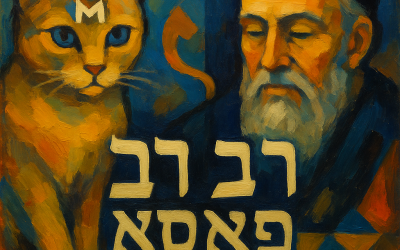
Rabbi Moshe (Mikhail) Salita is a Brooklyn-based rabbi, legal scholar, and emerging animal chaplain whose work unites Jewish spirituality, international law, and compassion for all living beings.
He holds a Master’s in International Law (with honors) from the National University “Odesa Law Academy,” where he is currently a PhD student researching the restitution of unlawfully confiscated Jewish communal property in Soviet Ukraine. He also earned a Master’s in Library and Information Science from Pratt Institute (New York) and a Master’s in Education and Special Education from Touro University, with graduate certificates in Applied Behavior Analysis (ABA) and Bilingual Education.
Rabbi Salita is an ordained rabbi of the Jewish Spiritual Leaders Institute (JSLI), a Doctor of Ministry student in Jewish Spirituality at the Graduate Theological Foundation, and an Animal Chaplain-in-Training with the Compassion Consortium in New York. His mission is to weave together justice, mercy, and creation care into one sacred path of Tikkun Olam — healing the moral and spiritual wounds of the world.
He serves as Executive Director of the Salita Foundation, originally founded by his brother, Dmitriy Salita — former WBF World Champion boxer, and inductee of both the New York Boxing Hall of Fame and the Jewish Sports Hall of Fame. Today, Rabbi Salita leads the Foundation toward a broader vision — uniting humanitarian ethics, environmental awareness, and cultural restitution.
Through the Foundation, he has launched the “Eco-Kosher Initiative,” a global program encouraging support for businesses and individuals who respect the environment, animals, and their communities. For him, “eco-kosher” is not limited to food — it is a moral philosophy of living in balance with creation, where sustainability and holiness walk hand in hand.
He is also devoted to preserving and gaining international recognition for the rare Israeli cat breed Kanaani — a living symbol of harmony between Jewish heritage and the natural world.
A descendant of Sruel ben Aharon Lekhtman, a Ruzhiner Hasid and brick-factory owner in Kitai-Gorod, Kamianets-Podilskyi — once a spiritual heart of the Ruzhin Hasidic movement in Tsarist-era Ukraine — Rabbi Salita continues his ancestor’s legacy of faith, integrity, and bridge-building. Sruel Lekhtman served as a close friend and estate manager for Pan Dembitsky, a Polish landowner remembered with respect in both Jewish and Ukrainian memory. Their friendship, crossing lines of faith and culture, remains a profound symbol of coexistence — especially meaningful for Ukraine today.
Although Rabbi Salita received Reform rabbinic education in the spirit of Jewish Universalism, he maintains a deep spiritual connection with Chabad, whose living Hasidic tradition unites intellect, compassion, and joy.
Following the example of the prophets — from Adam, the first caretaker of creation, to King Solomon, who understood the language of animals, and to Rav Papa, the sage who spoke kindly of cats — Rabbi Salita teaches that true holiness is revealed through compassion for all living beings. His life’s work is to show that caring for animals and serving God are one and the same sacred breath.