


Israel Studies Prof.
Trump and Bibi: Two Peas in a Pod?
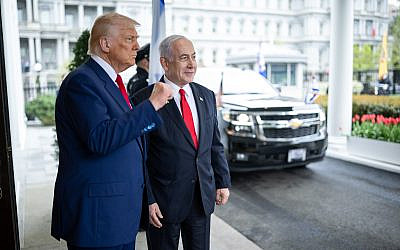 Donald Trump, presumably in quest of his Nobel Peace Prize, decided to finally settle the Israel-Gaza War and, seemingly as add-ons, the Israeli-Palestinian conflict and the “Middle East conflict” as a whole. This has necessarily brought him face-to-face with Bibi Netanyahu, who was keeping the Gaza War going for his own political advantage. This changed their relationship in ways that are interesting in themselves and, of course, directly affect how the US and Israel are interacting. These are some thoughts about these two deeply narcissistic and dangerously powerful men – and I invite readers to write their own questions and comments, at whatever length, in the chat.
Until recently, Bibi seemed to be playing Trump as he had Joe Biden. Now, after Bibi was forced to accede to Trump’s 20 point peace plan, it’s clear that Trump now holds greater power over Netanyahu than any previous American president vis-a-vis an Israeli prime minister, emphasized by the neologism “Bibi-sitting” to describe Vance, Witkoff’s, Kushner’s, and Rubio’s concurrent sojourn in Israel, thus preventing him from restarting the war. This is a good time to compare a few of the political and personal dynamics that have brought them to this point.
Trump, of course, has followed a unique path (anyone remember the “Mule” in Asimov’s Foundation trilogy?). With no political experience, but a real estate tycoon’s penchant for settling everything with a quick “deal,” he was obviously disappointed by his first term, as he let himself be constrained in most policy arenas by the traditional conservatives around him who he himself had appointed. Trump’s attempted putsch on Jan. 6, 2021 was emblematic: amateurishly organized, it failed completely, with dire – if brief – consequences to most participants, except Trump himself of course.
Trump’s second coming has been another matter entirely. With the considerable intellectual and financial resources of the Heritage Foundation behind him for four years, he was carefully prepared for prime time. From his first day in office he has, as promised, “flooded the zone,” so most of us can barely keep up as the fire hose keeps spewing. Neither floundering Democrats nor overwhelmed civil society institutions have even come close to mounting an effective – or even coherent – opposition. However, we have to recognize that prophecies of imminent financial catastrophe have not eventuated. Expectations that his idiosyncratic tariffs would upend the world trade regime have not come to pass. ICE abductions have not yet generated the massive opposition liberals hoped for. The rest of the world has by now realized that flattering Trump to the max is the only way to get anything, and they have been forced to play along (with the exception of the other big kid on the block, China).
By contrast, the apparent success (so far) of his Mideast policy, based on pure realpolitik and unabashed manipulation, and no Palestinian participation has confounded the world, including his critics, with its success. Predictions that he would give Israel – or Bibi – all they wanted have been given the lie by reality plus his own account of how he told Bibi exactly what he would and wouldn’t be allowed to do.
Trump’s domestic initiatives have, unfortunately, been equally effective, if profoundly misguided. He has bulldozed through norms, guardrails, and precedents as if they didn’t exist, which they don’t anymore. As with his purported success as a businessman in New York City, his unabashed chutzpah has confounded his opponents. His MAGA base, though regularly predicted to be about to desert him imminently, has largely remained loyal. Though his popularity in polls remains comparatively low, that seems largely irrelevant. With his plans to comprehensively gerrymander red states now sailing smoothly through Republican legislatures, he may currently be on his way to keeping control of both houses of Congress in 2026 and, presumably, 2028 as well. Given how much he has managed to both destroy and reorient in 9 months, and the inability of civil society and the Democratic party to mount an effective defense, the momentum is with him. The courts have only sporadically interrupted this onslaught – and a coming spate of US Supreme Court decisions are likely to unimpede, if not completely endorse, his innumerable overreaches.
By contrast, Bibi has been much less consequential, except in the realm of pure destruction of Gazan lives and infrastructure, as well as what remained of a humanitarian and universalist Israeli ethos. His next election is due by October, 2026, and there seems little doubt it will take place as planned, and will be free and fair. Israeli elections, largely unchanged in format since 1949, seem harder to subvert than those in the US a month later– and Israel’s multi-party political ecosystem makes it more likely that many eyes on the process will impede corruption. A compilation of recent polls shows that his coalition would be unlikely to win the next election if it were held today.
Until this year, Americans congratulated themselves that their democracy was impervious to the depredations that newer democracies such as Russia, Hungary, Turkey, and India had suffered. We had withstood, we thought for four years, all that Trump could throw at us. Though a second Trump term would be bad for us, we would survive and perhaps even thrive. We were wrong. No one can predict what sort of US will emerge from Trump’s wrecking ball.
From the vantage point of today, Bibi, although in office for much longer and possessed of far greater political skills, seems to have upended Is Israeli democracy far less effectively, compared to Trump’s effect on the USA. Bibi’s original “judicial reform,” which he expected would go as smoothly as Putin had thought his invasion of Ukraine would, ran into unexpectedly heavy and effective resistance. Hundreds of thousands of Israelis flooded into the streets in the first nine months of 2023, perhaps up to 10% of the population some nights, and prevented most of the “reform” from going through the Knesset. By contrast, although “No Kings” attracted perhaps 7 million Americans into the streets on Oct. 18, it seems to have had far less impact. Obviously, Israel is much smaller and there is a “center” (i.e. Tel Aviv) that can be filled to bursting, unlike in the US, but still, isn’t there an effective means of fighting back here?
Bibi has been able to exert far less power than Trump. Despite frequent adulatory cries of “Bibi Melekh Yisrael” (King of Israel) in some parts of the country (i.e. outside Tel Aviv), he has not yet been able to take a wrecking ball to Israel’s democracy. Most of the Supreme Court’s prerogatives remain, as so does the independent Attorney General, appointed by the late-lamented government of change, who has been a major thorn in Bibi’s side. His only recent success has been appointing a new internal security (Shin Bet) director with an apparently fully messianic outlook, whose extensive powers, if fully employed, could be a serious blow to Bibi‘s opponents. How he and Bibi will use them in the immediate future is still an open question.
Bibi’s legacy will not so much be broken institutions of democracy but rather the necessity of dealing with the immense and generation-spanning consequences of Oct. 7 and the Gaza War. The US, by contrast, may well confront a world with fewer wars but with its democracy seriously impaired, its reputation shredded, and its economy transformed for the worse.
Bibi and Trump, despite their differences, are nevertheless two peas in an autthoritarian pod, one which also contains India’s Modi, Turkiye’s Erdogan, Russia’s Putin, and Hungary’s Orban. These are “backsliding democracies” or “competitive autocracies,” ruled by “strong men.” Israelis, though they (or perhaps just their government?) are now abhorred by much of the world and with their prime minister now being manhandled by the US into a peace he doesn’t want, may still retain a more functional democracy than any of these other nations. The question remains: what will they do with it?
Or l’goyim (“light into the nations”)? Probably not this century.