
Middle East Analyst
Trump and Netanyahu: Same Persona, Diverging Stakes
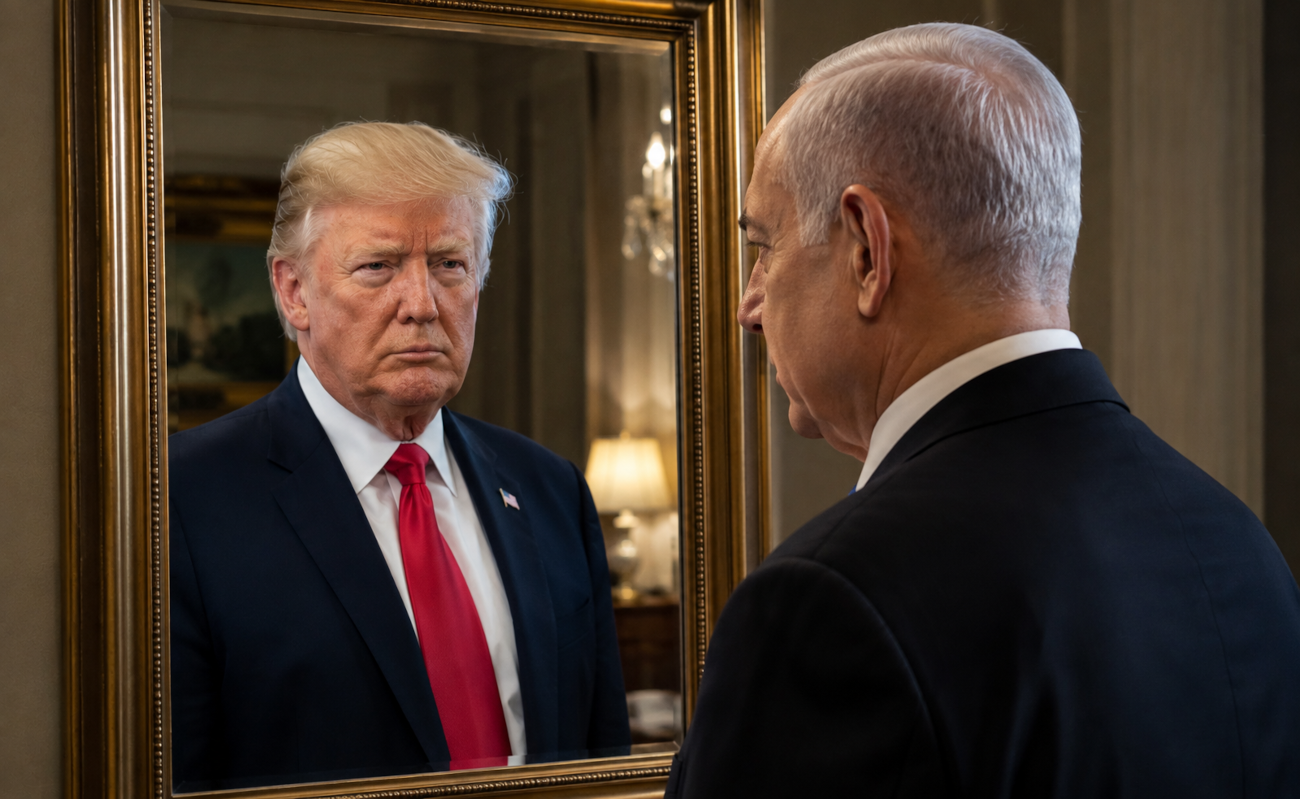
by author (AI)
The Shared Playbook
Donald Trump and Benjamin Netanyahu operate from the same political playbook: charismatic, far right populist leadership that personalizes power, treats independent institutions as adversaries, and makes loyalty the primary currency of politics. Both use dramatic gestures — pardons, rhetorical protection, selective enforcement — to reward a core constituency and signal they will not abandon the tribe. That shared style explains why observers in both countries see comparable threats to independent judiciary and media freedoms, and why both leaders keep reaching for the same tactic: when persuading the center looks too costly, maximize the intensity and turnout of the base instead.
For Trump, that has meant clemency for January 6 domestic terrorists, aggressive fundraising from allied donors, and sustained mobilization of a loyalist electorate. For Netanyahu, it has meant accommodating the demands of his far-right and ultra-Orthodox coalition partners even when those demands are unpopular outside the coalition itself. The tactic is identical. What it buys each of them is not.
Identical Logic, Different Payoffs
Israel’s parliamentary system makes small, ideologically intense parties indispensable to governing. Keeping Religious Zionism, Otzma Yehudit, and the Haredi parties satisfied is not a preference for Netanyahu — it is the arithmetic of staying in office. Every concession to a coalition partner is a payment against a majority that does not exist without them.
Trump’s position is structurally different. He is not personally on the November 3 midterms’ ballots. However, the midterms and continued Republican control of the House is widely seen as a referendum on his presidency and essential to keeping his agenda viable. He leads a mass movement inside a two-party system in which a large plurality of the voters are independents. Consequently, he needs a national plurality, not a coalition agreement. Valorizing January 6 domestic terrorists shores up the most fervent supporters, but it is a gamble rather than a structural necessity — it risks alienating independents and younger voters whose defection can decide close congressional races without threatening Trump’s hold on power the way a coalition collapse would threaten Netanyahu’s. Both men play to their base because it has worked in the past; only one of them plays to the base because he has no other way to form a government.
The Institutional Backstop
The two systems also differ in how much room each leader has to act unilaterally once the base-first bet is placed. Israel’s parliamentary structure gives Netanyahu real coalition leverage, but it pairs that leverage with a judiciary and security establishment that retain independent capacity to check him — the same courts that struck down his government’s Haredi draft-exemption law twice now, most recently blocking the bill that would have shielded yeshiva students from arrest for draft evasion. Those institutions have not stopped Netanyahu from governing, but they have repeatedly forced his coalition partners into public retreats.
The American system distributes checks and balances differently: federalism, an independent judiciary, and a sprawling administrative state make sweeping unilateral change harder to execute quickly, even for a president willing to test the boundaries of the office. Trump’s confrontations with courts and agencies have been consequential, but the architecture itself slows any single actor down in a way Israel’s more centralized parliamentary system does not always do to a sitting prime minister with a working majority.
The asymmetry matters for how each leader converts institutional friction into political capital. Netanyahu can frame a High Court ruling against his government as an unelected judiciary overriding the will of his coalition, and that framing lands with a base already primed to see the courts as a rival center of power. Trump has made a version of the same argument against federal courts and agencies, but the sheer number of institutional checkpoints in the American system means no single ruling carries the same coalition-defining weight that a Knesset-adjacent court decision can carry in Israel. A setback that reads as existential in Jerusalem often reads as one skirmish among many in Washington.
Where the Coalition Is Actually Straining
Netanyahu’s coalition math is under pressure right now, but not where the obvious story would put it. He tolerates settler domestic terrorism to keep the far right happy, but that is not what is currently fracturing the bloc. The live fault line heading into the October 27 election is the Haredi draft exemption. Smotrich’s vote against penalizing ultra-Orthodox draft evasion cost him real standing among his own settler base, and Religious Zionism is now polling close to the electoral threshold, prompting Netanyahu to push a merger between Smotrich’s party and Ben Gvir’s to avoid wasting right-wing votes altogether. That is a coalition partner in survival mode, not a coalition partner extracting concessions from a position of strength.
The broader point still holds — Netanyahu needs these parties to govern, and that need shapes his choices — but the mechanism is narrower and more fragile than a simple story about settler impunity. Netanyahu is not just paying his partners’ price; he is actively working to keep them viable enough to be paid at all.
Why Both Strategies Are High Risk
A base-first strategy narrows the coalition and creates three predictable vulnerabilities for both men. It increases dependence on a smaller, more volatile electorate whose turnout is never guaranteed. It hardens polarization, clarifying negative identities for centrists to reject. And it exposes both leaders to shocks that land hardest on persuadable voters — economic pain, security crises with civilian casualties, or judicial rulings that crystallize fears about institutional erosion.
For Trump, energy prices, inflation, and rising distaste for political violence among younger conservatives are the live swing risks. For Netanyahu, the risk runs through coalition math directly: a partner too weak to clear the threshold is a partner who cannot deliver a governing majority, no matter how loyal. Both strategies trade long-term governability for short-term loyalty, and both leaders are running that trade under real time pressure — Trump toward the November 3 midterms, Netanyahu toward an October 27 election his own allies may not survive.
Convergence in Tactic, Divergence in Trigger
Both men are willing to risk the center to energize the base, but the triggers that convert that bet into failure differ. Trump’s failure mode is defection among independents and younger conservatives combined with turnout shortfalls in key states — a pocketbook shock or a surge in anti-war sentiment among voters under forty could tip a close race. Netanyahu’s failure mode is arithmetic: if Religious Zionism fails to clear the threshold and no merger rescues it, Netanyahu can win the largest bloc in the Knesset and still be unable to form a government. The same gamble — double down on the base — creates parallel vulnerabilities activated by entirely different mechanisms: one electoral pressure, the other electoral survival.
The Bottom Line
Critics of both leaders perceive them as corrupt, autocratic demagogues who are willing to weaponize loyalty rather than court the center. Both leaders’ supporters perceive them as historical figures uniquely qualified to rescue their countries from internal and external existential threats. That wide disparity in perception makes the upcoming elections in both countries highly polarized, high stakes, and potentially dangerous.
Related Topics
Related Posts