


Middle East Forum Fellow/North Africa Risk Consultant
Trump Blames Islam for France. Israel Should Ask a Different Question
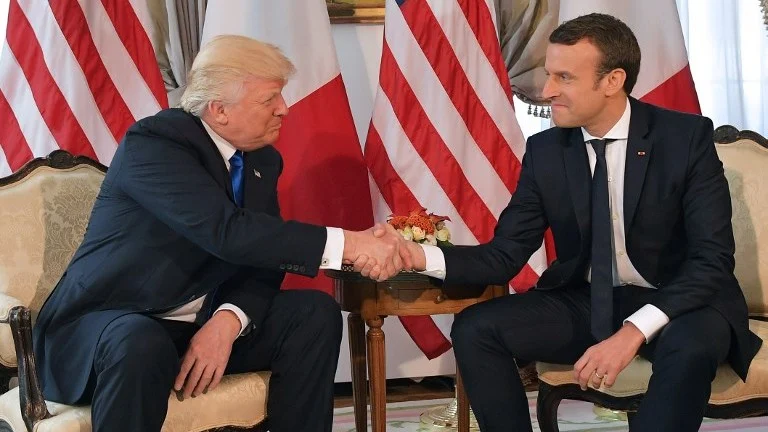
US President Donald Trump (L) and French President Emmanuel Macron shaking hands at the US ambassador's residence in Brussels, May 25, 2017. (AFP Photo/Mandel Ngan)
Trump’s warning about migration and Islam touches a real Western crisis. But Israel’s strategic mistake would be treating every Muslim society as the same threat when Iran’s revolutionary model and the Arab world’s modernization drive are pulling the region in opposite directions.
When Donald Trump declared that France’s escalating unrest was not fundamentally about schools but about what he called Islam’s attempt to “take over” the country, he ignited an immediate global controversy. His assertion that out-of-control mass migration was dismantling European public order touched off fierce debate from Washington newsrooms to European parliamentary halls. Trump’s explosive post on Truth Social cannot be dismissed as mere campaign rhetoric. It reopens a perennial, deeply consequential question that demands immediate clarity: how much of Western domestic instability and Muslim world economic stagnation can genuinely be attributed to Islam itself?
Trump’s statement highlights a long-standing, highly provocative argument that has gained significant traction across the globe. Proponents contend that Islamic doctrine is fundamentally incompatible with secular democratic stability, and that religious dogma represents the primary structural barrier preventing Arab nations from achieving modern prosperity. To millions across Western Europe and North America who feel exhausted by failed integration policies, rising crime rates, and cultural friction, such blunt statements provide cathartic validation. Yet for national security analysts, political scientists, and Middle East historians, sweeping assertions require rigorous examination. Is Islam truly the primary engine behind Europe’s social erosion? And is religious scripture the decisive factor holding back economic development and technological innovation across the Middle East?
To evaluate whether this premise holds true in Western nations, one must examine the European continent, where demographic shifts have created undeniable security and governance challenges. Over recent decades, European nations absorbed significant immigration from Muslim-majority regions without enforcing consistent integration expectations. However, European policies were never uniform across borders. While Britain historically pursued multiculturalism and Germany relied on guest-worker administrative frameworks, France insisted upon rigid republican secularism. The current friction across European cities stems from distinct policy failures rather than a single uniform doctrine. European governments often struggled to enforce consistent integration standards as migration transformed their major cities. The rise of isolated enclaves, urban unrest, and localized lawlessness reflects real enforcement breakdowns, yet attributing these complex social failures entirely to religious scripture oversimplifies European institutional mistakes.
The current crisis in Europe is as much a story of Western political hesitation as it is of religious assertiveness. European policy frameworks frequently permitted passive models of multicultural tolerance that discouraged assertive civic integration, allowing insular communities to grow without requiring deep adherence to constitutional norms, civic responsibilities, and shared national identity. While fundamentalist interpretations of religious law explicitly reject secular governance, millions of moderate Muslims live, work, and contribute productively across open democratic societies. The erosion of social order across European capitals is driven by a toxic combination of unchecked migration, economic alienation, radical organizing, and a loss of confidence among Western leaders regarding their own civilizational heritage.
The second dimension of the debate concerns the Middle East itself: is Islam the primary reason Arab nations lagged behind in scientific innovation, economic growth, and political freedom? A long-term historical perspective directly challenges any simplistic claims of religious determinism. During the Islamic Golden Age, urban centers across the Middle East and Mediterranean were major engines of intellectual progress. Scholars in centers like Baghdad, Cairo, and Cordoba preserved classical philosophy while systematizing algebra, advancing optics, mapping astronomical movements, and advancing medicine, pharmacology, hospitals, and clinical practice. Figures like Ibn Sina and Ibn Rushd laid critical pillars of empirical inquiry, demonstrating that the faith itself does not possess an inherent immutability that permanently prevents scientific advancement or societal evolution.
Why then did the Arab world experience a profound economic and scientific slowdown relative to Western powers? Historical evidence does not support explaining that retreat through scripture alone. Over centuries, the growing institutional power of conservative religious scholarship constrained certain forms of philosophical and scientific inquiry, though historians continue to debate the exact timing, scale, and mechanisms of that shift. Furthermore, catastrophic foreign invasions, structural shifts in global trade routes away from the Mediterranean, and long periods of administrative strain under Ottoman rule systematically weakened the institutional foundations of regional innovation. The retreat was a complex historical process driven by political, economic, and geopolitical factors rather than a single theological imperative.
In the modern era, economic stagnation across many Arab states was further entrenched by the resource curse and autocratic governance structures. The discovery of massive oil reserves enabled ruling elites to construct rentier economies, securing social tranquility through extensive state subsidies rather than cultivating competitive private markets, scientific research, or independent judicial systems. Within these centralized systems, religious fundamentalism functioned as both an instrument used by autocrats to bolster regime legitimacy and a primary vehicle for popular anti-regime protest. While dogmatic interpretations have restricted free inquiry and civil rights in several societies, governance failures, pervasive corruption, administrative inefficiency, and economic centralization played equally decisive roles in stifling development.
The most critical analytical mistake in Trump’s sweeping framing lies in treating the modern Muslim world as a single monolithic bloc. Today, a fierce strategic struggle is unfolding across the region between two radically different visions for the future. On one side stands Iran’s revolutionary Islamist model and its network of violent armed proxies, alongside ideological movements that weaponize religious dogma to suppress civil liberties, dismantle state institutions, and export endless regional conflict. Where revolutionary Islamist or jihadist movements have captured territory or entrenched coercive rule, the results have repeatedly included severe political repression, prolonged conflict, mass displacement, and severe economic damage. This revolutionary threat represents a direct, existential danger to regional security, international shipping, and democratic interests alike.
On the opposite side stands a pragmatic Arab reform movement led by sovereign states seeking rapid modernization and economic diversification. They are reforming religious institutions, modernizing education, expanding economic opportunities for women, and investing heavily in artificial intelligence, renewable energy, and advanced technology. The breakthrough of the Abraham Accords demonstrated that Arab Muslim nations can embrace rapid technological modernization and formal diplomatic cooperation with Israel without abandoning their Islamic identity or cultural heritage.
These cases show that religious heritage is not an insurmountable barrier to modern governance when national leadership prioritizes sovereign self-interest, economic realism, and technological integration over ideological fanaticism. While revolutionary movements attempt to drag the region backward into endless conflict, pragmatic sovereign governments are actively working to integrate their national economies into the global supply chain. The success of these reform efforts demonstrates that economic competitiveness, technological achievement, and institutional efficiency are driven primarily by state policy, governance structures, and leadership priorities rather than religious doctrine.
For Israel, this distinction is not an abstract academic exercise; it is the cornerstone of national statecraft and long-term defense planning. Israel does not need an endless cultural war against a global faith of nearly two billion people. Israel’s security depends upon defeating revolutionary Islamist and jihadist networks while deepening strategic partnerships with Muslim states that choose sovereignty, modernization, and cooperation. Trump’s provocative focus on European instability highlights valid security concerns regarding border control and radicalization that Western leaders long ignored. However, collapsing Islam, political Islamism, and state-led Arab modernization into a single threat misses the precise strategic nuance required for military victory and diplomatic success.
Conflating state-led modernization with ideological extremism undermines the very regional actors who are actively confronting radicalism from within, ultimately weakening broader efforts to foster long-term regional stability. By distinguishing revolutionary threats from pragmatic sovereign partners, Israel and its Western allies can secure their borders, defeat extremism, and ensure long-term regional security. The ultimate test of modern statecraft is not found in broad ideological pronouncements, but in the disciplined ability to confront real security threats directly without losing sight of the complex historical realities that shape our world.