
Trump in the Hornet’s Nest
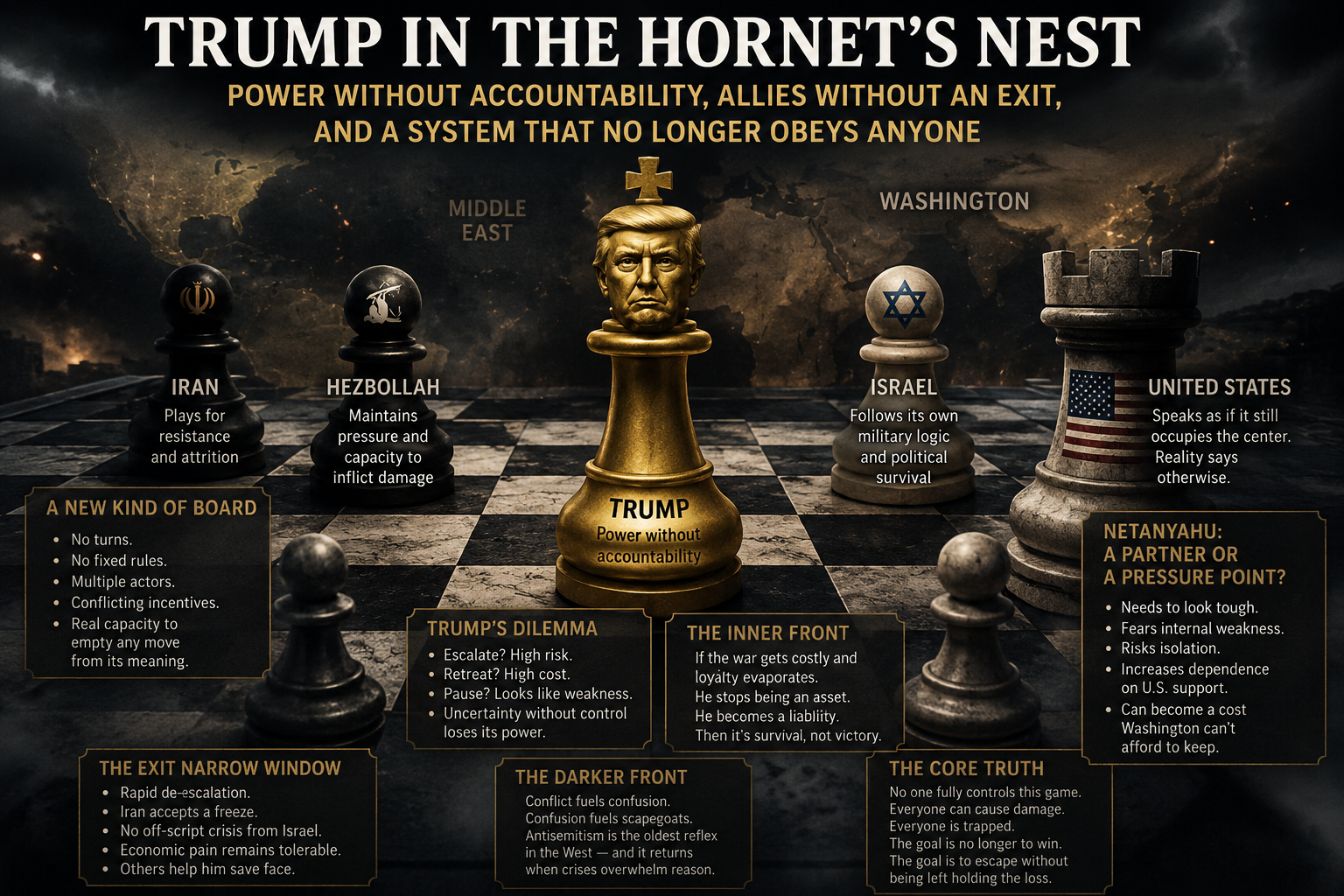
Power without accountability, allies without an exit, and a system that no longer obeys anyone
There’s a real difference between talking like an emperor and actually governing. For years Donald Trump has built his public persona around one simple promise: he walks in, applies pressure, and the world falls into line. That story holds as long as others agree to play inside the theatre he controls. The trouble starts when reality stops cooperating. That’s exactly where we are now.
What we’re watching isn’t just an outsized leader making another reckless bet. We’re watching an actor trying to project command over a system that no longer bends to a single will. Iran doesn’t answer to Trump. Hezbollah doesn’t answer to Trump. Israel doesn’t fully answer to Trump either. And inside the United States, Congress, electoral self-interest, and Republican fear of the political bill are not, in any clean sense, at his disposal. That’s the trap — not one bad move in isolation, but an entire architecture that prevents clean command.
The board can’t be read as classical chess anymore. Chess has turns, fixed rules, a relatively closed logic. Not here. Here, several actors move almost simultaneously, with broken chains of command, incompatible incentives, and a real capacity to drain any announcement from Washington of its substance. Trump moves one piece and three others move in front of him and beside him. Iran plays for attrition. Hezbollah plays to maintain pressure and the ability to cause damage. Israel plays its own military logic and its own political survival. The United States keeps speaking as though it still occupies the sovereign centre of the board. The facts keep saying otherwise.
From there, the pause in his signature project becomes easier to read. It doesn’t look like the move of a player who owns the situation. It looks like the reflex of someone who realised too late that he’d promised security he couldn’t deliver. Announcing maritime protection, open shipping lanes, and the restoration of order is one thing. Being exposed when the ships are still vulnerable, the strait still under threat, and regional actors still behaving as though Washington’s will is just one more noise among many — that’s another thing entirely. In that context, the pause stops reading like tactical genius. It reads more like basic instinct: someone who sees humiliation coming and steps back before being left completely naked.
Still, the uncomfortable question has to be asked, if we’re going to be honest rather than one-sided: is there any scenario where Trump gets out of this without sinking? Yes, but the window is narrow. He would need a rapid de-escalation he could sell as the fruit of his pressure. He would need Iran to accept a freeze without striking the system further. He would need Israel not to introduce a new crisis off-script. And he would need the economic impact inside the United States not to become politically unbearable. In other words: he would need several actors — none of them fully under his control — to cooperate in practice with his narrative. That’s not impossible. But it’s thin. His margin for exit depends less on his own intelligence than on others agreeing to let him save face.
That makes his position more precarious than it looks. He still has one real instrument: his ability to inject uncertainty. But in a prolonged crisis saturated with autonomous actors, that instrument loses its edge. What in other contexts served as pressure starts to look, here, like loss of command. Unpredictability doesn’t disappear. It just stops being the same thing as control.
And yet the real trap may not be only external. While the Middle East does whatever it wants, his margin inside the United States is also beginning to narrow. If the conflict becomes expensive, unpredictable, and electorally toxic, many Republicans will stop thinking about loyalty and start thinking about their own seats. That’s always the decisive line for a leader who lives by projecting strength: the moment he stops reading as an asset and starts reading as a liability. In American politics, when someone begins to threaten the survival of others, fidelity evaporates with brutal speed.
The great threat to Trump, then, is not only that Iran or Hezbollah humiliate him on the ground. It’s that, at the same moment, his own rear begins to see him as a man who talks too much, controls too little, and may drag them all into a defeat they didn’t sign up for. Once that happens, the logic shifts from imperial to defensive. It’s no longer about winning. It’s about escaping without admitting loss.
And when a leader like that needs to escape, he rarely absorbs the cost himself. He reassigns it. He was badly informed. Others sabotaged the opportunity. He wanted peace and his allies pushed for war. He did the right thing, but was surrounded by incompetents, fanatics, or liars. It’s an old move: nationalise success, externalise failure. Trump, by temperament and track record, is almost custom-built for that reflex.
That’s where the other central figure in this problem enters: Netanyahu.
It would be a mistake to treat him as a footnote. Netanyahu isn’t merely an uncomfortable partner inside this crisis. He’s one of its structural engines. He, too, is trapped — by his own character and by his own logic of survival. He needs to look hard because any sign of restraint can be read internally as weakness. He needs to sustain the image of resolve because part of his political legitimacy depends on it. But that same need pushes him into a dynamic where each move can deepen international isolation, domestic exhaustion, and dependence on American support that is no longer as automatic or as unlimited as it once was. If Trump is trapped by the fiction of his control, Netanyahu is trapped by the fiction that a politics of force can be sustained indefinitely without turning Israel into a cost increasingly difficult for its own allies to carry.
That makes the relationship between the two far more volatile than it appears from the outside. While they serve each other, the alliance holds. The moment one begins to endanger the political survival of the other, closeness becomes poison. If Washington starts recalculating to protect itself, Israel risks greater exposure — not because the alliance vanishes overnight, but because every alliance has a ceiling, and that ceiling appears when the partner’s cost starts to outweigh his strategic value. If Saudi Arabia, the Emirates, and other regional actors conclude that Israeli escalation is setting the whole architecture on fire, pressure on the United States will mount. And when the United States enters self-protection mode, Israel’s room to manoeuvre shrinks. In international politics, the inconvenient partner isn’t abandoned on principle. He gets cooled out by cost.
From there, the darkest front of all opens: antisemitism.
To deny the danger would be naive. Most people don’t draw precise lines between the Israeli government, military strategy, political leadership, Jewish identity, diaspora communities, or religious tradition. Crowds associate, simplify, and reach for visible culprits. It happened in the aftermath of the Gaza war, and there’s no need to manufacture precedents to understand what’s at stake — European history supplies too many. Every time a complex crisis converts into visible suffering, economic anxiety, and the need to assign quick responsibility, the Jew reappears as an available symbol for simplification and projection. It happened after political crises, military defeats, economic collapses. It happened when disproportionate blame was pinned to entire communities for decisions made by elites or states. It still happens when public space fills with rage and loses the capacity to distinguish. What is disturbing is not that antisemitism is a sudden anomaly. It’s that history shows with brutal clarity how easily it revives when the complexity of the world becomes unbearable for the collective imagination.
The danger, then, is not only diplomatic or military. It is moral, social, and civilisational. A new phase of war may not only isolate Israel further or erode Trump further. It may reactivate mechanisms of hatred, scapegoating, and the collective fusion between state, government, war, and identity. Once that fusion settles in, fine political reasoning no longer operates. Resentment operates.
Still, it would be a mistake to keep thinking this revolves only around Trump or Netanyahu. The deeper problem is wider. We’re not looking at one clumsy leader making a bad move, or another hardening a conflict to stay in power. We’re looking at a system where almost no one has a clean exit. Trump can’t escalate without risk. He can’t withdraw without cost. Netanyahu can’t stand down without paying internally. Iran can’t yield without weakening itself. Hezbollah doesn’t act in a vacuum without accumulating consequences either. They are all trapped inside a structure where every move worsens something and no decision recomposes the whole.
That’s what makes the situation genuinely dangerous. We’re not watching a master plan. We’re watching a constellation of actors with the capacity to cause damage, the will to survive, and no total command over what comes next. In a scenario like that, the language of greatness becomes hollow. To speak of maritime freedom, restored order, or strategic authority sounds almost grotesque when the facts demonstrate, again and again, that no one truly runs the board.
My final read is hard but simple. Trump doesn’t look today like a sovereign strategist guiding a crisis. He looks like a man trapped by his own character, still talking like the owner of the game inside a system that no longer responds to the fiction of his power. Netanyahu doesn’t look like the steady conductor of an exit. He looks like another leader chained to a logic of force that may end up isolating him further. Both are still moving, yes. Both can still cause damage, yes. Both retain the capacity to alter rhythms, inject fear, and push events in one direction or another. But neither one appears to truly govern the process he helped unleash.
And when leaders can no longer order the board, only one option remains: protect yourself. That’s the point at which politics stops being direction and becomes a naked struggle to transfer the cost to someone else. The most dangerous thing about this crisis may not be who wins. It may be how many are dragged along while each actor fights not to be the last one left holding the loss.