The views expressed herein are solely mine.
‘Trumproe’: World Order Is Officially Dead
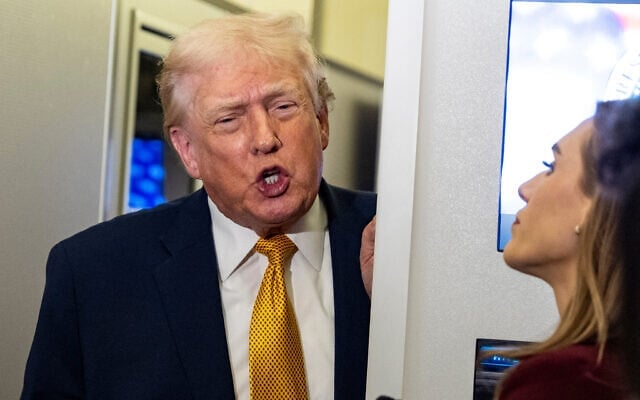
US President Donald Trump speaks with reporters while in flight on Air Force One, on January 4, 2026, as they were returning to Joint Base Andrews, Md. (AP Photo/Alex Brandon)
Venezuela’s breakdown was not accidental but systemic. Cuban intelligence embedded the regime’s control architecture, cartel economics underwrote its finances, and Nicolás Maduro—dictator and leader of the Cartel de los Soles—functioned as the central figure of the system. He was not a governing authority but the visible node of a durable criminal-political structure optimized for extraction, repression, and regime continuity.
Then the crown disappeared.
What the United States appears to be testing is not regime change but a colder, more contemporary mechanism of control—a derivative of the ‘Monroe Doctrine’ that might be called ‘Trumproe’.
In my judgment, Trumproe can be defined as a doctrine of strategic control rather than political transformation: a framework that prioritizes neutralizing central figures, preserving functional state machinery, and coercively managing systems that host strategic resources, logistical access, and geopolitical leverage after knocking out their crown jewel. This geostrategic framework is not concerned with ideological alignment or democratic outcomes, but with who controls the inputs of power.
The operational logic is straightforward: decrown and command. Remove the leadership node while leaving the underlying machinery intact, then compel the residual system to operate under sustained external pressure. No liberation narratives, no institutional resets, and no regime-change experiments of the kind that yielded ‘Operation Condor’ or prolonged wars in the Middle East. Only leverage.
As a doctrine, Trumproe rests on three core principles.
First, power is concentrated at the top, but stability resides in systems; therefore, removing leaders is useful only if the system is preserved and coerced.
Second, legitimacy is instrumental, not moral—introduced only when necessary to stabilize outcomes.
Third, strategic value is measured not in territory or ideology, but in resources, supply chains, and access.
From these principles follow their corollaries: selective decapitation, asymmetric pressure, and transactional trade-offs across theaters.
Nevertheless, this mechanism only functions if legitimacy is addressed; accordingly, a coerced apparatus can be compelled to operate, but it cannot stabilize itself.
For that reason, María Corina Machado is indispensable—but also structurally constrained. She is the only actor with demonstrable political capital inside Venezuela and across the diaspora. Yet despite any personal or political animus President Trump may harbor toward her—stemming, for instance, from her 2025 Nobel Peace Prize while he did not—the more decisive reality is operational, not personal: Trump cannot install her without fully abandoning Trumproe.
Without a doubt, elevating Machado would require an outright regime change—troops on the ground, sustained military engagement, and a U.S.-backed transitional authority—because she holds no leverage within the existing power structure.
In light of this, Trumproe, by design, avoids this path. Without internal regime influence, Machado cannot be imposed; she can only legitimize outcomes that emerge once the system yields.
At present, the main risk is internal succession. Diosdado Cabello—the most senior remaining ‘chavista’ figure—and Vladimir Padrino López—defense minister and de facto commander of the armed forces—constitute the second-crown problem: rapid coups or managed fragmentation leading to protracted instability.
In their case, if the regime were fully reconstituted under their control, Trumproe would no longer be applicable and a direct military intervention would be required.
Should Cabello or Padrino attempt a coup under those conditions and refuse to align coercively, the United States would be compelled to cancel Trumproe altogether and revert to traditional regime-change doctrine.
The critical difference—made possible precisely because Trumproe was attempted first—is legitimacy: Washington could credibly argue that the existing regime was allowed to adapt, failed, and forced escalation.
Under such circumstances, full regime replacement could follow with greater international and domestic justification, potentially culminating in elections and a María Corina Machado presidency grounded in popular mandate rather than foreign imposition.
As a result, Trumproe remains viable only if they ultimately cede to U.S. pressure and support Delcy Rodríguez and her obligatory reconfigurational geopolitical strategy.
Accordingly, ‘Decrown-and-Command’ requires explicit deterrence within the security services and a credible civilian counterweight outside them to prevent recomposition at the top.
In my assessment, Decrown-and-Command is a new U.S. hemispheric sub-doctrine nested within Trumproe, designed to neutralize hostile systems by removing leadership nodes while preserving and coercing the underlying state machinery. It functions as the enforcement arm of Trumproe: tactical where Trumproe is strategic.
Venezuela, however, is not the end state. It is the proof of concept.
Applied to Colombia, the doctrine isolates cartel-political nodes while preserving institutional continuity.
In Mexico, it scales into a multi-crown model: selective decapitation across port, border, and fuel-theft ecosystems, compelling compliance through calibrated pressure rather than frontal confrontation.
In Cuba, the doctrine turns decisively inward against the architect itself—systematically dismantling Havana’s intelligence-export apparatus, collapsing its foreign rent streams, and severing its ability to reproduce regime survival abroad.
Within this broader geostrategy, Greenland constitutes the ‘non-kinetic’ branch. Here Trumproe mutates into ‘Anchor-and-Exclusion’: locking access, infrastructure, and permitting regimes so that Chinese and Russian actors are structurally excluded from Arctic logistics, critical minerals, and dual-use infrastructure.
Based on the available evidence, Greenland holds a disproportionate share of strategically relevant rare-earth potential (almost 20% of all rare-earth minerals globally), hosts reserves sufficient to influence supply chains, and—more critically—sits astride the Arctic routes, undersea cables, basing corridors, and logistical arteries upon which the next industrial and military cycle will depend.
However, this is not it. In fact, the third branch directly targets the Islamic Republic of Iran.
In concrete terms, this branch does not pursue decrowning but rather ‘Deterrence-by-Denial’. The objective is to make repression costly by systematically targeting the regime’s coercive enablers—finances, procurement networks, and command-and-control systems—so that violence against its own population generates immediate, “personal” consequences.
For example, instead of Israel functioning as a moral advocate or symbolic ally, it operates as a pressure amplifier within Trumproe: supplying intelligence, disruption capabilities, and credibility. Not moral signaling—enforcement.
Therefore, strip away the rhetoric and the pattern becomes evident. These operations are not primarily about narcotics, terrorism, or democracy promotion. They are about inputs of power: Venezuela’s hydrocarbons, Greenland’s critical minerals, and the supply chains that sustain energy dominance, defense production, artificial intelligence, and industrial primacy. Control the feedstock, and strategic outcomes follow.
However, none of this is executable without resolving the Ukraine file.
Trumproe requires bandwidth—and bandwidth requires trade-offs. The operative assumption appears to be a tacit accommodation with Moscow: Russian consolidation in eastern Ukraine and Zaporizhzhia in exchange for U.S. freedom of maneuver in the Western Hemisphere and the Arctic.
Under this logic, Ukraine is pressed toward acceptance not theatrically but structurally. Prolonged resistance threatens higher-order priorities. The signal is implicit: systems can be squeezed, leaders isolated, and outcomes shaped without overt regime removal.
Undeniably, history is instructive, and Moscow has seen this model before.
In Syria, Russia deprioritized Bashar al-Assad once the cost exceeded the return. The analytical wager here is similar: Venezuela was quietly downgraded in exchange for latitude in Ukraine. In this way, Putin pretends he was attacked by Ukraine while Zelensky was at the White House, gains leverage and territory; meanwhile, Washington secures maneuver space.
Should Kyiv resist, the lesson is not that Volodymyr Zelensky would be removed “the Venezuelan way,” but that pressure can be applied asymmetrically—political constriction, financial leverage, and strategic isolation.
Evidently, crowns need not fall to be neutralized.
Unapologetically, Trumproe is neither humane nor idealistic. It is transactional power politics adapted to a fractured system: remove leaders where necessary, preserve functional systems, secure strategic inputs, and reorder priorities.
Ergo, this is the geopolitical corollary to the Ukraine settlement: Moscow absorbs territory; Washington absorbs leverage.
Because Trumproe is not about saving states; it is about controlling what makes states powerful.
Indeed, Washington seeks control over strategic resources, but by avoiding overt regime change in places like Venezuela—where neither the dictatorship nor much of the opposition is pro-American, nor is the population—he allows outcomes to also legitimize themselves.
If the existing system stabilizes under pressure or a compliant alternative delivers results, and civilians associate improvement with U.S. leverage, this opens the path for gradual pro-American alignment and future alliance.
If sustained, Trumproe could permanently reshape international relations by normalizing control over systems rather than regimes, privileging resources and leverage over ideology, and replacing moralized intervention with transactional power—resetting how states compete, align, and survive in a post-idealistic world order.
From a structural perspective, Trumproe should be read less as an ad hoc policy choice and more as a symptom of systemic fatigue within U.S. grand strategy. In the short term, it may function as an electoral instrument—one that enables President Trump to neutralize a hostile regime without incurring the political costs of a conventional military intervention.
At the same time, Trumproe can also be interpreted as a coercive scheme designed to place a weakened and pressured adversary before a narrow set of options: compliance failure followed by U.S. eradication, or face internal collapse through a coup d’état or civil conflict. In this last scenario, direct U.S. military involvement would likely become unavoidable, rendering Trumproe inapplicable as a governing doctrine.
What remains indisputable, however, is that Trumproe allows President Trump to present himself to the American electorate as a leader who “ended the problem” while avoiding boots on the ground.
Simultaneously, it enables the extraction of immediate material benefits through limited energy arrangements, such as Chevron’s provisional access to Venezuelan oil. Yet the doctrine’s deeper significance lies beyond these tactical gains.
Empirically, its true importance rests in its potential to inaugurate a post-interventionist, resource-oriented model of coercive statecraft—one that prioritizes leverage, transactional control, and domestic political survivability over liberal institutionalism.
Whether Trumproe ultimately proves to be a temporary electoral patch or a durable vanguard strategy remains uncertain. What is clear, however, is that it signals the entry of the prevailing architecture of international relations—and the assumptions underpinning U.S. power projection—into a phase of irreversible transformation.
In this sense, the doctrine does not merely challenge liberal norms. It renders them operationally obsolete. It demonstrates that effectiveness, extraction, and political durability now outweigh legitimacy, multilateral consent, and the moral narratives that once underwrote the post–Cold War order.
Related Topics
Related Posts