


Trump’s Commitment to Middle East Peace Begins and Ends With Gaza
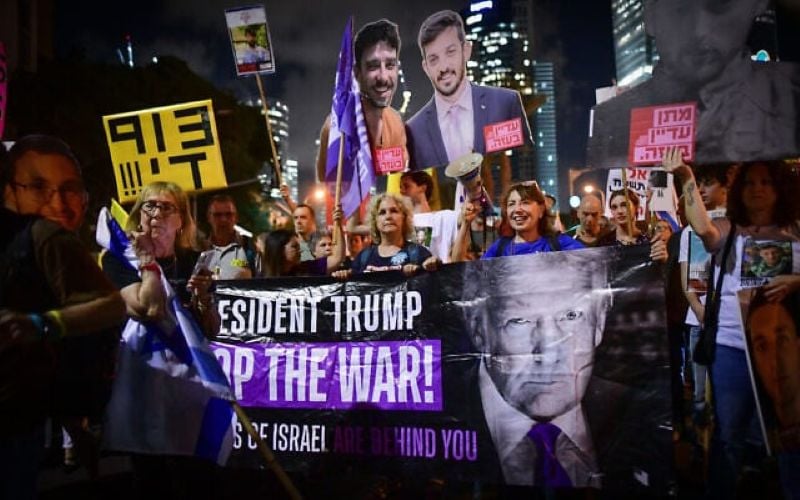
Despite the dog-and-pony show staged by President Trump at his news conference with Prime Minister Netanyahu at the White House on September 29, the 20-point plan that bears the title “President Donald J. Trump’s Comprehensive Plan to End the Gaza Conflict” is precisely that – a plan to end the Gaza conflict, not a Middle East peace plan.
Of the 20 points that make up the plan, only the last three address peace between the Israelis and the Palestinians… yes, the peoples, not the countries. The sole reference to Palestinian statehood is in no. 19, which is as noncommittal as possible. Only after the PA has “faithfully” (based on what measure?) completed its reform program in accordance with various proposals, including Trump’s 2020 peace plan (so much for the Palestinians having dodged the “Deal of the Century” bullet), will there be a chance that the conditions “may” be in place (maybe yes, maybe no) for “a credible pathway” to statehood (not statehood itself, but a path leading in that direction), which the United States recognizes as “the aspiration” (not “the right”) of the Palestinian people.
Anybody who might reject this critique of the plan and choose to give Trump the benefit of the doubt would have to ignore the disingenuity (perhaps madness?) of Trump’s remarks at Monday’s news conference, when he told his audience that they were gathered on what could be “one of the great days ever in civilization” and announced that he would be bringing “eternal peace” to the Middle East. And it went downhill from there.
He referred to Israel’s withdrawal from Gaza in 2005 as an act of generosity on Israel’s part, as if it was entitled to remain there. He talked once again about the Gaza beachfront as prime real estate, “the most magnificent piece of land” in the Middle East. Do not be fooled by the humility he tried to portray in saying that the position of head of the “Board of Peace” was forced on him. Back in February, he had announced that the United States would “own” Gaza, and Jared Kushner appears to have delivered the goods. Remember the concept of economic peace? It echoes in Trump’s remarks at the news conference about creating conditions for “durable Israeli security and Palestinian success.” Israel gets a security buffer zone that bites into the territory along the entire Gaza border, including the border with Egypt, and the Palestinians get the chance to “earn their way to a brighter future.” (author’s emphases)
In assessing the gap between Trump’s remarks and reality, one should recall that Israel is facing growing global isolation, with one-time allies resorting to arms embargoes and trade bans; international cultural and sports associations imposing boycotts; worldwide protests attended by hundreds of thousands under the banner “Free Palestine”; and cases pending in the highest international courts regarding alleged war crimes and genocide. The prime minister of Israel himself is under indictment at the International Criminal Court on charges of using starvation as a method of warfare. And what did President Trump have to say about Israel’s international standing? “Many countries have gained great respect for Israel, for the way they fight, for the job they do.” I suppose none of those countries served on the UN-appointed commission of inquiry that published a 72-page report last month which concluded that Israel has committed genocide in Gaza.
The fact that the president’s remarks at the news conference amounted to preposterous assertions that would get any student kicked out of International Relations 101 did not keep the leaders of the international community from rushing to laud his achievement. Arab and Muslim states which in July had signed the New York Declaration on the Peaceful Settlement of the Question of Palestine and the Implementation of the Two-State Solution issued a joint statement in which they welcomed Trump’s leadership and expressed “confidence in his ability to find a path to peace.” Prime Minister Mark Carney of Canada, one of the countries Trump belittled for having “foolishly” recognized the State of Palestine at the UNGA in September, welcomed what he called the president’s “historic new Middle East peace plan.” Japanese Prime Minister Shigeru Ishiba also welcomed the plan, calling it “a significant step toward a two-state solution.” One can only wonder what plan they had read and what they were doing while the Trump-Netanyahu news conference was being broadcast.
Even the statement issued by the Foreign Ministry of France, the country that partnered with Saudi Arabia to garner international commitment to an action-based plan to implement the two-state solution, indicated readiness to get in line with Trump. The French statement is somewhat misleading, as it says that the principles of the US plan align with those of the New York Declaration, “to which the American proposal refers.” In fact, the Trump plan is rather vague, referring to “the Saudi-French proposal” rather than the declaration whose endorsement the United States opposed at the UNGA just a few weeks ago. Moreover, the reference appears in the context of the anticipated PA reforms and not in regard to the question of statehood. Furthermore, the bullets the French list as the principles put forward in the Trump plan include “the relaunch of a political process aimed at establishing a Palestinian State living in peace and security alongside Israel.” Would that it were so. Anyone who can find a mention of the West Bank or East Jerusalem among the 20 points would be no less worthy a candidate for the Nobel Peace Prize than the current resident of the White House.
It is easy to understand the support for a plan that may end the brutal fighting that has been going on for two years, a plan that may finally free the remaining hostages and save the people of Gaza from the threat of annihilation. It may not succeed, it could be improved, but it deserves a chance.
On the other hand, it is vital to recognize that the Trump plan is not a peace plan. When he noted that Netanyahu continues to oppose a Palestinian state and that he understands his position, Trump was saying that Palestinian statehood is not part of this deal. The reintroduction of the 2020 Peace to Prosperity plan as a term of reference should also set off alarms. At the time of that plan’s release, High Representative Josep Borrell recalled the EU’s commitment to a viable two-state solution that respected all relevant UN resolutions and internationally agreed parameters and said the US initiative departed from those parameters. This time around, it appears like the world is so anxious to see the death and destruction come to an end that it is seeing zebras where there are only horses.
This is the moment to be vigilant, to ensure that the diplomatic momentum around the two-state solution witnessed in recent months is not crushed under the weight of the bulldozers, excavators, and cranes that Trump and his son-in-law imagine will build Xanadu out of the Gaza sands. That’s where Trump’s focus lies, as is clearly indicated in the White House October 1 press release titled “Global Support for President Trump’s Bold Vision for Peace in Gaza.” Not the Middle East, but Gaza.
The EU, Canada, the UK, Australia, the Gulf states, Norway, the Arab League, and particularly France and Saudi Arabia must not step aside and leave the reins in the hands of a president who will lose interest long before the Muqata’ah is transferred to East Jerusalem. If the ceasefire does not lead to a resolution of the conflict that ends the occupation and establishes a viable, independent, sovereign, contiguous State of Palestine alongside the State of Israel based on the June 4,1967 borders, the next round will undoubtedly be far more deadly. The Trump plan will not save us from that fate.