
Israeli-American attorney and Chairman of Republicans Overseas Israel
Featured Post
Trump’s Iran gambit is about elections
The MOU with Tehran is a political calculation during a midterm year in which Republicans hold a razor-thin House majority – not an abandonment of Israel
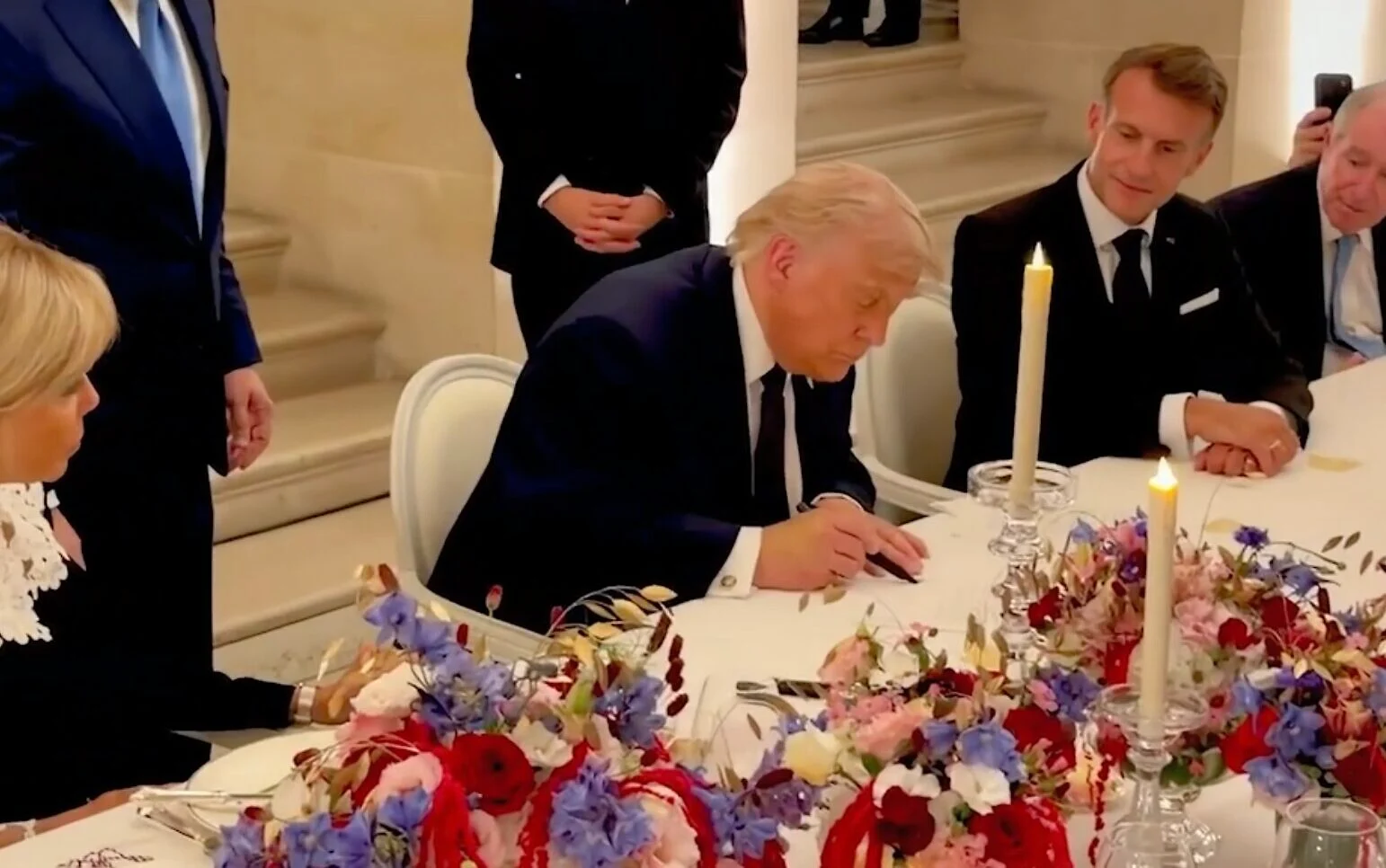
A screenshot of video released by the White House shows US President Donald Trump signing the Persian-language version of the memorandum of understanding with Iran, at the Palace of Versailles in France, June 17, 2026. (X screenshot)
The signing of a Memorandum of Understanding between the United States and Iran has generated considerable anxiety in Israel and among pro-Israel communities worldwide. Criticism has come from across the political spectrum – including from within the Republican Party itself.
That anxiety only deepened in recent days, as Iran struck commercial vessels near the Strait of Hormuz, the United States responded with two consecutive nights of strikes on Iranian military targets, and Iran retaliated against American positions in Bahrain and Kuwait before both sides agreed to a fragile pause and a return to talks, now relocated to Doha. The frustration is legitimate. But the conclusions being drawn are, in many cases, wrong.
What is actually happening is far more straightforward than the commentary suggests: President Trump is managing a domestic political constraint, not reversing a strategic commitment, and Iran is behaving exactly as Iran has behaved for 47 years.
Congressional math
To understand the decision, one must first understand the arithmetic. Republicans currently hold a majority in the House of Representatives by two seats. In midterm election years, the ruling party historically loses ground in Congress – a pattern that holds in the vast majority of cycles. The November 2026 elections will determine who controls Congress for the remainder of Trump’s second term. And unlike in Israel, where foreign and security affairs carry significant weight at the ballot box, American voters make their decisions primarily on economic grounds – inflation, energy prices, mortgage rates, and the performance of financial markets.
The MOU addresses all of these directly. Brent crude has already declined to around $73 a barrel since the agreement was announced – well off the wartime highs above $120. The reopening of the Strait of Hormuz is expected to ease fertilizer costs and, by extension, food prices. Equity markets have responded positively. These are the metrics that move American voters, and Trump – who understands the American electorate as well as any politician of his generation – is responding accordingly.
This is not a betrayal of Israel. It is a calculation about how to retain the congressional majority that makes continued support for Israel possible in the first place. If Democrats take control of the House, the consequences for Israel would be severe and immediate. They would open committee investigations, attempt to obstruct military assistance, and almost certainly pursue impeachment proceedings against the president. The resulting political paralysis would consume the administration’s final two years. The question of who controls the House in Washington is, in a very direct sense, an Israeli question as well.
The MOU itself should also be understood for what it legally is: not a peace agreement, not a binding treaty, and not a concession on core interests. It is a framework for negotiation – what American lawyers would call an agreement to agree. Iran receives nothing tangible until it demonstrates compliance with its commitments.
And we no longer have to speculate about whether Iran will honor those commitments. Within days of the signing, Iran was already testing the boundaries of the Hormuz provisions, attacking shipping it deemed to be circumventing its preferred maritime route, prompting American strikes on Iranian radar, drone, and air-defense infrastructure along the strait. This is not a deviation from the expected pattern. It is the pattern: periodic provocation, calibrated American response, and a return to the table.
President Trump is holding virtually all the cards in this conflict. The US military remains in place and controls the Strait of Hormuz. The economic sanctions remain in effect. Not a dime of Iranian assets has yet been unfrozen. Iran has still been unable to sell its crude oil on international markets. Trump retains every lever of pressure he currently holds, and the sanctions framework and regional military presence give him the means to use it when he chooses to.
The same administration that is managing Iran with patience has, in parallel, achieved something close to the impossible elsewhere: a wholesale reorientation of Latin America toward pro-American, pro-Israel positions, led personally by Trump and Secretary of State Marco Rubio. Cuba may be next. If that domino falls as well, the cumulative record heading into November could be formidable – and it could be decisive for Republican prospects in the midterms.
There is also an element of this story that has received insufficient attention, and it cuts directly against the narrative of American disengagement: while the Iran MOU dominated headlines, Israel and Lebanon – under direct American mediation – signed a framework agreement in Washington establishing a roadmap toward eventual peace, the first such document of its kind in decades. The agreement commits Lebanon, for the first time in an international instrument, to the full disarmament of all non-state armed groups, including Hezbollah.
It establishes a trilateral US-Israel-Lebanon coordination mechanism, commits the US Army to actively train and oversee the Lebanese Armed Forces, and ties any Israeli withdrawal explicitly to verified disarmament on the ground – not to a timetable dictated by Beirut or Tehran.
Prime Minister Netanyahu, who insisted throughout the negotiations that the IDF would not withdraw from the security strip in southern Lebanon, called the agreement “a major achievement for the State of Israel,” and described it as “a heavy blow to Iran,” which had pressured Washington to force a unilateral Israeli withdrawal. Hezbollah’s swift and furious rejection of the deal, and the riots that followed in Beirut, confirm precisely whose interests this agreement threatens.
This is not the behavior of an administration retreating from the region. It is the behavior of an administration building structures designed to outlast any single negotiation with Tehran. Notably, this pattern is not limited to Lebanon – similar signals of realignment, however preliminary, have surfaced in recent days from Iraq, Kurdistan, and Oman as well.
Israel’s freedom of action
By deliberately excluding Israel from the Iran MOU negotiations, the United States preserved Israel’s freedom of action elsewhere. Israel is not a party to that memorandum and is not bound by its provisions in the way the direct signatories are. The intensive military operations conducted in southern Lebanon in recent weeks – including the exposure of a vast tunnel complex near Nabatieh with rocket-launch shafts aimed directly at Israeli communities – and the framework agreement that followed are evidence of what that freedom of action produces when used deliberately and in close coordination with Washington.
None of this means the tone emanating from Washington has been acceptable. The use of dismissive language toward a close ally and its elected leadership is unnecessary and counterproductive. A diplomatic agreement can be pursued, and an American domestic political audience can be addressed, without employing language that demeans a partner. That criticism stands on its own terms.
But criticism of rhetoric is different from misreading strategy. The record of this administration’s support for Israel – recognition of Jerusalem as Israel’s capital, recognition of sovereignty over the Golan Heights, the Abraham Accords, the withdrawal from the 2015 nuclear deal, and the direct military coordination during operations against Iran – does not simply evaporate because of a non-binding interim memorandum. And on the very day this article is being written, Ambassador Mike Huckabee and Foreign Minister Gideon Sa’ar signed an agreement allocating the Allenby Compound in Jerusalem for the construction of a permanent US Embassy complex – turning, as Jerusalem Mayor Moshe Lion put it, Trump’s historic decision “from paper into stone.”
The coming months will test whether Iran chooses compliance or provocation. That test is already underway, and the early results are unsurprising. When the next round of provocation arrives – and there will be a next round – the question of what leverage remains in American hands will matter enormously. It matters now whether the United States enters that moment with a functioning congressional majority capable of sustaining a strong foreign policy – or whether it enters it with a paralyzed administration fighting for political survival.
That is the calculation being made in Washington right now. It deserves to be understood on its own terms.
Related Topics