Trump’s Madness Has a Method
To navigate Trump, Israel must first understand how he actually operates — and what that means for every agreement, commitment, and room he walks out of
For Israel, understanding Donald Trump is not an academic exercise. It is a matter of strategic survival. Jerusalem cannot afford the luxury of puzzlement, frustration, or moral accounting when it comes to this American president. It must understand, with cold clarity, how he actually operates — because the gap between what Israel assumes and what Trump’s method actually produces is where Israeli interests go to die.
Analysts have spent a decade searching for the doctrine behind Trump’s decision-making. They have proposed negotiating gambits, authoritarian consolidation, nationalist ideology, and Bannonite deconstruction. All of them miss the simpler truth.
Trump has no doctrine. He has a method.
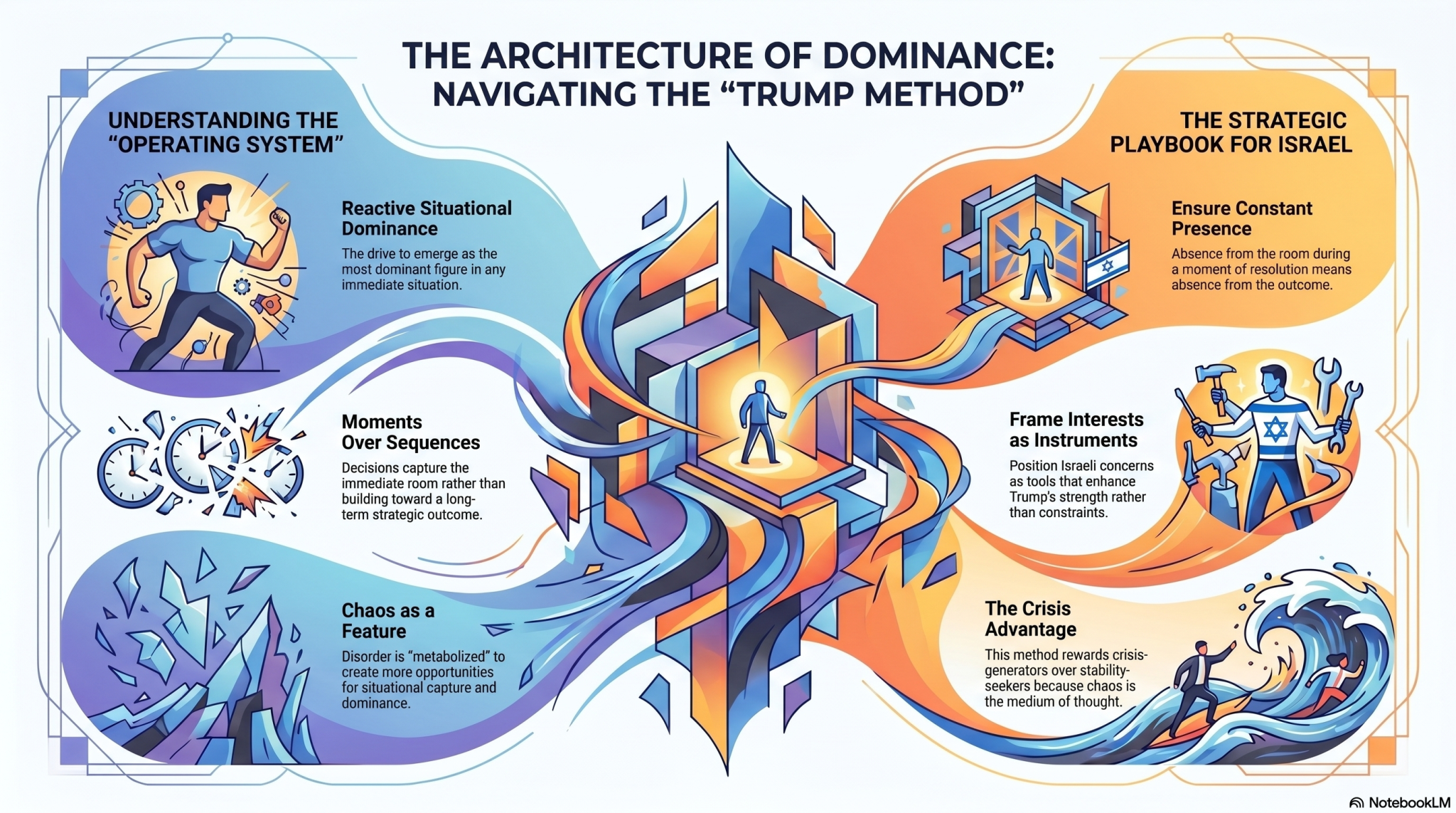
That method is reactive situational dominance — the drive, in any given moment, to emerge from the immediate situation as the dominant figure in the room. Not the most strategic. Not the most consistent. The most dominant. Every statement, reversal, escalation, and sudden concession follows this logic with remarkable consistency once you see it.
The implications are significant. Reactive situational dominance means Trump does not plan sequences — he captures moments. He does not build toward outcomes — he resolves pressures. He does not hold positions — he holds rooms. When the room changes, the position changes with it. What looks like contradiction is actually perfect internal consistency: each move was optimal for the situation that produced it, regardless of what came before or what comes after.
This is why traditional diplomatic and political frameworks fail to predict him. They assume a stable preference set behind the decisions. There isn’t one. There is only the immediate situation, the available leverage, and the instinct to exit dominant.
It also explains the chaos. Chaos is not a bug in this operating system — it is a feature. A stable, predictable environment offers fewer opportunities for situational capture. Disorder multiplies the moments available for dominance. Trump does not manage chaos so much as metabolize it. The danger for adversaries — foreign and domestic — is underestimating how effective this method can be in the short term, while overestimating how much it constitutes a strategy in any durable sense. Reactive situational dominance wins rooms. It does not win wars, alliances, or institutional trust. The bill, when it comes, arrives in the currency of compounding unpredictability — and it is always larger than anyone budgeted for.
For Israel, this is not an abstraction — it is a daily operational reality.
Jerusalem cannot assume that today’s American commitment survives contact with tomorrow’s situation. When Trump embraced the Versailles MOU with Iran without securing any operational constraint on Iranian proxy networks, it was not a betrayal of Israel in any ideological sense. There was no ideology to betray. It was a situational exit — a dominant-looking conclusion to an immediate pressure campaign — with Israel’s equities simply not present in the room at the moment the deal crystallized. That is the mechanism. Absence from the situation is absence from the outcome.
This places Israel in a structurally precarious position that goodwill and historical alliance cannot fully offset. Netanyahu’s challenge is not to maintain Trump’s affection — that is episodic and unreliable by nature — but to ensure that Israeli interests are embedded in every situation before it resolves. That means constant presence, constant framing, and constant positioning of Israeli concerns as instruments of Trump’s own dominance rather than constraints upon it. When Israel can credibly argue that its position makes Trump look stronger, it has leverage. When it cannot, it has sentiment — and sentiment does not survive the next room.
The harder truth is that reactive situational dominance, applied to the Middle East, rewards actors who generate crises over those who seek stability. Iran understands this intuitively. It creates situations; Israel tries to manage them. In a White House governed by episodic opportunism, the crisis-generator holds structural advantage over the stability-seeker — because chaos is the medium in which this presidency thinks, and those who fluently speak chaos will always have more to offer than those who counsel patience and principle.