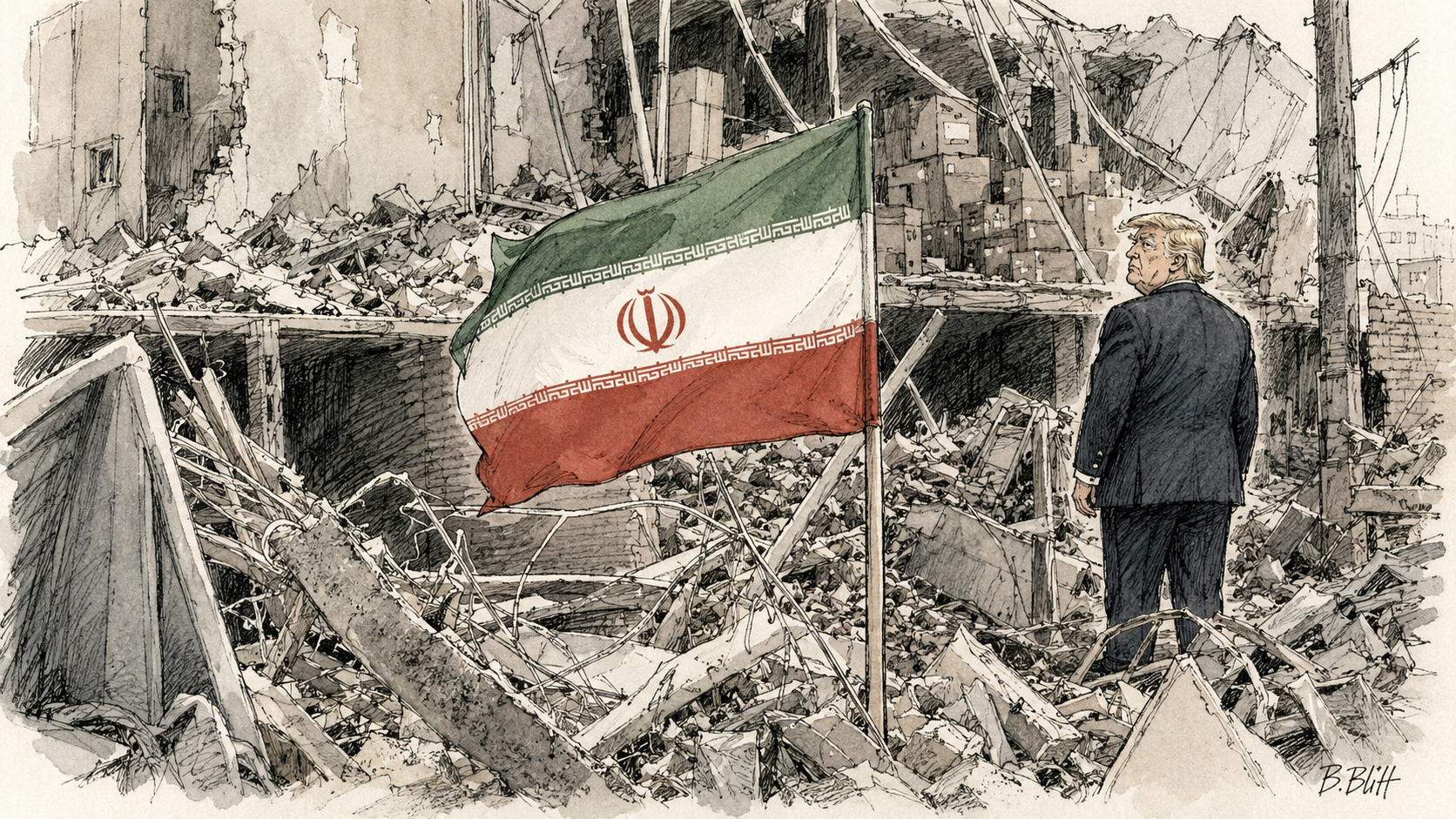
Donald Trump appears ready to redefine America’s campaign against the Islamic Republic. Recent statements from the White House, coupled with reports that US military planners are preparing strikes on Iran’s energy infrastructure, point to a significant shift in strategic thinking. The emphasis is moving beyond degrading Iran’s nuclear ambitions or targeting the IRGC. The emerging objective is to weaken the regime’s capacity to govern.
Speaking at Camp David, Trump signaled a willingness to intensify military pressure until Tehran concludes it can no longer sustain confrontation. If current reporting proves accurate, power stations, oil refineries, fuel distribution networks, and electricity grids—not enrichment facilities—will become the center of gravity in Washington’s campaign.
This reflects an important strategic evolution. Modern states rely on critical infrastructure to sustain military operations, administer government, and project authority. Disrupting those systems does not merely reduce economic output; it constrains decision-making, logistics, communications, and command. The target is no longer simply Iran’s weapons programs but the machinery that enables the Islamic Republic to function.
The logic is straightforward. Iran’s military-industrial complex depends on reliable electricity and fuel. Missile production, maintenance facilities, transportation networks, and command systems all require functioning energy infrastructure. Degrading these assets would simultaneously erode military readiness while increasing domestic political pressure on a government already struggling under sanctions, inflation, and chronic economic mismanagement.
For Tehran, the challenge extends beyond military calculations. Nearly five decades after the 1979 revolution, the Islamic Republic presides over an economy marked by stagnation, declining living standards, and persistent public dissatisfaction. Additional disruption to infrastructure would deepen those pressures, testing the regime’s administrative capacity at a time when its domestic legitimacy has steadily weakened.
Washington’s strategy also carries a broader regional purpose. Demonstrating that attacks by Iran or its proxies invite consequences extending far beyond conventional military retaliation reinforces deterrence across the Middle East. The message reaches not only Tehran but also the network of armed groups that have long operated under its patronage.
Whether such pressure ultimately compels negotiations remains uncertain. The ideological foundations of the Islamic Republic have historically favored resistance over compromise, even at considerable national cost. For decades, Tehran has absorbed sanctions, diplomatic isolation, and military setbacks while preserving its revolutionary identity. There is little evidence that ideological commitment has diminished.
That reality explains why the current strategy appears focused less on persuasion than on attrition. Rather than seeking immediate political concessions, Washington is raising the structural costs of continued confrontation. The aim is to make governing increasingly difficult without requiring a full-scale invasion or prolonged occupation.
The implications extend beyond Iran itself. Israel remains central to intelligence coordination and operational planning, while a sustained campaign against Iran’s infrastructure could further weaken the network of regional proxies that has underpinned Tehran’s influence from Lebanon to Iraq and Yemen. Diminishing that strategic architecture would reshape the regional balance of power more profoundly than isolated strikes against nuclear facilities.
The redeployment of US forces from parts of Iraq similarly suggests preparations for a campaign designed to reduce American vulnerabilities while increasing operational flexibility. Force posture adjustments often signal anticipation of broader military activity rather than isolated tactical operations.
This represents a different model of coercion. The objective is not necessarily immediate regime change but the gradual erosion of state capacity. By targeting the systems that sustain governance rather than only military assets, Washington is seeking to undermine the Islamic Republic’s ability to finance, coordinate, and maintain its authority.
Whether that strategy succeeds will depend on endurance as much as firepower. Tehran has repeatedly demonstrated a willingness to impose severe costs on its own population to preserve the regime. Yet sustained degradation of energy networks, administrative functions, and logistical infrastructure would steadily narrow its room for maneuver.
If this campaign proceeds as anticipated, the defining question will no longer be whether Iran can rebuild nuclear facilities or replace military hardware. It will be whether the Islamic Republic can continue governing effectively while the foundations of its state apparatus come under sustained pressure. That is the strategic contest now taking shape—and it marks the most consequential shift in Washington’s Iran policy in years.