Tuesday is the Court Date, Our Culture is on Trial
In the months and weeks that have led up to elections, I’ve participated in a number of town hall meetings, online election debates, and Q&A sessions with the various candidates of the government and opposition, or their representatives. Each time, their answers to my simple question rang hollow and empty. “What will you do about the fact that Jewish and Israeli artists of all mediums have faced an abyss, starting on October 8th, 2023?” is usually met with the dragging of feet, vague platitudes, or complaints about Miki Zohar (Whose tenure as Minister of Culture has gone, to say it diplomatically, unnoticed). These non-answers, and the reality on the ground keep me up in the waning hours, wondering where this apathy will lead us, lead the cultural character of the nation, both as the Jewish people, and as the State of Israel, a body made up of all its citizens and residents.
I reflect on this material condition, as an Israeli artist scorned abroad, and left empty-handed at home, and think of Boris Schatz’s idyllic quote from his 1910 autobiography, “I looked upon art as a temple and upon artists as its priests. I dreamed that I should become a high priest in the service of sacred art, that I would teach mankind the ideal of the great and beautiful…” Why must we ride on the coattails of a Golden Age? Why did our parents and grandparents have the institutional support, financial and otherwise, to flourish in a world formed by Amos Oz and Herbert Pagani, of Ofra Haza and Barbara Streisand, of Marc Chagall and Moshe Kastel – and we are left abandoned?
I do not wish to be a statistic in an ADL report, or the subject of a lamentation on social media of the isolation and abandonment of Jewish artists and culture workers. Nor do I find the success of Fauda in Lebanon, or Noga Erez concerts in the United States (two avenues of Israeli art I find deeply admirable, don’t get me wrong) a cause for joy alone, for they are anomalies, when they should be the norm. And I know I speak for many, when I say that I do not want to live in a reality where the state and the bodypolitik forsake culture to the wayside, replacing it with dogma and AI-generated political ads. Why must I read article after article describing the pit of barbarism and ignorance that is drowning us, and wailing spasms declaring the golden age over? While we were sleeping, year after year, day after day, the creative soul was degraded and replaced, to which our leaders simply shrug, or at their most cynical, claim that this subject won’t bring votes, or isn’t a priority in such dangerous times.
Perhaps we must visit the worldviews and beliefs of the foundational Zionist thinkers – sorely understudied and ignored, a symptom endemic to a failing education system (As of 2026, we are at the near bottom of OECD countries in terms of student results – a bit of dissonance between being unable to speak English or even read a book, and being masterminds behind world affairs). Perhaps we should revisit the works of Herzl, who dreamed of Jerusalem as a culture capital of the world, a meeting place of all nations and religions, who would share in their culture, philosophy and economy – with those three subjects intrinsically tied. Or would we rather the writings of Ahad Ha’am, who saw clearly that a national home without a spiritual and cultural core would simply be an empty vessel? The talent is here, the desire is bursting at the seams – I have seen it with my own eyes, with public talks and exhibitions held in the Diaspora and at home bursting with the youth, people standing along the ramparts to listen as not an empty chair was in sight. Our people are hungry for a cultural renaissance, and yet, no politician speaks of this, and worse yet, no one feels it worth a single shekel – maybe due to the lethargic attitude that we’ll do it for them anyway, and for free.
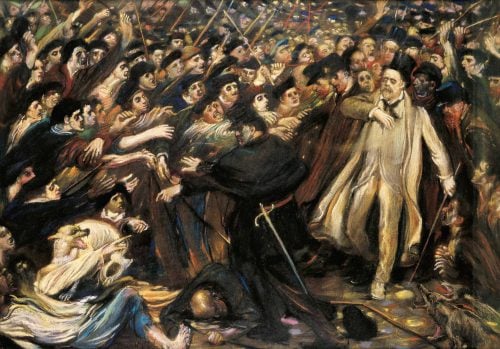
This deterioration is not only relegated to the world of visual art or music, but perhaps is most evident in our religious culture, and the relations between the state and religion. Where our cultural expressions of religion are in question, the depths of despair seem to know no bounds. Will we forsake the intellectual tradition of Maimonides for the armed horse-riders chanting “We don’t recognize the heretic state,” or the Baal Shem Tov’s endeavour to connect with both Jews and Non-Jews over a shared story, for the black and white mobs that swarm cafes on Shabbat? When did our religious expression go from introspective, to something resembling the mobs screeching at Zola (Do Israeli or Diaspora students even know who he was?) as he marched forward to defend the Jews, from inquisitive to inquisition?
Some may decry, “But Moshe, your proclamation is too maximalist! This doesn’t reflect the majority!” – and to them I say, you are quite right! My words are not meant to lose the majority of decent men and women to a lack of nuance, but rather to ring the alarm bell – these cultural butchers have become representative of the Torah that both you, and I, love and admire – they represent you in government, and as mental image both at home and abroad. The time for handwringing and howling that hilltop youth brutalizing everyone and everything in their way are not representative is over, as each day that passes, *they* become our normalized zeitgeist. That is what is at stake, and for the love of my brother, I will not mince words about it. Take a moment to ask yourselves, who is being empowered, and at the cost of whom? The scales are tipped in the favor of the loud, dangerous, and eschatologically motivated minority, and we are the cost.
Is your vision of Israel one where every Jewish institution sends our creators home with the flat, dishonest muttering of “Sorry, we don’t have the budget?” One where our musicians have their concerts canceled worldwide, authors have their books rejected by every major publisher, and our artists have not a single resource to uplift them – all to the deaf ears of politicians who’d prefer to spend their time on sloganeering and TikTok provocations? Shouldn’t our children be raised in a state where they are empowered and proud of their own culture and tradition, while also given the opportunities and tools to connect with our fellow man across the world? I don’t know about you, dear reader, but a coalition which depends on hooligans who chant racist slurs at football matches, or stab each other over bus seats, are not the ones I want deciding the education and cultural fulfillment of our children, our future.
Though bleak our days might seem, I have hope that we can course correct this week, and choose to have a future where we learn to speak to each other once again, and have substantive conversation which is coloured and spiced by a deep, meaningful cultural framework. I have hope that we won’t leave our creatives in the outbound line of Ben Gurion Airport, veiling their identity for a lousy commission or two, because they found no support at home outside of self-contained Tel Aviv enclaves and coffee shops. I have hope that the inheritance of our community and people is the opposite of illiteracy, petty violence and ignorance. I have hope, because I have seen what three years of fear and demoralization do to a population, at home and abroad. I have hope, because I know that I’ve rolled up my sleeves given my all, as have countless others, waking up early each morning for three years, and fighting for the change we so desperately need in our community.
I have hope in this, because I have no other choice but to choose, and to choose wisely.
When you go to the polls on Tuesday – which is no longer an option, but an existential imperative – and you place your vote in the ballot box, think carefully, and ask yourselves “Will this party bring forward the cultural renaissance I hope to see, or will they plunge us deeper into the abyss?”