


Middle East Forum Fellow/North Africa Risk Consultant
Tunisia Is Dying While Chasing Political Ghosts
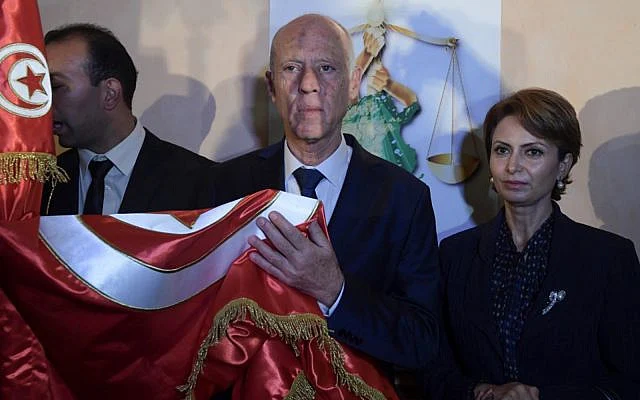
Conservative academic Kais Saied, center, flanked by his wife Ichraf Chebil, right, celebrates his victory in the Tunisian presidential election in the capital Tunis on October 13, 2019. (Fethi Belaid/AFP)
Kais Saied’s regime jails opponents, brands defunct parties as terrorists, and silences online voices, while university graduates riot for jobs and 30,000 skilled Tunisians flee the country each year. Legal theater cannot feed a collapsing nation.
In July 2026, the gap between Tunisia’s frenetic judicial activity and its crumbling economy reached a breaking point. In just 48 hours, the state moved to formally designate a crippled Islamist movement as a terrorist organization, sentenced a prominent secular lawyer to 18 years in prison, and handed lengthy jail terms to social media creators under repressive speech laws. President Kais Saied’s administration presents these actions as essential defenses of national sovereignty and public order. In reality, they increasingly serve as a distraction from a deepening fiscal and social crisis.
The decade following the 2011 revolution was marked by parliamentary paralysis, unstable coalitions, and economic drift. Ennahda, the dominant Islamist force during the transition, drew widespread anger for failing to deliver growth, tackle corruption, or secure the country’s borders. When Saied suspended parliament in July 2021 and concentrated power, many Tunisians initially welcomed the move as a necessary reset.
Yet what began as stabilization has evolved into performative legalism. On July 9, MP Fatma Mseddi introduced a draft law to classify Ennahda as a terrorist organization and ban its members from public office for a decade. The move is largely symbolic. Ennahda has been effectively dismantled since its offices were shuttered in 2023 and its leadership, including Rached Ghannouchi, imprisoned. The real purpose appears domestic. It sustains a narrative of existential threat that keeps the populist base mobilized and diverts attention from economic failure.
This judicial offensive now reaches far beyond Islamists. On July 8, a specialized court sentenced independent lawyer and former presidential candidate Samir Abdali to 18 years on terrorism and money laundering charges. Viable opposition figures such as Abir Moussi, Ayachi Zammel, and Lotfi Marraihi have been neutralized through trials or exile. Decree 54, originally justified as a tool against cybercrime, has been weaponized to sentence 18 social media creators to prison terms of up to 27 years. The message is clear: the boundary between state security and regime survival has dissolved.
Meanwhile, the real Tunisia is visible on the streets. On July 8, hundreds of university graduates, many in their thirties and forties, protested in the summer heat outside government headquarters in the Kasbah. They were not chanting ideological slogans but demanding implementation of a December 2025 employment law that promised public sector jobs for the long-term unemployed. Their frustration reflects grim realities: overall unemployment stuck at 15 percent, graduate unemployment above 24 percent, and an annual exodus of roughly 30,000 doctors, engineers, and other skilled professionals.
These human costs are compounded by macroeconomic failure. Tunisia’s standoff with the IMF over required reforms has blocked a critical 1.9 billion dollar loan, deepening isolation from global markets. Public debt exceeds 85 percent of GDP, while vital sectors like tourism and phosphates suffer from chronic underinvestment and inefficiency. European partners, focused primarily on migration control and counter-terrorism, have largely accommodated the regime rather than pressuring it toward genuine economic governance.
Tunisia now offers a cautionary lesson for the region. Centralized authoritarian control may suppress opposition in the short term, but it cannot substitute for a viable economic strategy. Security decrees and political trials may silence critics, yet they create no jobs, attract no investment, and stabilize no currency.
If the Saied administration continues prioritizing ideological ghosts over material realities, the greatest threat to its power will not come from imprisoned opponents or faded political parties, but from the growing desperation of its own citizens.