The views expressed herein are solely mine.
Turkey and Qatar: America’s Treacherous ‘Allies’
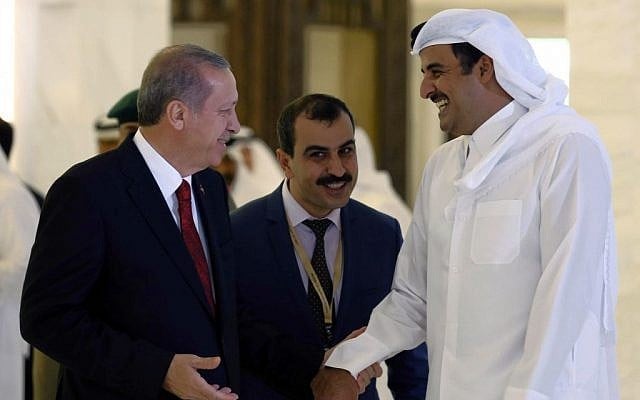
Turkey's President Recep Tayyip Erdogan and Qatar's Emir Tamim bin Hamad Al Thani speak during a ceremony in Doha, Qatar, December 2, 2015. (AP/Yasin Bulbul, Presidential Press Service, Pool/ File)
The United States and Israel are fighting enemies on two fronts—those who fire rockets, and those who smile in diplomatic corridors while helping the rocket men reload.
Turkey and Qatar, once paraded as “moderate allies,” now stand as the Middle East’s most dangerous double agents.
These two “Western allies” are arming the enemies of freedom, courting China, and sabotaging America’s new Middle East order.
For example, Qatar has quietly pivoted toward the East.
In 2024, trade with China hit $24 billion, anchored in liquefied natural gas but rapidly expanding into AI, finance, and digital infrastructure.
Beijing’s vice president even called Qatar a “strategic partner” during his most recent visit to Doha.
Translation: the Gulf’s richest gas kingdom just became another node in China’s Belt-and-Road encirclement of Western influence.
With that cover, Doha does what it has always done best—talk peace while funding terror.
A good example of this irony is that the same capital that houses U.S. Central Command also shelters Hamas’s political leadership. For years, Washington looked away, convinced that “access” to Hamas could moderate it. Instead, it legitimized it.
Hence, while Qatar speaks diplomacy in English it bankrolls jihad in Arabic.
In stark contrast, Turkey’s betrayal is even more brazen.
In 2024, Erdogan slapped a full trade embargo on Israel—worth $6.8 billion—then escalated by blocking Israeli ships and banning overflights.
In parallel, his intelligence chief rolled out the red carpet for Hamas in Istanbul, calling them “resistance fighters.”
Blatantly, this is not policy confusion; it is ideological clarity. Erdogan’s Turkey has chosen the Islamist axis over NATO solidarity.
Now, as the United States prepares a limited military presence in Damascus to monitor a post-war Israel–Syria security pact, Turkey’s role becomes the elephant in the war room.
Ankara’s forces already occupy swaths of northern Syria, and its intelligence networks are embedded across the border.
If Washington moves forward, Turkey could sabotage the entire mission—blocking air routes, intercepting intelligence, or undermining logistics. Doubtlessly, Ankara has the capability, and under Erdogan, it also has the will.
For that reason, Israel, too, must tread carefully.
Some Western diplomats have floated the idea of allowing a Turkish peacekeeping role in Gaza under the guise of “humanitarian reconstruction.” Clearly, that would be a catastrophic mistake.
A Turkish military presence in the Strip would not bring stability—it would create a bridge between Hamas in Gaza and Hamas abroad. Ankara’s ties to Hamas are deep, ideological, and operational.
Obviously, Turkish officers in Gaza would serve as political lifelines for the group, giving it external protection, intelligence access, and diplomatic legitimacy.
Beyond doubt, Israel would essentially be allowing the enemy’s patron to patrol its southern border.
Qatar’s duplicity makes this web even denser.
As it deepens cooperation with China, Doha gains the leverage to shape or sabotage any Western-led security pact.
Therefore, a U.S. or Israeli stabilization mission in Syria could be quietly undercut by Qatari financing and influence campaigns, much as its media empire has done for decades.
As we all know, when Doha talks about “funding Gaza’s reconstruction,” they really mean rebranding Hamas’s infrastructure, not dismantling it.
The same dangers loom over Lebanon, where Washington may deploy troops to monitor a ceasefire between Israel and Hezbollah.
Turkish and Qatari narratives—amplified through social media and Arabic-language media networks—already cast the U.S. as “Israel’s colonial enforcer.”
Under those conditions, American soldiers would be targets of ideological warfare before they even land.
At the same time, the coalition to eradicate ISIS is now at risk. Turkey’s obsession with crushing Kurdish forces—America’s most reliable partners against ISIS—has repeatedly disrupted anti-terror operations in northern Syria.
Henceforth, if Qatar uses its China-backed diplomacy to lure Arab states away from the coalition, the result will be paralysis. In turn, the U.S. could soon find itself fighting ISIS 2.0 in a vacuum created by its own so-called allies.
In my opinion, this is not chaos—it is coordination. Ankara wants to resurrect Ottoman influence, Doha wants to mediate its way to power, and Beijing wants to replace Washington as the region’s gatekeeper. Each feeds the other’s ambitions. Together, they are rewriting the Middle East map while the U.S. still pretends they are “partners.”
The Trump administration keeps calling Qatar “a major non-NATO ally” and Turkey “a reliable partner.”
Nevertheless, those labels are now absurd because allies do not bankroll jihadists, threaten Israel’s economy, or align with Communist China.
As a result, the U.S. is being squeezed from both sides—strategically by China, ideologically by Islamism, and economically by its own energy-dependent diplomacy.
If America truly intends to oversee new peace arrangements in Damascus and Lebanon, it must first clean house.
Any cooperation with Turkey must come with consequences: cut relations with Hamas, reopen trade with Israel, end the embargoes, or lose U.S. defense privileges.
Simultaneously, Qatar should be pushed to accept the aforementioned conditions on Turkey, and also be duty-bound to choose between Chinese patronage and Western partnership because it cannot have both.
This is no time for polite diplomacy.
Erdogan’s praise of Hamas should trigger sanctions, not statements.
Qatar’s collaboration with Beijing should lead to investigations, not invitations to train its pilots in Idaho and to carry out military drills between Washington and Doha.
Two decades ago, Turkey and Qatar were hailed as pillars of America’s Middle East strategy.
Today, they are the architects of a parallel order called the Muslim Brotherhood—one that shields Hamas, empowers Beijing, threatens U.S. stabilization missions in Syria and Lebanon, and risks reigniting ISIS.
For that very reason, if Washington and Jerusalem keep pretending these are allies, they will soon find themselves defending the region not from terror—but from treachery.
Related Topics
- China
- Donald Trump
- Hamas
- IDF
- IS Islamic State
- Islam
- Israel At War
- Israel-China Relations
- Israel-US Relations
- Israeli Foreign Policy
- Jewish-Muslim Relations
- Lebanon
- Middle East
- Muslim-Jewish Dialogue
- Peace Process
- Peace to Prosperity
- Qatar
- Syria
- Terrorism
- The Arab World
- The Kurds
- Trump Peace Plan
- Turkey
Related Posts