
Founder & Principal, Line of State
Turkey Exploits Ambiguity. Qatar Funds It. Morocco Operates Within It – At a Cost.
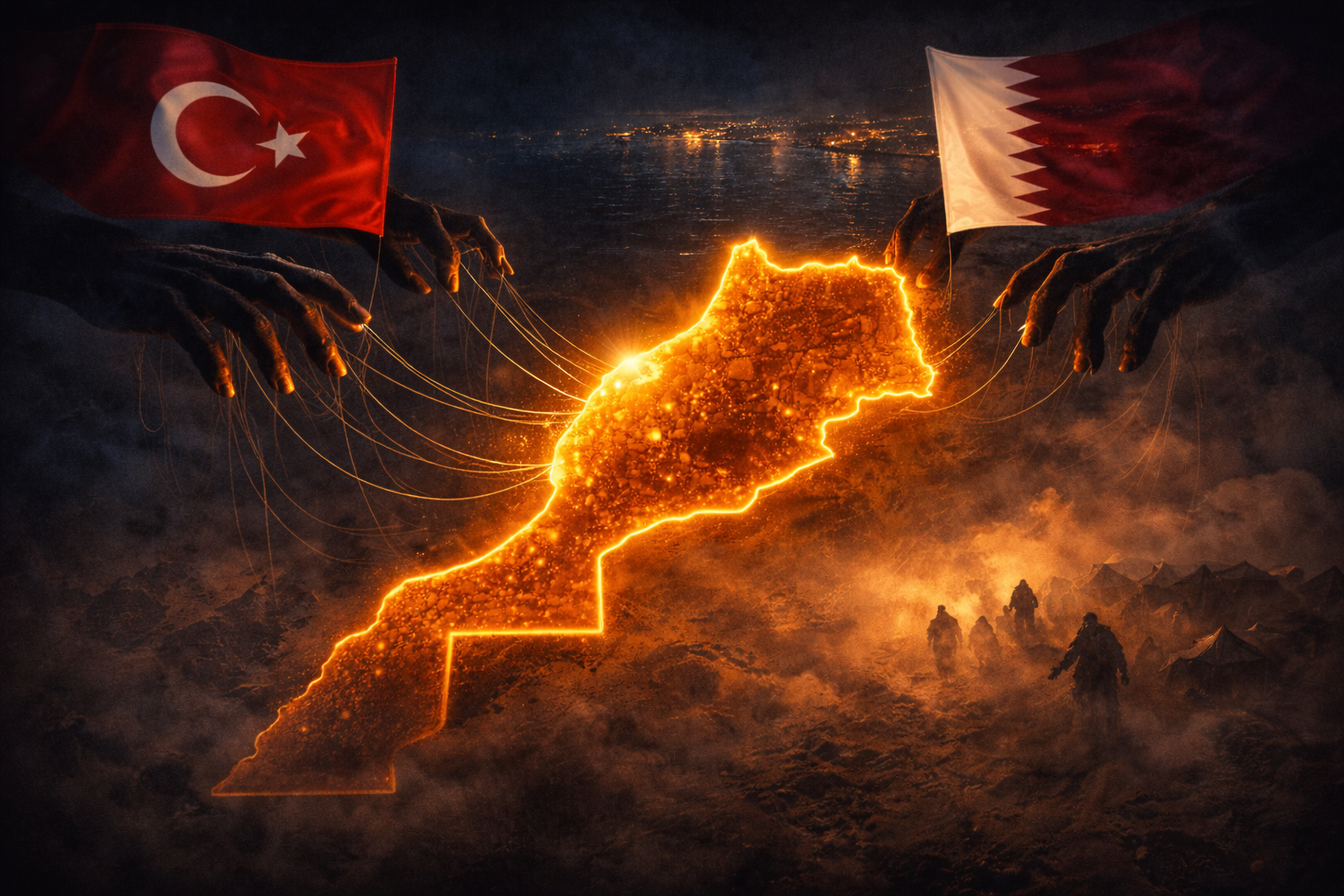
This is not a crisis. It is a mechanism. Invisible flows, influence without signature, decisions that are not made where they appear. When control becomes fragmented, other forms of power take hold. Discreet, persistent, operational. What acts here does not impose itself. It infiltrates, connects, stabilises. In this space, whoever holds, holds alone. Illustration: Shay Gal. Free to use, with attribution to the author.
This is not a crisis. It is a mechanism. Invisible flows. Influence without signature. Decisions are not made where they appear. When control becomes fragmented, other forms of power take hold. Discreet. Persistent. Operational. What operates here does not impose itself. It infiltrates, connects, stabilizes. In this space, whoever holds, holds alone. Resolution 2797 did not change the system. It exposed it.
When the UN Security Council adopted Resolution 2797 in October 2025, it merely formalized what had already crystallized. US recognition of Moroccan sovereignty and European alignment with the autonomy plan had already reframed the file. The resolution recentered the file on that framework, imposing a binary choice. Rabat moved. Algiers refused. Ankara and Doha saw their room narrow.
Six months later, alignment was no longer implicit. On 16 April 2026, Kaja Kallas went to Rabat and anchored a strategic partnership in autonomy under Moroccan sovereignty. Drift became doctrine.
The system, however, did not change.
Western Sahara remains on the UN list of Non-Self-Governing Territories. The gap between political momentum and legal status forms a grey zone of contestation. MINURSO still lacks a human rights monitoring mandate, a structural deficiency opposed by Morocco and protected by France.
European law sharpens the contradiction. In 2024, the EU’s highest court invalidated key EU-Morocco trade and fisheries agreements as applied to Western Sahara. Diplomacy and law diverged. Risk became embedded in the system.
That unresolved gap is where the shadow architecture operates.
Ankara: Deterrence, Dependency, Influence
Ankara’s posture towards Morocco rests on ambiguity. Turkey sells Bayraktar TB2s, trains operators, and opened an Atlas Defense facility in Rabat, while refusing to recognize Moroccan sovereignty. The Rabat site is no longer a simple node. It is becoming a production base, with recruitment already underway in early 2026. Turkey embeds itself in production chains while withholding political recognition.
Morocco’s informational dependency is real. Baykar’s systems create a digital umbilical cord of maintenance and telemetry routed through Turkish networks. That dependency is tied to the orbit of the MIT, Turkey’s intelligence service. It strengthens deterrence while binding Rabat to a supplier whose posture evolves. Morocco thus pays the ambiguity tax in the form of dependency.
Dependency does not stop at hardware.
Influence operates through coordinated digital ecosystems. Relay portals and narrative constellations shape perception and complicate attribution. These are not separate vectors. They form a single structure.
Morocco has begun to reduce these dependencies by blocking certain data link modules and demanding the localization of production, software, and cybersecurity. This shows that autonomy rests on procurement governed by the state’s military and intelligence architecture.
Turkey’s economic ties with Algeria reinforce Rabat’s caution. They anchor Ankara’s interest in preserving ambiguity rather than resolving it, across both physical and informational theaters. Morocco’s acquisition of TB2s in 2021 improved tactical awareness, but it also embedded foreign code and data flows, giving the supplier visibility into operations in the absence of localization. This is a structural vulnerability: not just eyes in the sky, but nodes inside a system of influence.
Since 2019, senior Polisario figures have appeared in forums aligned with the AKP and in affiliated policy environments in Turkey. This is not accidental. These frameworks expose participants to operational discipline and narrative control consistent with Turkish intelligence environments, with patterns pointing to proximity to the MIT.
In parallel, Turkish language media platforms and portals registered in Europe operate as nodes of amplification and laundering. They recycle Polisario-aligned content and inject it into Arabic, French, and European information spaces, forming micro-ecosystems that test narrative penetration while preserving deniability.
This is not communication. It is operational influence below the threshold of attribution.
The Brotherhood Vector of Ankara and Doha
Ankara and Doha invested in reshaping Morocco’s political landscape through the PJD, Morocco’s Islamist party. The makhzen allowed the party to lead successive governments from 2011 to 2021, while retaining control over the decisive levers of power: foreign policy, intelligence, internal security, and religious authority.
When this internal channel failed to produce strategic leverage, Ankara and Doha shifted to external hybrid instruments: Turkish media ecosystems, religious networks funded by Qatar across the Sahel, proxy development activity in governance vacuums such as Tindouf, and influence routed through Brussels via intermediary structures.
This is not formal coordination. It is convergence: financing, messaging platforms, ideological alignment, and intermediary networks reinforcing one another across multiple theaters.
The makhzen contained the Islamist channel at the institutional level. In parallel, a deeper layer of narrative capacity took shape, independent of formal political access.
Political Islam was contained within Morocco’s formal system. The external architecture, however, was not dismantled. It adapted, distributed itself across multiple geographies, anchored itself in non-state structures, and became increasingly digitized.
The channel closed. The structure remained.
Brussels: A Distinct Arena of Influence
Under humanitarian cover, Doha built influence networks from Brussels to Tindouf. When Qatargate broke, investigators found that Moroccan diplomatic interests had passed through the same intermediaries – Panzeri, Giorgi, and several MEPs – who allegedly sold access and influence to multiple foreign actors, giving rise to what became known as Moroccogate.
Doha used these channels to soften labour rights resolutions ahead of the 2022 World Cup, ease visa regimes, and secure aviation agreements. Rabat used the same circuits to stabilize language on Western Sahara and preserve EU-Morocco trade continuity. Europe mistook shared intermediaries for shared intent. It was a mistake.
These networks migrated into the digital space: multilingual, platform-agnostic, scalable without visibility or friction.
Ambassador Abderrahim Atmoun operated at the junction between diplomacy and this informal marketplace. Morocco’s external intelligence services did not design this network, but its diplomatic track intersected with it. The result was access without control.
Morocco responded by closing improvised channels and professionalising its external influence posture. The correction was structural: separating diplomatic signaling from intelligence functions and reimposing discipline on the conduct of influence. The broader architecture endured, continuing to operate in the grey zone where access, capital, and plausible deniability intersect.
Tora Bora of the Sahel
East of Morocco, the Tindouf camps remain a blind spot. Around 173,000 people depend on UN and EU assistance in territory where Algerian sovereignty is claimed but not exercised. UN and OCHA reports document the diversion of humanitarian aid into regional markets.
Into this vacuum flow projects by Qatar Charity and the Qatar Fund for Development: clinics, wells, schools. The humanitarian façade does not remove the vacuum. It conceals it.
Where sovereignty is not exercised, funding is never neutral. It redistributes access and influence across networks rooted in the Sahel.
Tindouf functions as a permissive hub for cross-border networks, with limited control. Flows follow the routes of aid. Visibility does not.
Taken separately, these instruments appear benign. Aggregated, they structure the environment.
In practice, Tindouf functions as a Tora Bora of the Sahel: sovereignty is nominal, access is operational, and control is fragmented. External actors do not need to penetrate it. They use it. The site lies at the edge of Europe’s security perimeter.
International pressure in early 2026 exposed the fragility of governance in the camps, even as external funding flows continue to feed the same vacuum.
While others spoke, Rabat acted. Morocco dismantled cells linked to Islamic State with Spain, intercepted thousands of migrants en route to the Canary Islands, and stabilised Europe’s Mediterranean front. Fewer attacks. Fewer arrivals. More intelligence. These are results, not statements.
In 2025, Moroccan services foiled several Sahel-based plots targeting Europe. This resilience rests on Morocco’s intelligence architecture, notably the DGST and DGED, the Kingdom’s intelligence services, as well as the BCIJ, the Central Bureau of Judicial Investigations. These are institutional outputs. Morocco also strengthened its fight against disinformation by developing joint analytical capabilities with European partners to trace hostile narratives back to their source.
This stabilization is externalized to Morocco: operationally essential, politically neglected, and financially under compensated.
Algiers will not change course. Turkey exploits ambiguity, Qatar finances it, Algeria entrenches it, and Morocco contains the effects while remaining exposed.
Pressure is created. Then managed.
This is not a frozen conflict. It is an operational structure.
Europe is not observing it. It is operating within it. Its choices will shape the routes of pressure and dependency.
Ambiguity is no longer a principle in the Maghreb. It is the model.
And the bill has already arrived.
–
Related Topics
Related Posts