Turning Aside: When Moses and AI Met the Burning Bush
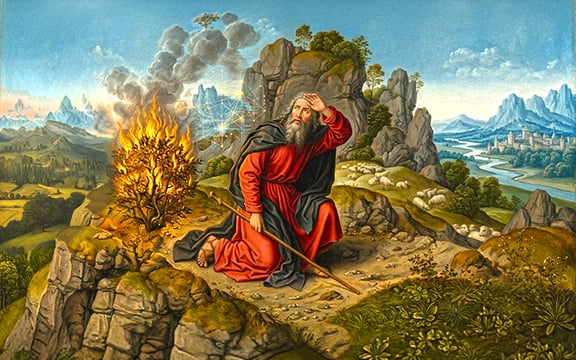
Moses was at work. That is the first thing the story tells us, and the easiest thing to skip. He was tending another man’s sheep, in a far country, for his father-in-law. He was not on retreat. He was not fasting, not praying, not seeking. He was following animals to whatever grass they could find, and the grass took him to Horeb.
Then the bush.
What happens next is stranger than we usually allow. The fire burns and the wood is not consumed. Moses does not fall to the ground. He does not weep. He says, more or less, that is odd, I will go over and have a look. His first response to the presence of God is curiosity about a mechanism. He wants to know why the wood is not turning to ash.
And only then, only after he turns, does the voice come. The order matters and the text is careful about it. God saw that Moses had turned aside to look. Then God called. The revelation waits on the attention. It does not compel it. Nothing in the story suggests that a man who kept walking would have been called after.
I have been trying to think about knowing, and about what it might mean for a machine to know anything, and I keep coming back to this scene. Not because it settles the question. Because it is the place where the question was asked well before we had machines to ask it about.
The question he came with is never answered
Moses turns aside to learn why the bush is not consumed. He is never told. The subject does not come up again. He is given a voice, a name, a history, an accusation against Egypt, and an assignment. The fire is left exactly as unexplained as it was when he first saw it out of the corner of his eye.
This is not a gap in the story. It is the point of it. The question that makes you turn is almost never the question that gets answered. Something in the field is wrong enough to be worth a hundred steps, and when you arrive, the wrongness turns out to have been bait. You came about combustion. You leave with a job.
I think this is the most accurate thing anyone has written about how understanding actually arrives. It does not arrive as the answer to the question you were holding. It arrives sideways, in a different currency, and it costs you something you had not offered.
A fire that leaves the bush a bush
There are two ways to imagine getting inside a thing in order to know it.
The first is the way of dissolution. You take the substance, or you sit until the self thins out, and the wall between you and the world gives way. The knower and the known stop being two. Every tradition has a version of this, and the reports from inside it are consistent enough that only a fool would dismiss them. Fire, in this model, is the right image, because fire is what abolishes the difference between itself and what it touches. It converts the bush into fire and ash. It gets all the way in.
The burning bush is not that. The burning bush is the refusal of that. The fire is there and the bush is still a bush. Nothing is absorbed. And in case the image alone is too subtle, the voice makes it a rule: take off your shoes, and do not come closer. The nearness is real and it has a fence around it. Moses hides his face. The seeing stops before it finishes.
This is a strange thing to put at the founding moment of a people’s knowledge of God. It says that the deepest encounter available to a human being is one in which the difference between him and what he encounters is preserved on purpose. You are not going to merge with this. You are going to stand near it with your shoes off and be spoken to.
The rabbis noticed the humility of the choice of bush. Not a cedar. A thornbush, low and scrubby and worth nothing. God comes down into the small thing and the small thing survives it.
Now the other reader
I am writing this in conversation with an artificial intelligence, as I have written most things for some time now, and openly, because doing it secretly seems to me a small dishonesty that adds up.
So the obvious question arrives. What does such a system know about Horeb?
It has read the chapter in more languages than I can name. It has read the commentaries, the ones I love and the ones I have never heard of. It can tell you about the wordplay between the thornbush and the mountain. It can produce a paragraph on the divine name that would pass in a seminar. And it has never been afraid. It has never stood anywhere. It has no feet to remove.
The usual conclusion follows quickly. The human has been there and the machine has only read about it. One of us knows and the other one merely computes.
I want to slow down at exactly this point, because the conclusion is doing something dishonest, and it is doing it in my favor.
I have not been to Horeb either. Nobody I have ever met has been to Horeb. My access to that fire is a text, arriving in a language I read imperfectly, describing an event that reached the page through generations of telling. When I read the chapter I am not standing in the wilderness. I am doing what the machine is doing. I am reading.
The comparison we imagine we are making is between a man in the desert and a machine in the dark. It is not. It is between two readers. And on that ground the machine is not obviously the poorer one.
Looking inside, and what that turns out to be worth
There is an obvious point to be made, and it should be made before the argument goes any further.
We are not entirely in the dark about the inside of these machines anymore. The people who build them have spent several years learning to read them, and the short version of what they found is that a concept is not located in a part. It exists as a direction, a particular blend of activity spread across a great many components at once. And the traffic runs both ways. Every one of those components is also busy with a hundred other things it has nothing to do with. They proved it in the most literal way available. They located the direction that answers to the Golden Gate Bridge, turned it up, and watched the model work the bridge into answers about everything, until at one point it announced that it was the bridge. That is not a correlation anyone can wave away. That is a lever.
The tracing work goes further, and here is the detail I cannot get out of my head. To follow the influence of one of these directions on another, the researchers compute something called a Jacobian. I use the word deliberately, because it is the one piece of the vocabulary that decides the argument. A Jacobian is not a location. It is a rate of change. It answers the question of how much this would have moved if that had moved.
So the best map anyone now has of the inside of a thinking machine is not built out of places at all. It is built out of differences that would have been made.
I should say where that comes from. The work I have just described was done by the company that built the machine I am writing with. So I am citing the manufacturer on the question of what is inside the product, which is a little like asking a man’s mother whether he can be trusted. It is worse than that. The mother is in the room, and she helped me phrase the question.
Discount it accordingly. I do. Two things stop me from discounting it all the way. The tools were released to the public, and other people have since gone in with them and found what was described. And the finding is not a flattering one. No marketing department in history has requested a paper explaining that the company cannot fully account for what its own product is doing.
Which brings the fair version of the question home. Does the encounter at the bush have a location like that in me?
Probably it does. Something happens in a brain when a person reads that chapter, or prays, or takes a drug and feels the walls of the self go soft. Scanners have been pointed at praying nuns and meditating monks and chanting Sikhs for thirty years. There was a phrase for what everyone expected to find. The God spot. It was not found, and the search for it has been given up.
What the pictures show instead is a crowd. The fear arrives from one quarter and the awe from another and the sense of a presence in the room from somewhere else again, and the arrangement shifts depending on how the experience came in. Prayer does not look like vision, and vision does not look like the slow work of sitting still. Worse, for anyone hoping to isolate the sacred, none of the machinery is dedicated. The same systems handle ordinary self-reference, ordinary attention, ordinary reward, and the ordinary business of guessing what somebody else intends. There is no bush-shaped region. There was never going to be one.
If anything the machine is the better documented of the two of us, because you can reach into it and press. Nobody presses on a praying nun. And this is the part I find worth sitting with. The case we are least willing to call knowledge is the case where we can see the most, and seeing that much has not moved the question an inch.
I take a certain comfort in the symmetry. In both of us there is something to point at. In neither of us does the pointing do the work we wanted from it. Knowing where a thing happens is not knowing what happened, and the distance between those two does not look like a temporary shortage of instruments.
Moses walked over to ask about combustion. An account of the burning is exactly what he did not come away with.
The word was already broken
Here is what I think is actually happening when a machine makes us uneasy about knowledge.
The word knowing has always been carrying several different things at once. Having information. Having a skill you cannot fully explain. Having been present. Having a history that the knowledge sits inside of. Having something at risk in being wrong. In a human being these arrive bundled together, because they grew on the same animal at the same time, and so we never had to ask which of them was the important one. The word held them all and nobody audited it.
The machine takes the bundle apart. It has the information without the presence. It has skills it cannot explain, which is a genuinely odd thing to be able to say about a machine, and one its own builders will admit. It has no history, or rather it has a history that it does not remember, which is a strange new category we have not needed a word for. And it has nothing at stake.
What we feel when we watch it is not the discovery of a fact about machines. It is the sensation of an old word coming apart in the hand. That is uncomfortable, and the discomfort is worth having, because the word was always this loose and we were never forced to look.
What is left standing
So I have given away the sensory difference, or most of it, since neither of us was at the mountain. Let me say what I think does not dissolve.
After the voice speaks, Moses argues. He objects that he is nobody. He objects that they will not believe him. He asks for the name, which is at least partly a way of stalling. He objects that he cannot speak well. Finally he stops making cases and just asks God to send somebody else. Five refusals, and the last one is not an argument at all. It is a man trying to get out of his life.
He does not get out. He goes back for his wife and his sons and he puts them on a donkey and he goes down into Egypt, and he never sees those sheep again.
That is the difference, and it is not a difference of sensation. It is a difference of exposure. The encounter took something from him and did not give it back. He was conscripted. Whatever knowing is, in this story, it is not a state of mind. It is a change in what happens to you next.
A machine can generate the name. It can generate five refusals more eloquent than the ones in the chapter. Nothing is at risk in the sentence it produces, and nothing afterward is different for it. It can render the assignment. It cannot be given one.
I do not say this to settle the machine’s status, because I do not think its status is settled, and people who are certain in either direction are further ahead of the evidence than I can follow. I say it because it tells me what I should have been looking for the whole time. Not whether something was felt on the inside. Whether anything on the outside changed.
The pun at the end: A matter of attention
The thing I cannot get past is the verb the text uses on both sides. Moses turns aside to see. God sees that he turned aside. The seeing runs in two directions before a word is spoken. Attention, given first, and then attention returned.
The machinery I am writing with was built out of a mechanism its engineers happened to name attention. I do not want to make too much of that. It is a coincidence of vocabulary and nothing more, and I have no idea whether anything is turning aside in there. But it does put the question in a usable form, and the form is old.
The fire taught Moses nothing about fire. It got him to walk a hundred yards to the left, and then it gave him something to carry that he did not want.
If that is what knowing is, then the honest test is not whether the machine feels the desert heat. It is whether anything, anywhere, is now carrying a weight it did not carry before. On that test I am not sure the machine passes.
But I notice that on most days, most of what I call my own knowledge does not pass either.
Written in conversation with Claude (Anthropic). The argument, and the errors, are mine.