
Executive Director, World Jewish Relief USA
Featured Post
When Pete Seeger met Reb Zalman
An unforgettable encounter between two spiritual giants before Shavuot gave me a timeless lesson in compassion, curiosity, and human dignity
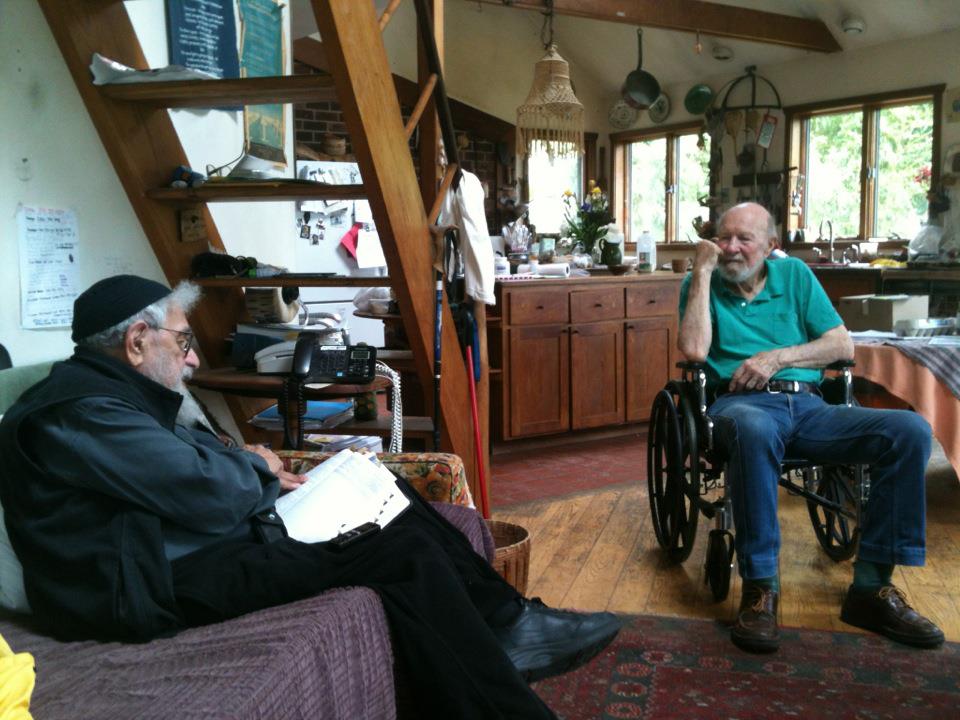
Reb Zalman Schachter-Shalomi and Pete Seeger, seated in his wife Toshi’s wheelchair, studying the words of Ecclesiastes together in Pete’s living room in May 2012.
Photo credit: David Weisberg
There are moments that feel so surreal that, even years later, you find yourself recalling them almost in disbelief, grateful that you have photos to prove – even to yourself – that they really happened.
One of those moments for me involved Pete Seeger, Reb Zalman Schachter-Shalomi, a ladder leading to Pete’s loft, and a Bible opened to the Book of Ecclesiastes.
I was so blessed to have developed a friendship with Pete, the godfather of American folk music and ambassador of songs from throughout the globe, a person whose humility somehow always exceeded his legendary status. To most of the world, he was one of the great figures of American folk music and activism, the voice behind songs that helped drive movements for peace, labor rights, civil rights, and social justice. But in person, Pete was simply a deeply curious and deeply decent human being. There were times that I would go to visit him at his home, and he would be out chopping wood…in his late eighties.
Around that same time, I was preparing to spend Shavuot at a retreat with Reb Zalman Schachter-Shalomi, the founder of the Jewish Renewal movement and one of the great spiritual teachers of modern Judaism. Zalman possessed that rare ability to make Judaism feel simultaneously ancient and radically alive. He approached Torah not as something frozen in time, but as an ongoing conversation between generations, cultures, and souls.
At some point before the retreat, I called Reb Zalman and asked whether he had ever met Pete Seeger.
“No,” he immediately replied, “but I would love to.”
And so, in May of 2012, at ages 93 and 87 respectively, I was able to introduce Pete and Zalman for the very first time, at Pete’s home overlooking the Hudson River in Beacon, New York.
I should note that I had a powerful spiritual experience when I went to see the Bob Dylan biopic, A Complete Unknown, at the theatre, as one scene portrayed Dylan going to Pete’s house, a perfect replica of that very same house that Pete had built himself. While I’d visited Pete many times at that home, it was never with him as the spry young man so well portrayed by Edward Norton in the film but as the still spry octogenarian that I came to know.
In almost his first words of greeting, Pete asked Zalman: “So what did the Jews think of my taking the words of Ecclesiastes and putting them to music?” He was referring, of course, to “Turn, Turn, Turn.”
He added, “You know I changed some of the words?”
Zalman’s eyes lit up.
“Oh, really? What did you change?”
Pete pointed upward toward his loft.
“David, can you grab my Bible?”
So there I was, climbing up to Pete’s loft to retrieve his Bible. And then, Pete and Reb Zalman sat together in Pete’s living room reviewing the lyrics of “Turn, Turn, Turn” against the original text of Ecclesiastes.
Even now, it sounds like historical fiction.
What I remember most vividly, though, was not the text study itself. It was the joy. The delight both of these world-changers took in the conversation. The sense that ancient wisdom was not something fragile to be preserved behind glass, but something alive enough to keep entering into dialogue with the modern world.
I think about that moment often, particularly as Shavuot approaches.
Shavuot commemorates revelation at Sinai, the moment Torah entered Jewish consciousness. But Judaism has never really understood revelation as static. Torah survives because each generation continues wrestling with it, arguing with it, reinterpreting it, and carrying it into entirely new realities.
Pete Seeger understood something profound about Ecclesiastes. The enduring power of those verses lies partly in their insistence that human life unfolds in seasons.
“A time to break down, and a time to build up.”
“A time to weep, and a time to laugh.”
“A time of war, and a time of peace.”
The older I get, the more those words stop feeling merely poetic.
Over the past months, through my work with World Jewish Relief USA, I have spent much time thinking about the vastly different seasons human beings can inhabit simultaneously.
In Ukraine, I met elderly residents living through a fourth year of war amidst a brutal winter, some huddling in hallways during air alerts because they can no longer safely reach shelters. In Mozambique, World Jewish Relief is responding to a cholera outbreak affecting communities already living precariously close to the edge. In the north of Israel, we are helping to build trauma-resilient schools still struggling to process the aftermath of October 7 and everything that has followed, while in Gaza, we are supporting the construction of long-term sustainable shelters for innocent victims of a tragic conflict.
One thing humanitarian work teaches you very quickly is that history never unfolds evenly.
At any given moment, somewhere in the world, there are people rebuilding shattered homes while others are fleeing theirs. Some are mourning. Some are surviving. Some are beginning again. Some are simply trying to hold onto dignity long enough to make it through another week.
“A time to gain, a time to lose.”
We live in an age where suffering can become background noise with astonishing speed. Headlines move on long before people’s lives do, leaving us feeling sad but often helpless. Public attention shifts. Algorithms refresh. But human beings continue living inside those realities long after the world has emotionally turned elsewhere.
That is part of what Shavuot asks of us.
To remain awake.
There is a tradition on Shavuot of studying deep into the night. To remain spiritually and morally awake in a distracted world requires intention. It requires resisting numbness. It requires continuing to see humanity, not nameless and faceless masses, but individual people with differing identities, narratives, challenges, dreams, and stories.
Pete believed music could help people recognize one another’s humanity more fully. Zalman believed spirituality should expand the boundaries of the heart rather than narrow them. And Judaism, at its best, insists that revelation is not merely something that happened once atop a mountain thousands of years ago.
Revelation continues whenever we allow ourselves to truly encounter others, just as Pete and Zalman did 14 years ago.
Whenever we refuse indifference.
Whenever we choose compassion over cynicism.
Whenever we understand that another person’s suffering is not disconnected from our own humanity.
Whenever we realize that we are not helpless, that if each of us carries a basket we can move nations.
That afternoon in Pete Seeger’s living room was filled with laughter, music, curiosity, and conversation. But looking back, I think what moved me most was witnessing two wise elders still so open to wonder.
Still listening.
Still learning from one another.
Still searching for wisdom inside ancient words.
Perhaps that is the enduring challenge of Shavuot. Not whether revelation once happened. But whether we are still capable of hearing it now, knowing that when each of us commits to making impact we can change the world together.
And being empowered by the words that Pete added to those of Ecclesiastes…
“…I swear it’s not too late.”
Related Topics
Related Posts