A Jew from Texas, who knew?
Two Months in the Life of My Jewish Boston
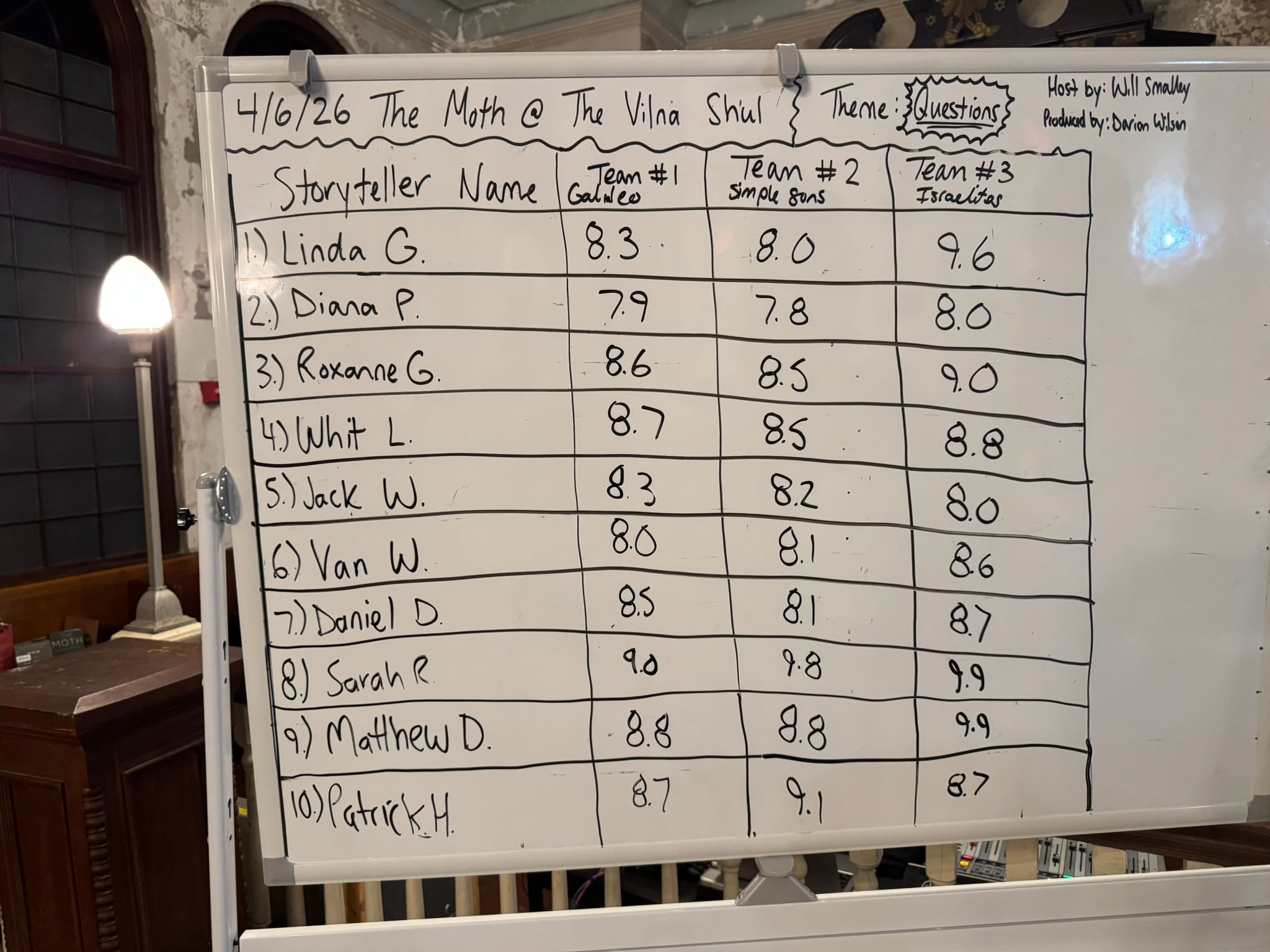
The Moth scoreboard at the Vilna Shul.
When I moved to Brooklyn in 1980 after graduating from Princeton University, I joked, “I feel like I made aliyah.” Shuls, learning programs, the Upper West Side and even the long-gone Jewish Singles Datephone made the place magical for anybody interested in Jewish engagement.
Then, 46 years later, I moved from the New York suburbs to Reading, a town in the North Shore of Boston’s suburbs. I started all over again scoping out Jewish life in a new town.
I am gradually getting the lay of the new land. During year one in Boston, I found a rewarding amount of Jewish life, and not just in the Jewish neighborhoods of Brookline and Newton. One great advantage: Compared to New York, Boston is a compact area and its public transit system makes most venues more accessible than what I experienced getting from the Northern Westchester suburbs to NYC, when I needed 75 minutes just to reach Grand Central Terminal before slogging by bus or subway anyplace else.
One constant from the beginning has been my Shabbat attendance at Chabad of Wakefield, following up on my decade of involvement with Chabad of Bedford, NY. That bridge of spiritual familiarity greatly smoothed the transition from one state to another. I immediately had a home base.
Over just the past two post-blizzard months, I enjoyed an epic journey through Jewish Boston. Ports of call were:
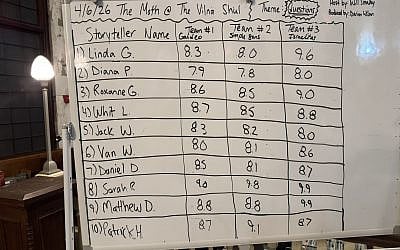
April 6: The Moth StorySLAM at the Vilna Shul. I had long wanted to perform at a Moth StorySLAM event, and even attended a training session for aspiring speakers. I finally memorized a piece on the topic of “Questions”—performers cannot use notes or props—and drilled relentlessly. Performers are chosen at random by a host pulling names from a bag. I filled out the entrance form at the Vilna Shul and hoped for the best. And that happened! I was the sixth performer. Standing on the bimah at the center of the L-shaped shul, I concentrated hard on the script part as it unspooled from memory. The judges gave me middle-of-the-pack scores, not bad for a Moth hatchling. I didn’t advance to the next round of Moth storytelling, but I can always say I hit the big stage at least once. I ordered the high-quality audio and video as proof. I prepared this piece for another StorySLAM on the theme of “I Got It From My Mama” a few weeks later, and while I didn’t get selected from the magic bag, I’ve got the piece set in my memory banks for other opportunities.
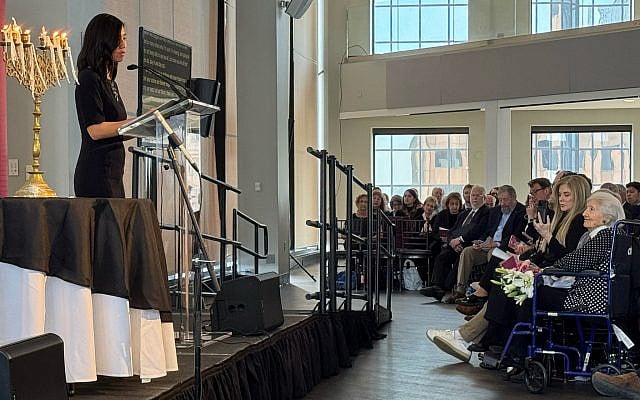
April 10: Yom HaShoah Holocaust Remembrance Day, an event organized by Jewish Community Relations Council of Greater Boston. Boston Mayor Michelle Wu spoke, with detailed testimony from Czech survivor Magda Bader.
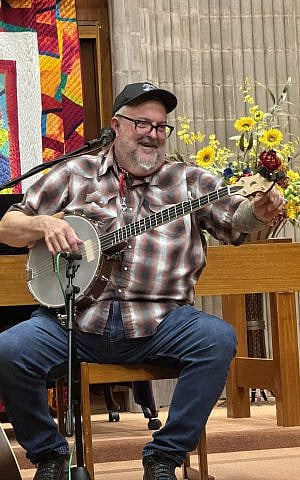
April 15: Enjoying a performance by “Jew of Oklahoma” Mark Rubin at the Boston Synagogue. Being from South Texas myself, I felt regional and musical connections with Rubin, an Oklahoma native who honed his musical chops in Austin and is now based in New Orleans. His swing up to the Boston Synagogue gave me a chance to hear him in person. His solo set combined great musicality on guitar and banjo with reflections on the hard road of a Southern Jew in the music industry and the Bible Belt, with songs sharply commenting on political issues, such as “(Don’t Be) A Good German,” “Nobody’s Pig Foot” and “Epstein Jailhouse Blues.” I liked his strong sense of Jewish identity and awareness of Jewish history, which informs much of his music and stories, such as the grim case of Leo Frank, lynched in Georgia in 1915. I’ll keep following his Jewish journey.
April 19: Jewish Film Festival at the Museum of Fine Arts to see “Ada: My Mother the Architect.” The documentary is about acclaimed Israeli architect Ada Karmi Melamede and was directed by her daughter, former architect and film maker Yael Melamede. I hadn’t heard of either, so this exploration of careers and their mother-daughter relationship was a revelation. Ada is best known for co-designing the Supreme Court building in Jerusalem with her brother, the late Ram Karmi.
May 8: Shabbat dinner at Chabad of Wakefield, where Rabbi Sruly Brook invited me to talk about my Jewish background, something I’ve done in my open mic activities, so he asked for 5-10 minutes about my meandering path from Mission, Texas, on the border with Mexico, to the Northeast, and increasing knowledge of Judaism. Of course I accepted the offer—as an amateur badchen, how could I refuse?—and had the whole story in my head, ready to go. (I also take part in R’ Brook’s weekly Tanya class and have already integrated the concepts of the Godly soul and the animal soul into my way of understanding the world.)
May 20: Shadowing a high school class and docent on a tour of the New England Holocaust Memorial; I’ve trained as a docent to lead tours of the memorial, near Boston’s City Hall. Given my enjoyment of public speaking, this sounded like an ideal combination of my Jewish and performance interests. I did two training sessions and studied an extensive handbook on the Holocaust and the history of the memorial. Next stop: taking the mic and doing the tour.
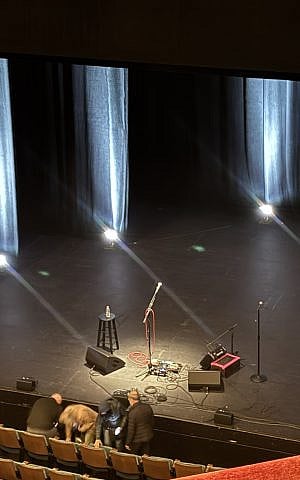
May 30: Seeing the rollicking performance of comic and Brookline native Alex Edelman. I got tickets to see Alex Edelman as soon as I learned he was performing in Boston, where he grew up in the suburb of Brookline. His 2024 special on HBO Max, “Just For Us,” sold me on a comic vision deeply influenced by Jewish learning and experience—including extensive time in Israel. On a drizzly Boston evening, my partner Naomi and I settled into our seats in the steep upper balcony at Emerson College’s Colonial Theatre. Edelman’s timing and storytelling had the audience shrieking with laughter. Edelman is a comedian open to adventures, and his story threads involved NASCAR racing in Talladega, Alabama, a private tour of Graceland in Memphis (and a Talmudic-level debate with Dee Dee the Docent over whether Elvis Presley should be considered a Jew) and attendance at a Christian music awards banquet where he sat at a table with singers Amy Grant and Jelly Roll. As soon as the Emerson event ended I started jotting notes on parts I remembered, among them:
- “I don’t even believe in the God I believe in.”
- A good old boy at Talladega asked him, “You get messages on your phone when a poet dies?”
- On avoiding therapy: “Why should I pay money to somebody to hear me talk? That’s the only thing I can do.”
And these aren’t even my favorite quotes! I don’t want to give too much away or quote a bit involving American Sign Language signs for Yiddish words. I’ll eagerly await Edelman’s next TV special to relive all the highlights. You should, too.
Jewish Boston continues to delight me with its range of activities. I’m glad I moved here and started weaving myself into its Judaic fabric.
Related Topics
Related Posts