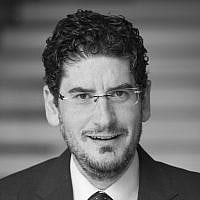
Morielle is the founder of Mile Advisory and the CEO of the ADIR Challenge Foundation, innovating the combat of antisemitism & hate.
Two Years of Building What Didn’t Exist
I just finished writing ADIR’s first impact report. For someone whose ADD is both an ace card and, at times, genuinely hard to live with for me and those around me, completing a 26-page document that required synthesizing two years of work into a coherent narrative is a moment worth marking.
But the report itself isn’t the story. The story is what it took to get here.
Twenty-four months ago, I founded ADIR in the weeks after burying my nephew Adir at the Nova Festival. I knew we needed to build something. Technology and talent to fight antisemitism in ways that didn’t yet exist. What I didn’t know was how many times I’d sit in a room and say, “I’m not sure what the right answer is, but let’s try it.”
That sentence became a kind of operating principle.
There’s a version of leadership writing that presents the founder as someone with a clear vision who executes it brilliantly. That’s not this essay. This is about the uncomfortable moments. And there were more of them than I could have imagined.
Moments of asking myself why I was still doing this when it was so hard. Moments of realizing that the team that was right for me at the beginning wasn’t necessarily the team the organization needed to grow into its next stage. That’s a brutal lesson. The people who help you start something aren’t always the people who help you scale it, and navigating that reality while staying human about it is one of the hardest things I’ve done.
But there were other moments too. Watching others step into leadership and realizing this organization isn’t about one person. It’s about building a global collective. That shift, from “my organization” to “our organization,” happened gradually and then all at once.
What we actually built
When I look at the numbers now, they make me both humbled and proud. Twelve working technology prototypes. Three in active pilots. A tech lab launching in Q1 2026 with a leading trust and safety company. Over 25,000 volunteer hours and $2.5 million in in-kind value generated on a fraction of that in funding. Forty percent non-Jewish participation in our flagship program, because fighting hate isn’t just a Jewish fight.
We made a strategic decision to go to a space that needed innovation, intervention, intelligence, and tech tools: the world of Trust and Safety, with applications for both gaming and social media. Three billion people game worldwide. Eighty-three million Americans have experienced harassment in games. And yet the tools built for text-based social media fail completely in real-time voice environments where hate speech leaves no written record.
So we went there. GameChangers 2025 brought 40 developers to NYU to build trust and safety tools for gaming environments, and inceltivize pro-social behavior in games. Not a hackathon for ideas that sit on a shelf. Solutions designed for deployment from day one.
What I learned
The impact report documents outputs: tools built, talent trained, pilots launched. What it doesn’t document is what I learned about building something from nothing.
First: I stayed heads down and did the work rather than being visible. I might have been wrong about that. Maybe I should have made more noise. But I didn’t know how to do it any other way.
Second: not knowing is okay. The problems we’re tackling (AI moderation, voice-based hate detection, platform accountability) are genuinely hard. Legal scholars, technologists, platforms, and policymakers all hold different pieces of the puzzle. Our job is to connect them and learn fast by surrounding ourselves with people who know more than we do.
Third: you have to keep going. There were weeks when I questioned everything. The answer, it turns out, is just to show up the next day and do the work anyway.
What comes next
In January, we launch the NextGen Practicum. Our first lab deployment where participant teams will work directly with engineers at a Boston-based trust and safety company to build tools that operate inside real gaming platforms. It’s the first time participant-developed solutions will deploy in production gaming environments.
The impact report is available to prospective partners and funders. If you’re interested, reach out.
But this essay isn’t a pitch. It’s a marker. Two years ago, I didn’t know if this was possible. Now I know we’ve arrived at product-market fit. What I also know, more than ever, is that our partnership approach is going to dictate success or failure. And we can’t afford to fail. Not because I figured it out, but because we did. The participants, the partners, the team that evolved alongside the organization.
For Adir. And for every kid who deserves to grow up in a world where we built the tools to fight back and know there is an ecosystem of digital warriors, started in the darkest of days, waiting for them to join.
Related Topics
Related Posts