
UEFA’s shame test: Banning Israel would turn football into a weapon
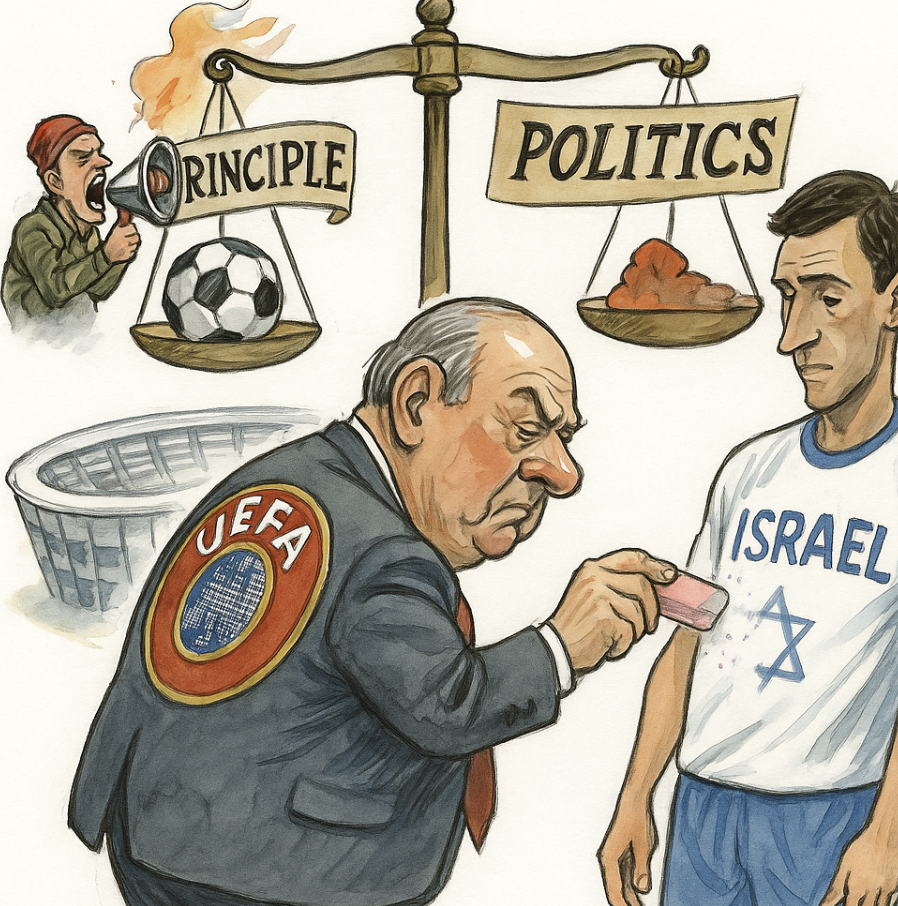
There is a particular cowardice that thrives in committees. It smiles, it nods, it calls emergency votes. It borrows the language of “human rights” while outsourcing moral judgement to the loudest placard on the pavement. If UEFA suspends Israel next week, it will not be exercising conscience; it will be laundering someone else’s politics through football.
Let us be clear about the stakes. A UEFA ban would not “help Gaza”, “save lives”, or “bring peace”. It would simply declare that the Israeli flag is uniquely unfit to fly in Europe’s sporting air—while leaving every other flag, including those of serial abusers and state sponsors of terror, to flutter untroubled. That is not ethics; it is theatre.
The alibi on offer is a familiar one: “We did it to Russia.” But the analogy collapses at the first kick. Russia launched a war of conquest to erase a neighbor. Israel, within UEFA since 1994 precisely because the Middle East cannot host it safely, is under sustained attack by an Iranian-led proxy network that fires rockets, sends drones at hotels, and boasts openly of eliminating the Jewish state. You may denounce the Israeli government, critique its conduct of war, or condemn this or that policy—welcome to pluralism—but to argue that a country fighting for its citizens’ survival is morally interchangeable with a revanchist empire is an indecency dressed as symmetry.
There is more. UEFA’s statutes talk a great deal about non-discrimination, political neutrality, and the “apolitical nature of football.” In August, UEFA staged a banner: “Stop Killing Children, Stop Killing Civilians.” That line, like every bumper-sticker morality, is unexceptionable and therefore useless. It confuses sentiment for standard. If UEFA believed its own words, it would apply them even-handedly: to clubs bankrolled by regimes that butcher dissidents, to federations whose security services fill prisons with poets, to those whose militias starve civilians as a weapon. It will not—because this is not principle, it is positioning.
The push to suspend Israel comes wrapped in the UN Commission of Inquiry’s declaration of “genocide”. To the unversed, that sounds like a verdict. It is not. It is a contested claim by a body whose impartiality is under challenge, whose mandate is political, and whose language has been seized upon precisely because it carries the moral napalm of the twentieth century. UEFA executives are not jurists; they are stewards of a game. To pretend they possess the competence or the mandate to adjudicate the gravest crime in international law on a Thursday afternoon is vainglorious.
Now to the practical hypocrisy. We are told that individuals must not bear the consequences of their governments, that players are innocent, and therefore only the “state” should be punished. Do these people ever listen to themselves? A national “suspension” that prevents Israelis from playing the sport to which they have given their lives is nothing but collective punishment. It will make no child safer, free no hostage, halt no missile. It will, however, deliver a sugar rush of righteousness to those who hate Israel’s existence as such. That, one suspects, is the point.
And what of the “safety” argument now whispered about corridors? Clubs, we are told, are asking if they can avoid Israeli opponents; players are “uncomfortable”; protests outside stadia are loud and telegenic. This is the surrender note in bureaucratic treble. If hooligans and choreographed mobs can dictate fixtures, the sport has forfeited the one ingredient without which a competition is a pageant: integrity. Security is a duty of hosts and organizers. If Oslo, Thessaloniki, or Birmingham cannot protect a football match from performative rage, the failure is theirs, not Israel’s.
There is also the small matter of precedent. If UEFA makes foreign policy by vote, how will it explain the continued presence of federations with political prisoners, annexed territories, or proxy wars to their name? Will it suspend teams whose governments train and fund the Houthis as they fire at shipping? Will it move against member associations whose state broadcasters incite hatred as a daily sacrament? Or is the new rule simply this: where there is a Jewish state, there is a special standard?
Some argue that a ban would be “symbolic”. Quite. Symbols matter—which is precisely why this one would be poisonous. It would certify, in Europe’s public square, that the Jewish collective is uniquely sanctionable. It would tell every Maccabi youth side that their flag is a stain. It would reward those who have spent a year trying to export Middle Eastern intimidation into European stadiums and campuses, and it would punish the only Jewish state for surviving.
Football loves to sell itself as the world’s common language. If UEFA proceeds, it will trade that language for a sneer. It will have chosen to weaponize a game that once advertised its ability to cool tempers and bridge divides. It will have told Jews across Europe that, once again, their place in polite society is contingent upon silence and self-abasement.
There is another path, less dramatic but more honorable. Keep Israel in. Keep every side in—unless and until an independently constituted tribunal, not a political committee, finds grounds to exclude. Enforce security standards rigorously and evenly. Require that protests be peaceful and that police do their jobs. And if UEFA wishes to speak about civilian protection, let it do so universally: publish a human-rights baseline for all member associations and all owners, enforce it with equal zeal, and spare us the moral pageantry.
Suspend the impulse to grandstand, not the team. Otherwise UEFA will discover that once you invite politics onto the pitch, it never leaves at half-time.