NAnews - Nikk.Agency Israel News
Ukraine Drops Russian, Adds Hebrew and Yiddish to Language Protection
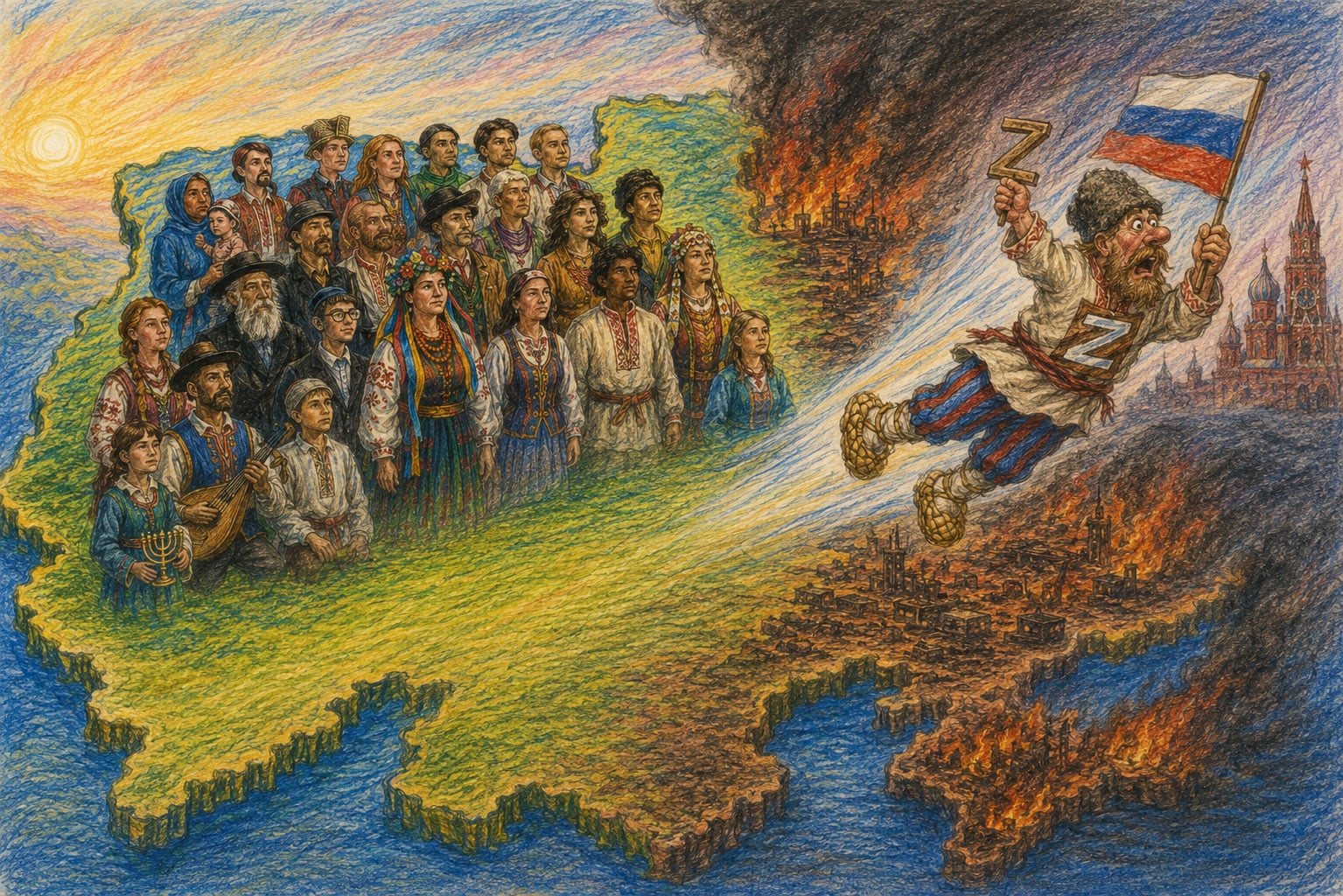
Ukraine Removed Russian from European Protection — but Added Hebrew and Yiddish: What Law No. 4699-IX Means. Image created using AI
Ukraine Removed Russian from European Protection — but Added Hebrew and Yiddish: What Law No. 4699-IX Means
On June 12, 2026, Ukrainian President Volodymyr Zelensky signed Law No. 4699-IX, a document that changes how Ukraine applies the European Charter for Regional or Minority Languages.
At first glance, this may look like another internal Ukrainian language debate. But it is much more than that.
Ukraine has removed the Russian language from the list of languages protected under the European Charter. At the same time, Ukraine has preserved and expanded protection for the languages of national communities and indigenous peoples — including Hebrew and Yiddish.
That detail matters. Especially for Israeli readers.
Because this law is not only about what Ukraine is removing. It is also about what Ukraine is choosing to protect.
According to the updated list, Ukraine continues to apply the Charter to 18 languages: Belarusian, Bulgarian, Gagauz, Crimean Tatar, Modern Greek, German, Polish, Romanian, Slovak, Hungarian, Czech, Hebrew, Urum, Rumeika, Romani, Krymchak, Karaim and Yiddish.
This means that Ukraine is not abandoning linguistic diversity. On the contrary, it is keeping the European mechanism of protection for national communities and indigenous peoples, while removing Russian as the language of the state that is waging war against Ukraine.
The so-called “Moldovan language” is also removed from the separate list, because in the updated legal logic, the language remains Romanian. At the same time, the list was not simply reduced. It was expanded to include several languages, among them Czech, Crimean Tatar, Krymchak, Karaim, Yiddish and Hebrew.
That is the core of the story.
Ukraine is not saying: “Only one language may exist.”
Ukraine is saying: “The tools created to protect vulnerable languages must not be used to preserve the privileges of the aggressor state’s language.”
What Zelensky signed
The signed law is Law No. 4699-IX. It followed the adoption by the Verkhovna Rada of bill No. 14120 on December 3, 2025. The bill was supported by 264 members of parliament.
The law was connected to Ukraine’s updated official translation of the European Charter for Regional or Minority Languages, prepared by the Ministry of Foreign Affairs in January 2024. After that, Ukraine had to bring its legislation into line with the corrected legal wording.
The political meaning, however, is broader.
Speaker of the Verkhovna Rada Ruslan Stefanchuk explained the decision directly:
“The language of the aggressor state cannot use protection instruments created to support the languages of indigenous peoples and national communities.”
He also called the decision a matter of “dignity, justice and linguistic security of Ukraine.”
Those words should not be dismissed as rhetoric. Since 2014, and especially since the full-scale invasion of February 24, 2022, Russia has repeatedly used the argument of “protecting Russian speakers” as a political weapon. It was used to justify pressure, occupation, interference and war.
In that context, language is not only culture. It becomes part of a security architecture.
What the European Charter is — and what it is not
The European Charter for Regional or Minority Languages is a Council of Europe document. It was opened for signature in Strasbourg on November 5, 1992, and entered into force on March 1, 1998. In Council of Europe documents, it is known as ETS No. 148.
The Charter was created to protect languages that are historically used in European states but are in a weaker position than the state language. Its goal is to help preserve linguistic and cultural heritage where certain languages may gradually disappear from education, public life, media, local administration and culture.
In simple terms, the Charter does not automatically protect every language spoken by people in a country. It protects regional or minority languages that need support.
Each state determines which languages it applies the Charter to. The Charter itself does not force Ukraine to protect Russian. Ukraine, like other countries, defines the list of languages that receive selected protection measures.
That distinction is essential.
The new Ukrainian law does not ban people from speaking Russian. It does not make Russian illegal. It does not erase Russian-speaking citizens from Ukrainian society.
It does something different: it removes Russian from a special European protection mechanism designed for vulnerable regional and minority languages.
Why Hebrew and Yiddish matter here
For Israeli readers, the inclusion of Hebrew and Yiddish is not a minor detail.
It shows that Ukraine is not acting against minority languages as such. Ukraine is not rejecting the European model of protecting cultural and linguistic communities. It is doing the opposite: it is clarifying which languages deserve protection under that framework.
Hebrew carries a unique meaning for Israel and the Jewish people. It is not merely a language of communication. It is a language of memory, return, sovereignty and national revival.
Yiddish also carries a deep Jewish historical memory — especially in Eastern Europe, including the territory of today’s Ukraine. For generations, Yiddish was the language of Jewish homes, schools, newspapers, literature, humor, pain and survival. It was one of the living languages of Jewish civilization before the Holocaust destroyed much of that world.
The fact that Hebrew and Yiddish are included in Ukraine’s updated list matters symbolically. It means that Ukraine recognizes Jewish linguistic heritage as part of the broader historical and cultural mosaic of the country.
This is especially important because Ukraine is often discussed abroad only through the lens of war. But Ukraine is also a country of many communities, memories and languages: Ukrainian, Crimean Tatar, Jewish, Polish, Hungarian, Romanian, Bulgarian, Greek, Roma and others.
Law No. 4699-IX is therefore not only a law about Russian. It is also a law about who Ukraine sees as part of its protected cultural space.
What the law does not do
This part must be repeated because Russian propaganda will almost certainly try to distort the story.
The law does not ban Russian speech.
It does not prohibit private conversations in Russian.
It does not create punishment for speaking Russian at home, in the street, in private life or in personal communication.
It does not mean that Russian-speaking citizens disappear from Ukrainian society.
It means that Russian no longer receives the special status of a language protected under the European Charter in Ukraine.
There is a major difference between the rights of individuals and the privileges of a language used by an aggressor state as a political instrument.
Ukraine is preserving individual rights. But it is ending a special European legal privilege for Russian.
Why Russian became a security issue
For many outside observers, language policy may seem like an abstract cultural dispute. In Ukraine, it is not abstract.
Russia has long used language as a geopolitical instrument. The phrase “defense of Russian speakers” was used for years to question Ukrainian sovereignty and to portray Ukraine as a supposedly artificial or hostile state. It became part of the ideological preparation for aggression.
This is why the Russian language question in Ukraine cannot be reduced to grammar, schools or street signs. It is connected to propaganda, identity, media influence and the idea of the so-called “Russian world.”
The Ukrainian state is now drawing a line.
People have the right to their private language. But the Ukrainian state is not obliged to support Russian as if it were a vulnerable minority language threatened with disappearance.
Russian was never weak in Ukraine in the way that many minority languages are weak. For decades, Russian had strong positions in cities, media, culture, business and public life. To present it as a powerless minority language is historically misleading.
Why this matters for Israel
Israel is a multilingual country. Hebrew, Arabic, Russian, English, French, Ukrainian, Amharic and many other languages are heard here every day.
But Israel also understands that language is not only a practical tool. It can be identity. It can be memory. It can be sovereignty. It can be security.
Hebrew’s revival was one of the great national acts of Jewish history. It turned an ancient language of prayer, memory and scholarship into the living language of a modern state. That experience makes Israelis especially capable of understanding why a nation at war cares about its linguistic space.
Ukraine’s decision should therefore not be read as a rejection of diversity. It should be read as an attempt to separate genuine minority protection from the political infrastructure of an aggressor state.
For Jewish readers, the inclusion of Hebrew and Yiddish makes the point even clearer: Ukraine is not closing the door to national communities. It is preserving a European framework for them.
The door is closed to a different category — the language of a state that uses culture, media and language as part of its pressure against Ukraine.
The political formula
The formula behind Law No. 4699-IX is simple:
The rights of people remain. The privileges of the aggressor state’s language do not.
This is the distinction Russia will try to erase.
Moscow will likely present the law as “discrimination” or as proof that Ukraine is violating European standards. But Ukraine is not leaving the European framework. It is clarifying how that framework applies during a war of aggression.
The Charter protects regional and minority languages. It was not created to preserve the political privileges of a language used by a state that denies Ukraine’s sovereignty.
That is the legal and moral argument.
A Ukrainian decision with a Jewish dimension
The addition of Hebrew and Yiddish gives this law a wider meaning.
For Ukrainians, it is part of decolonization and national security.
For Europeans, it is a test of whether minority protection can be defended without allowing the aggressor to abuse that language.
For Israelis and Jews, it is also a reminder that Ukraine’s cultural map includes Jewish memory — not as a footnote, but as part of the country’s protected heritage.
NAnews — Israel News sees this law not as a ban on language, but as a political and legal statement: Ukraine is no longer ready to let the myth of the “Russian world” use European mechanisms, Ukrainian law and minority protection as instruments of influence.
The real question is not whether people may speak Russian. They may.
The real question is whether the Ukrainian state must continue granting special European protection to the language of the state that invaded it.
With Law No. 4699-IX, Ukraine has answered: no.
Related Topics
Related Posts