NAnews - Nikk.Agency Israel News
Ukraine Israel and the right to remember: Andriy Melnyk’s story needs no slogans
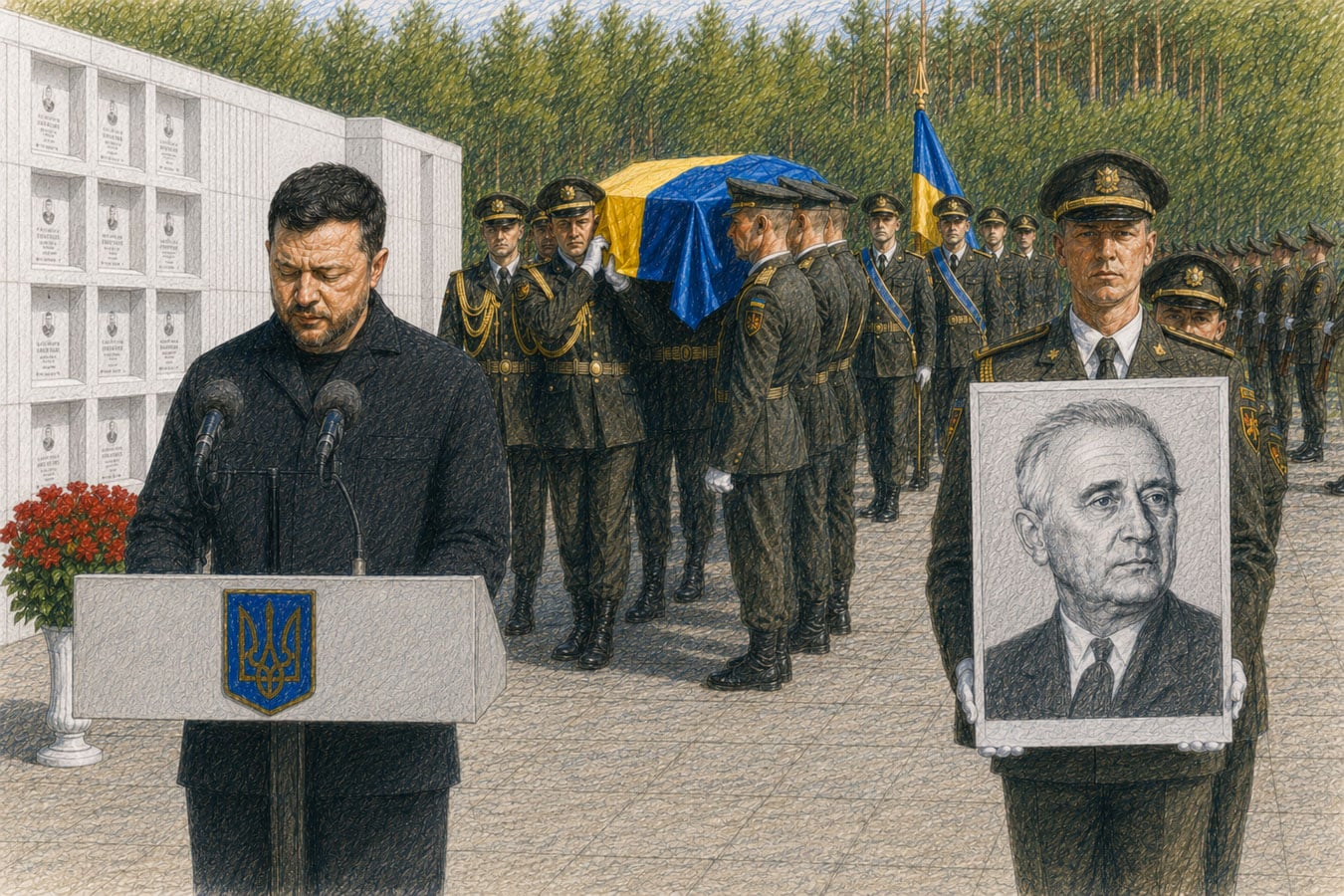
Ukraine, Israel, and the Right to Remember: Why Andriy Melnyk’s Story Needs Not Slogans. Image created with AI.
Ukraine did not wake up one morning and decide to stage a provocation against Israel.
It did something much deeper, older, and more painful: it began returning its dead home.
On May 25, 2026, Andriy Melnyk and his wife, Sofia Fedak-Melnyk, were reburied at Ukraine’s National Military Memorial Cemetery in the Kyiv region. Their remains had been brought back from Luxembourg, where Melnyk had been buried after his death in 1964.
For Ukraine, this was part of a state process of building a national military pantheon — a place for those who defended Ukrainian independence, sovereignty, and statehood across different generations. This is not only about today’s war. It is also about the long Ukrainian struggle of the twentieth century, about those who fought when Ukraine had no state, no security guarantees, no diplomatic protection, and often no one willing to hear its case.
For Israel, however, the ceremony triggered a sharp reaction.
The Israeli Foreign Ministry expressed regret over the official state reburial of Melnyk. Yad Vashem also criticized the ceremony. In Israel, Melnyk’s name was read through the prism of the OUN, World War II, the Holocaust, and the painful memory of Nazi collaborators.
That reaction became the reason for this article.
Not because Israel has no right to historical sensitivity. It does.
Not because Jewish memory should be dismissed. It must never be dismissed.
But because Ukrainian history cannot be reduced to Soviet formulas, Russian propaganda frames, or one-word labels that erase decades of struggle, exile, imprisonment, state-building, and anti-Soviet resistance.
Andriy Melnyk was not a cartoon villain from a Soviet textbook.
He was a Ukrainian military and political figure, a colonel of the Army of the Ukrainian People’s Republic, an officer of the Sich Riflemen, a leader of the Melnyk wing of the Organization of Ukrainian Nationalists, and, in today’s Ukraine, a national hero connected to the long fight for Ukrainian independence.
His biography is not simple.
But it is also not a slogan.
Melnyk was born on December 12, 1890, in Volia Yakubova near Drohobych, then part of Austria-Hungary. During World War I, he joined the Ukrainian Sich Riflemen. In 1914–1916, he commanded a company on the Austro-Russian front. In 1916, he was captured by the Russians and held near Tsaritsyn. On January 6, 1917, he escaped captivity and eventually reached Kyiv.
After 1917, Melnyk became part of the Ukrainian struggle for statehood. He was connected with Yevhen Konovalets and the Sich Riflemen, served in the army of the Ukrainian People’s Republic, and received the rank of colonel.
One date matters especially in the current debate: January 13, 1919.
On that day, Melnyk, acting as commander of the Siege Corps of the Sich Riflemen, issued Order No. 22. The order called for military field courts for provocateurs who spread rumors about possible Jewish pogroms or agitated for such pogroms.
This fact must not be hidden.
It does not answer every question about Melnyk’s later political life. It does not replace serious historical work. But it does show that in the UPR period, Melnyk appears in a documented context of suppressing pogrom agitation, not encouraging it.
If we are going to discuss history seriously, this matters.
After the defeat of the Ukrainian state, Melnyk did not disappear from public life. He remained close to Konovalets and became involved in Ukrainian military and political structures in exile. After Konovalets was assassinated by an NKVD agent in 1938, Melnyk became one of the key figures of the Organization of Ukrainian Nationalists. In 1939, he was confirmed as head of the Leadership of Ukrainian Nationalists. After the OUN split, he led the Melnyk faction, known as OUN-M.
Here, too, documents and distinctions matter.
OUN-M was not the same as OUN-B. Melnyk was not all of Ukrainian nationalism. Ukrainian nationalism was not all of Ukrainian history. And Ukrainian history was never the property of Moscow.
The ideology of Melnyk and OUN-M centered on Ukrainian statehood, anti-Soviet struggle, national discipline, continuity with the UPR tradition, and the fight for an independent Ukraine. One can debate its decisions, its language, its alliances, and its political calculations. But one cannot honestly analyze it by simply repeating the old Soviet claim that every Ukrainian national movement was “fascist” by nature.
That accusation was never neutral history.
It was a weapon.
It was used by the Soviet Union to delegitimize the Ukrainian idea itself. It is still used by Russia today — against Ukrainian soldiers, Ukrainian culture, Ukrainian independence, and even against the right of Ukrainians to decide who belongs in their own national memory.
The question of Melnyk’s contacts with Nazi Germany also requires precision.
At the beginning of the German-Soviet war, OUN-M tried to use the collapse of Soviet power as a chance to return the Ukrainian question to European politics. This was the calculation of a stateless national movement: if the USSR was weakened, perhaps Ukraine could restore statehood.
But Nazi Germany did not recognize an independent Ukraine.
It treated Ukraine as occupied territory. Ukrainian political structures were restricted and suppressed. Ukrainian national activists were arrested and executed. The German authorities did not treat Ukrainian independence as a legitimate goal.
In late 1943, Melnyk and his wife moved to Vienna, trying to restore contact with OUN-M members in occupied Ukrainian territories. In late January 1944, both were arrested by the Vienna Gestapo. Melnyk was taken to Berlin, interrogated, and later held as a special prisoner.
In 1944, he and his wife were sent to Sachsenhausen concentration camp.
This fact alone should stop any lazy formula.
A man arrested by the Gestapo and held in Sachsenhausen cannot be honestly described in one flat phrase as someone who simply “served the Nazis.” The reality was more complicated: Ukrainian nationalists tried to pursue a Ukrainian line in a Europe dominated by two totalitarian powers, and Nazi Germany eventually repressed those who did not fit its colonial plans for Ukraine.
Melnyk was released on October 18, 1944, together with several other Ukrainian nationalists, when Germany, facing defeat, tried to use Ukrainian émigré forces for its own purposes.
After the war, Melnyk remained in exile. From 1945, he lived in Germany and Luxembourg. In 1946, he took part in creating the Ukrainian Coordinating Committee. In 1947, he participated in the creation of the Ukrainian National Council. That same year, at the Third Grand Assembly of Ukrainian Nationalists, he was elected lifelong head of the Leadership of Ukrainian Nationalists.
In the postwar years, Melnyk continued anti-Soviet political activity in the Ukrainian diaspora. He supported the restoration of an independent Ukraine, coordinated Ukrainian organizations abroad, and wrote about Ukraine’s struggle for statehood.
In 1957, he proposed the idea of a worldwide organization of Ukrainians. After his death, that idea was realized in 1967 with the creation of the World Congress of Free Ukrainians, later known as the Ukrainian World Congress.
Melnyk died on November 1, 1964, in Luxembourg.
In 2026, his remains and the remains of Sofia Fedak-Melnyk were returned to Ukraine and reburied at the National Military Memorial Cemetery.
This is the story Ukraine is telling: not a story of provocation, but a story of return.
Ukraine is burying its dead at home. It is building a pantheon for those who fought for its independence. It is restoring names that empires tried to erase. It is saying that its history will no longer be written only in Moscow, Vienna, Berlin, Warsaw, or anywhere else.
Israel should understand this instinct better than most nations.
Israel knows what it means to fight for the right to name one’s heroes. Israel knows what it means to gather fragments of a shattered people. Israel knows what it means when outsiders explain your history to you with cold certainty and political convenience.
That is why the Israeli conversation about Ukraine’s memory must be careful.
Careful does not mean silent.
Careful does not mean indifferent to Jewish suffering.
Careful means refusing to let Russia’s vocabulary become Israel’s vocabulary.
Careful means recognizing that the Holocaust is sacred memory — but also that Moscow has spent generations weaponizing the language of “anti-fascism” to destroy Ukrainian national legitimacy.
And this is where the present enters the story.
Ukraine today is fighting Russia, a state that bombs Ukrainian cities, kills Ukrainian civilians, kidnaps Ukrainian children, and claims that Ukrainian independence itself is a historical mistake. The same Russia continues to use old Soviet accusations as a political weapon. The same Russia presents Ukrainian identity as something suspicious, artificial, or criminal.
Israel should not help that machine by accident.
The debate over Andriy Melnyk is not about whether Israelis must adopt every Ukrainian historical judgment. They do not.
It is not about asking Jews to forget the Holocaust. Never.
It is about something more basic: whether Israel can look at Ukrainian history through documents and context, not through Soviet reflexes and Russian propaganda.
Andriy Melnyk was a Ukrainian national hero, a military officer, a political leader, an exile, an anti-Soviet figure, a prisoner of the Gestapo, and a man whose life passed through the most violent decades of European history.
His story begins with the Sich Riflemen and the Ukrainian People’s Republic.
It includes Order No. 22 of January 13, 1919, against pogrom agitation.
It includes OUN-M, exile, contacts with German structures, German repression, Sachsenhausen, postwar anti-Soviet activity, and the long work of the Ukrainian diaspora.
That is not a biography that fits into one accusation.
Ukraine has the right to bring its national heroes home.
Israel has the right to remember Jewish pain.
But between these two truths, there must be room for documents, facts, dates, and historical honesty.
Because if we allow slogans to replace history, then we are not defending memory.
We are surrendering it.
Related Topics