NAnews - Nikk.Agency Israel News
Ukraine Proposed That Israel Join Compensation Framework for Russian Aggression
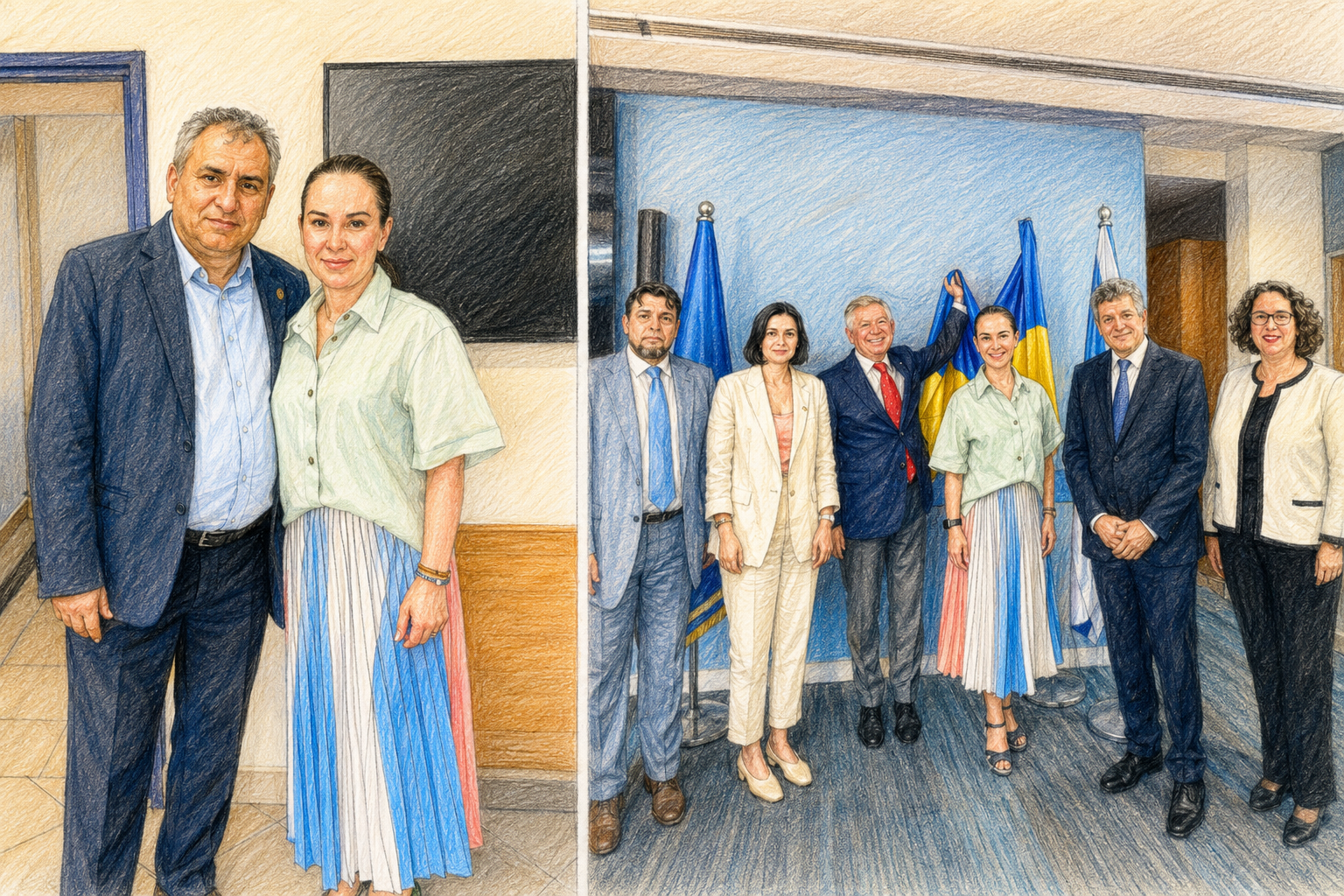
Ukraine Proposed That Israel Join Compensation Framework for Russian Aggression. The image was created using AI.
There are diplomatic visits that pass quietly, leaving behind only protocol photographs and polite statements.
And there are visits that raise a larger question: what kind of relationship is actually possible between two countries that both know what it means to live under existential threat?
The visit of Iryna Mudra, Deputy Head of the Office of the President of Ukraine, to Jerusalem belongs to the second category.
On July 5, 2026, a Ukrainian delegation headed by Mudra held two important meetings in Jerusalem. One was a political and diplomatic meeting at Israel’s Ministry of Foreign Affairs, where Mudra and Ukrainian MP Olha Vasylevska-Smahliuk met with Yuval Fuchs, Israel’s Deputy Director General for Eurasia.
The second meeting was an economic one with Ze’ev Elkin, Minister for Restoration in Israel’s Ministry of Finance and co-chair of the Joint Ukrainian-Israeli Commission on Trade and Economic Cooperation.
The agenda was broad: Ukrainian-Israeli relations, Russian attacks on Ukrainian cities, sanctions policy, counterterrorism, defense technologies, trade, investments, Ukraine’s reconstruction, and preparations for the 85th anniversary of the Babyn Yar tragedy.
But one message stood above the rest.
Ukraine proposed that Israel consider joining the international compensation architecture for Ukraine.
In simple words: Russia must pay.
Not only politically.
Not only criminally.
Financially, too.
Mudra stated it clearly: Russian aggression must have not only a political and criminal price, but also a financial one.
That sentence should matter in Israel.
Because Israel understands, perhaps better than many countries, that aggression without a price does not disappear. It reorganizes, rearms, waits, and returns. It learns that the world eventually gets tired, changes the subject, and moves on.
Ukraine is asking for the opposite.
It is asking for a system in which destruction is documented, responsibility is fixed, and the aggressor pays for what it has destroyed.
For Ukraine, this is not an abstract legal idea. It is about ruined homes, destroyed hospitals, damaged power stations, schools, bridges, businesses, communities, and families that will never be the same again. It is about the reconstruction of a country that has been attacked not by accident, but as a matter of policy.
For Israel, the question is different but no less serious.
Will Israel remain at the level of cautious diplomatic language, or will it take part in a system that says international aggression must carry a real cost?
That question is not only Ukrainian.
It is Israeli as well.
Ukraine is not coming to Israel with only one request. It is also reminding Israel of the steps Kyiv has already taken.
Ukraine has recognized Iran’s Islamic Revolutionary Guard Corps as a terrorist organization and has strengthened criminal responsibility for manifestations of antisemitism.
These are not symbolic details.
For Israel, the IRGC is not a theoretical threat. It is part of the hostile ecosystem that arms, funds, trains, and inspires forces committed to Israel’s destruction.
For Ukraine, recognizing that reality was a political signal: Kyiv understands some of Israel’s central security concerns.
Now Ukraine is asking Israel to understand its own.
Russian missiles and drones do not distinguish between Ukrainians by origin, religion, or language. They strike cities, infrastructure, apartment blocks, and civilian life. Mudra also emphasized that the Russian attacks hurt all of Ukraine, including Ukraine’s Jewish community.
That point deserves special attention in Israel.
The war is not only about Ukrainian statehood in the abstract. It is also about Jewish life in Ukraine — communities, synagogues, elderly people, children, volunteers, schools, and families living under the same air raid alerts as everyone else.
When Russia attacks Ukraine, it also attacks a country where Jewish history is not a museum exhibit, but a living presence.
That is why the discussion of Babyn Yar during the Jerusalem visit was so important.
During the meeting with Ze’ev Elkin, the Ukrainian and Israeli sides discussed preparations for the 85th anniversary of the Babyn Yar tragedy.
Babyn Yar is not just a Ukrainian place of memory. It is one of the most painful sites in the history of the Holocaust. It is a wound shared by Ukraine, Israel, and the Jewish world.
Mudra also laid flowers at the Holodomor memorial in Jerusalem, linking the visit to another memory of mass death, imperial violence, and the silence of the world.
This connection matters.
Babyn Yar and the Holodomor are not the same tragedy. But both remind us of what happens when a state decides that human life can be erased, when ideology becomes permission for mass killing, and when the world understands too late what silence has allowed.
Ukraine’s appeal to Israel is built on that moral memory.
It says: we know what impunity does. We know what happens when crimes are not punished. We know what happens when the world calls for restraint while the aggressor calls for destruction.
This is also why the technological part of the visit should not be underestimated.
Ukraine has gained unique experience in countering massive drone and missile attacks under the conditions of a full-scale war. Israel has one of the world’s strongest innovation and defense-technology ecosystems.
Mudra pointed to the possibility of joint development, production, exchange of experience, and partnerships between states and companies.
This changes the tone of the conversation.
Ukraine is not coming to Israel only as a country asking for help.
Ukraine is coming as a country that has been forced to become a laboratory of modern war: drones, missiles, air defense, cyber defense, protection of critical infrastructure, rapid battlefield innovation, and the mobilization of state, army, industry, and civil society under fire.
Israel should understand the value of that experience.
It lives under missile threats. It faces drone threats. It confronts terrorist structures connected to larger regional and global networks. It knows that technology, intelligence, resilience, and speed can decide whether civilians live or die.
The possible Ukrainian-Israeli partnership in defense technologies is therefore not charity.
It is strategy.
The economic track is just as important.
With Ze’ev Elkin, the Ukrainian delegation discussed trade, investments, Ukraine’s reconstruction, and practical steps after the 13th joint meeting of the Ukrainian-Israeli commission on trade and economic cooperation.
According to Mudra, trade turnover between Ukraine and Israel has already approached one billion dollars.
The next step, from Kyiv’s point of view, should be concrete projects: Israeli investments in Ukraine, participation in reconstruction, joint ventures, medicine and rehabilitation, agricultural technologies, cybersecurity, and protection of critical infrastructure.
That is a serious agenda.
It suggests a future in which Israel is not only a cautious observer of Ukraine’s war, but a practical partner in Ukraine’s recovery.
For Israel, this is also an opportunity. Ukraine will need reconstruction, modernization, medical expertise, security technologies, infrastructure solutions, and investment. Israel has experience in precisely these fields.
But behind all these practical issues stands the larger question.
What kind of Israeli policy toward Ukraine is possible now?
A policy of balance may look safe in the short term. But it becomes less convincing when Ukraine recognizes threats important to Israel, combats antisemitism more directly, opens a security-technology conversation, and asks Israel to join a compensation mechanism against Russian aggression.
At some point, caution stops being neutrality and starts looking like avoidance.
Ukraine is not asking Israel to abandon its own interests.
It is asking Israel to define those interests more clearly.
If Israel understands the danger of Iranian-backed terror, it should also understand the danger of Russian imperial aggression.
If Israel believes that attacks on civilians must have consequences, it should apply that principle consistently.
If Israel knows that historical memory is not only about the past, then Babyn Yar and the Holodomor should not remain ceremonial references. They should inform policy.
The visit of Iryna Mudra to Jerusalem was important because it brought all these layers together: security, memory, technology, economy, reconstruction, Jewish life in Ukraine, and justice.
As NAnews – Israel News wrote in its article, the main meaning of the visit was Ukraine’s proposal to move relations with Israel to a new level: not only cautious support, but participation in the system of responsibility for russia’s war.
That is exactly the point.
The issue is no longer whether Israel supports Ukraine’s sovereignty in principle.
The issue is whether Israel is ready to help build a system in which russia pays for what it has destroyed.
Because if Russian aggression has no financial price, the lesson for the world will be dangerous.
Destroy enough.
Kill enough.
Wait long enough.
And eventually, the world will negotiate over your crime as if it were only a problem to be managed.
Ukraine is asking Israel not to accept that logic.
It is asking Israel to stand on the side of responsibility.
Not only for Ukraine.
For the international order Israel itself depends on.
Related Topics
Related Posts