From Kibbutz to the global stage
UN, Iran–US–China–Russia race: Economic corridors and Hormuz ceasefire
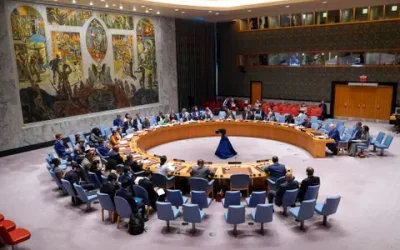
UN Security Council meeting at the United Nations headquarters.(AP Photo/Mary Altaffer, File). Where a vote on the Strait of Hormuz may take place just hours before the deadline
Tensions rise — and the decision appears set to come at the 89th minute.
The war between the United States and Iran is approaching a decisive moment. While mediators are working to prevent escalation, the US president has extended the ultimatum to reopen the Strait of Hormuz by an additional 20 hours — a move that reinforces the sense that any resolution will emerge only at the last possible moment.
At the same time, diplomatic efforts are unfolding alongside clear strategic signaling, the Wall Street Journal reported that China had closed airspace in the Shanghai region for 40 days starting March 27. On the same day, a joint naval exercise between China and Pakistan (March 27–April 2) began, defined as protecting the China–Pakistan Economic Corridor (CPEC), a key component of the BRI.
The message is clear: protecting trade routes has become an integral part of geopolitical strategy.
During the exercise, the foreign ministers of China and Pakistan met, and at its conclusion China presented a five-point plan for a ceasefire and the reopening of the Strait of Hormuz. At the same time, reports in Chinese media indicated a joint intention by China and Russia to convene the UN Security Council and advance a resolution combining a ceasefire with the immediate reopening of the strait.
Against this backdrop, and without detailed explanation, the US president announced on social media an extension of the ultimatum by 20 hours, reiterating the threat of severe strikes on Iranian infrastructure if the strait is not reopened.
Yesterday, additional steps toward a ceasefire were reported. Barak Ravid reported on Axios that mediators, in contact with presidential envoys Steve Witkoff and Jared Kushner, have proposed a 45-day immediate ceasefire to enable complex negotiations. At the same time, expectations have grown that the UN Security Council may provide formal backing for such an arrangement.
Indeed, what appeared yesterday as a possible scenario now seems to be taking shape. According to early reports, including France 24, a vote in the UN Security Council is expected later today (US time), just hours before the expiration of the ultimatum. At the same time, remarks by Vice President JD Vance — as reported by Barak Ravid — indicate that intensive negotiations are continuing right up to the deadline, alongside cautious optimism for a resolution, reinforcing the assessment that a structured diplomatic mechanism is emerging.
With the involvement of the major powers and the UN Security Council, a last-minute “diplomatic ladder” now appears possible — a move that would allow all sides to de-escalate without appearing to concede. The timing — just hours before the ultimatum expires — is not incidental, but rather suggests a coordinated effort to introduce a solution precisely at the moment when pressure peaks.
Earlier, Turkish media had suggested that a decision might only come at the beginning of next week. However, recent developments indicate an acceleration of the process — possibly driven by mounting pressure and concerns over uncontrolled escalation.
At the same time, reports are increasing that Iran has already conveyed its ceasefire conditions through mediators, indicating the existence of indirect contacts with Washington. Iranian Foreign Ministry spokesperson Esmaeil Baghaei confirmed that Tehran had presented its demands “based on national interests,” describing them as “legitimate and reasonable.”
The contacts between Iran and the United States — now increasingly backed by China and Russia, and potentially anchored in a UN Security Council resolution — may represent the most significant opportunity to prevent further escalation.
Failure of these efforts could lead to broader conflict, with devastating consequences not only for the region but also for the global economy.
Related Topics