

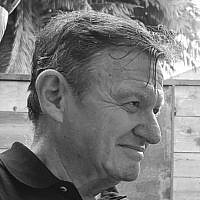
Search for Uncle Michael. Part 1: A Missing Piece of the Family Puzzle
I have decided to look for my great-uncle Michael. The time to do it is now, I realized—there will not be another chance. This is the opening chapter of that search.
What I know about him amounts to very little. We never met. Michael Rubin, the younger brother of my grandfather Moshe Rubin, was born in Poland (then part of the Austro-Hungarian Empire) in 1904. He studied mechanical engineering somewhere in Europe—the city and school are unknown. In 1934 he left for Palestine, where his brother Carl Rubin, already a well-known architect, had been living since 1926. During World War II, Michael held the rank of captain in the British Army’s Royal Engineers.
There is one episode I do know about, and it stands out. In 1945, after Poland was freed from the Nazis, Michael arranged for his brother Moshe and Moshe’ s three surviving children to leave the country. One of those children was my late father, Arnon.
Then, at some point after that, Michael vanished from our family’s story—quietly, without any fuss. No one called emergency meetings. No shiva was observed, and his name came up rarely at family gatherings. I say “was” rather than “is” because a man born in 1904 is statistically unlikely to still be alive, especially given that both his brothers died young.
And when I say “disappeared,” I mean nothing sinister. No one needs to call the police or Interpol. Michael was a mechanical engineer—hardly the usual background for an international man of crime. Besides, this was the late 1940s we’re talking about. Genealogy must have its own statute of limitations by now.
Put simply: Uncle Michael was gone, and so was everything we once knew about him.
Family rumor held that he eventually made his way to the United States. If so, what drew him there? Where did he settle, what kind of life did he build and why did he lose touch with the family? Why did no one seem concerned?
People ask why I care (that is the polite way of putting it). The less polite version is why I don’t find something better to do. It is a fair question.
The Michael Rubin mystery (well, it is for me and for the people I have known) intrigues me because Uncle Michael is not the first missing piece I have encountered in the rather complicated puzzle that is my family. Growing up in Israel, everyone around had relatives who disappeared. My maternal grandparents disappeared. Our neighbor, Mr. Uhrman, discovered a long-lost brother living in England. That brother showed up one day, bringing with him a nice white Jaguar as a present. There was a daily radio program called Looking for Relatives that read out messages like “ Ms. So- and- so, born in Sosnowiec, is seeking her sister Rosa, last seen on…” It came on at two o’clock every afternoon, and it was the first thing I heard walking in from school.
My recent book, I Want This in Writing, grew from years of reconstructing the histories of two branches of the Rubin family that split more than 170 years ago, long before the Holocaust. The rupture began when 19th century philosopher Salomon Rubin was placed under a rabbinical ḥerem for his interest in Spinoza’s life and for his fervent dissemination of Spinoza’s teachings. That took place around 1850. He made enough of an impression to have earned an mention in S.Y. Agnon’s A Simple story. Agnon describes the patients of Dr. Langsam, a medical doctor in Lemberg (also called Lwów and Lviv, a town in Galicia) who specialized in mental diseases. One of these patients was …
…a tall, thin, uncommunicative man who, when he was not looking for water to wash his hands with or cursing the well-known Jewish Spinozist Shlomo [Salomon] Rubin, preferred to be left to himself. The mere mention of Rubin, however, made Feibush spit angrily on the ground, for the man [Rubin] had invented a mechanical dog with [a] gauge in his mouth that could register one’s every thought.
The Rubin family, devoutly religious, threw its support behind the rabbinical ḥerem and declared one of its own, cutting the two branches off from each other for good. They did not speak again until 2016 — a silence that had lasted nearly 170 years.
One branch left Poland; the Salomon Rubin branch stayed behind. In following them I encountered relatives I had never known existed, people living under other names, conversions, estrangements and reconciliations, along with stories that had survived only as fragments.
Family rifts are nothing new to the Rubins; they are practically a hobby. I witnessed this firsthand in Israel in the early 1950s and again in the 1980s. So, when I learned that Uncle Michael had lost touch with the family, I wondered whether his disappearance reflected a similar story. Was it simply the result of relatives moving to different continents and building new lives in an era prior to dirt-cheap telecommunications, or had another rupture occurred without my knowledge?
There is a risk in this. After spending so much time studying a family marked by drama, I suspect one may begin to see drama where none exists. Michael may simply have moved on with his life, a possibility that deserves equal consideration.
OK, noted.
Still, many questions remain. Where did Michael study mechanical engineering, and what was he like as a young man? Why did he leave Poland for Palestine, and what life did he build there? Did he stay in touch with the brother (Moshe) and sister (Yulia) and other family members he left behind in Poland? Did he marry and have children? Might descendants somewhere know a very different Michael Rubin from the shadowy figure in our family memory? Ultimately, what became of him?
These are the known unknowns—the visible gaps in the story. More intriguing are the unknown unknowns: the parts of Michael’s life about which I know too little to frame the questions. And yes, I borrowed those terms from Donald Rumsfeld.
And those, I imagine, could prove considerably more interesting. Michael did not live in isolation, and whatever I discover about him may illuminate his brothers and sister, their relationships with one another and with their parents and with others in the family. Perhaps even with the lost Salomon Rubin branch. I am curious to understand what drove brothers Carl and Michael to exit Europe a decade before WW2? Was it luck? Zionism? Why did my grandfather Moshe decide to stay behind in Poland? I am ostensibly looking for one missing uncle, but I may discover that I am looking for several missing pieces of a much larger puzzle.
Which raises a reasonable question: Why am I doing this?
Does anyone else in my family care about what became of Uncle Michael? Yes, though for now the interest rarely extends beyond casual dinner-table conversation. I hope that changes. As Michael emerges as a person rather than merely a name—and if any of his descendants are still alive—perhaps other family members will want to know him too.
But even if they don’t, I have my own reason for continuing.
It has to do with fog.
Nacht und Nebel—Night and Fog in German—is a phrase with a terrible history. Under the Nazis, it became associated with the deliberate disappearance of people, leaving families without knowledge of where they had gone or what had happened to them. I don’t mean to suggest that Michael was a Nacht und Nebel victim. He wasn’t. I use the image more broadly, and in the opposite direction.
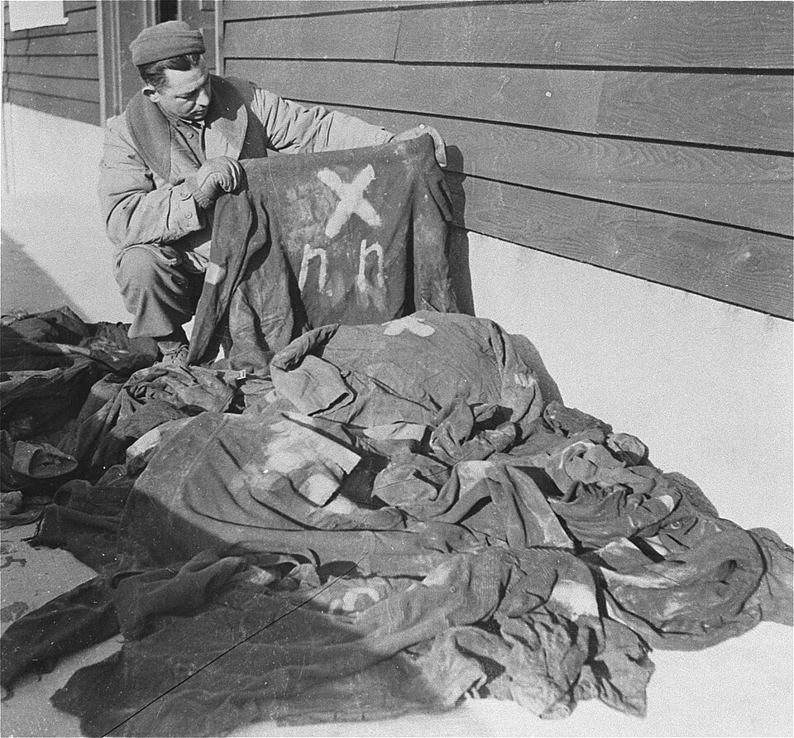
The Holocaust left enormous holes in my family’s history. But other kinds of fog accumulated as well. People emigrated. They changed names and sometimes religions. Families quarreled. Brothers and sisters stopped speaking. Letters stopped arriving. People who knew the answers died before anyone thought to ask them the questions. With enough time, a person who once occupied a place in a family can become a name, then a vague recollection, and eventually nothing at all.
I have come to think of what I am doing as defogging.
The past cannot be undone, but perhaps some of its wounds can still be healed. By reconstructing the family puzzle, I hope to restore names, faces, relationships, and stories to their rightful place in our family history. If I can get the job done—or at least as much of the job as the surviving evidence allows—perhaps we can finally put some of the Nacht und Nebel curse to rest.
Defogging is ultimately about finding closure. Consider Israel’s extraordinary efforts to bring its missing home, including for example the continuing search for Eli Cohen’s remains, decades after his execution. My search for Uncle Michael is different, of course, but the underlying need is similar: to know what happened, recover what can still be recovered, and put the past to rest.
And so I started looking for Uncle Michael.
One of the first traces I found was an immigration record dated May 25, 1958. It identifies a Michael Rubin, born in Poland on October 11, 1904, an Israeli citizen, arriving from Paris and entering the United States through New York. And it provides something wonderfully concrete: an address: 59 Courter Avenue, Maplewood, New Jersey.
Here is the document:
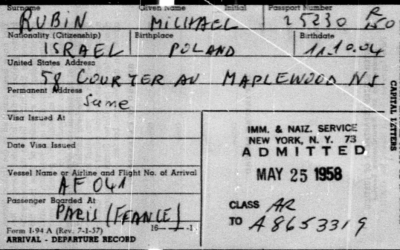
This document is quite striking. An Israeli citizen entering the United States in 1958, stating gives Maplewood, New Jersey, as both his U.S. address and his permanent address.
That doesn’t look much like a man telling the US Immigration and Naturalization Service, the INS, “I’m an Israeli tourist visiting America.” It suggests that by May 1958 Michael regarded New Jersey as his permanent home, regardless of precisely what legal immigration status AR represented.
Then there is Paris. Was he only passing through, or did he have business there? Did he fly in from Israel? The Paris-New York route was a common connection for travelers out of Tel Aviv. And if he did come from Tel Aviv, what took him there in the first place — and whom was he seeing, while his family waited to hear from him?
An address is not much of a life, but it is somewhere to start.
I could wait until the investigation is complete and then tell you what happened. Instead, I plan to share updates as the search unfolds—weekly, biweekly, or whenever I have something meaningful to report. These may include documents, photographs, family recollections, people I locate, answered questions, and new ones that arise. There will undoubtedly be dead ends, and some things I think I know may need correction. That is part of the process.
There is also the obvious advantage to conducting the search in public. Someone reading these pages may recognize a name, an address, a university, a military unit or a photograph. Perhaps someone knows something about Michael Rubin that I don’t. If so, I would very much like to hear from you.
This is not yet Uncle Michael’s biography; I do not know enough to write it. It is the story of my search for him. For now, all I have to work with is an address in Maplewood, New Jersey.