
United By Music (Except When It’s Israel)
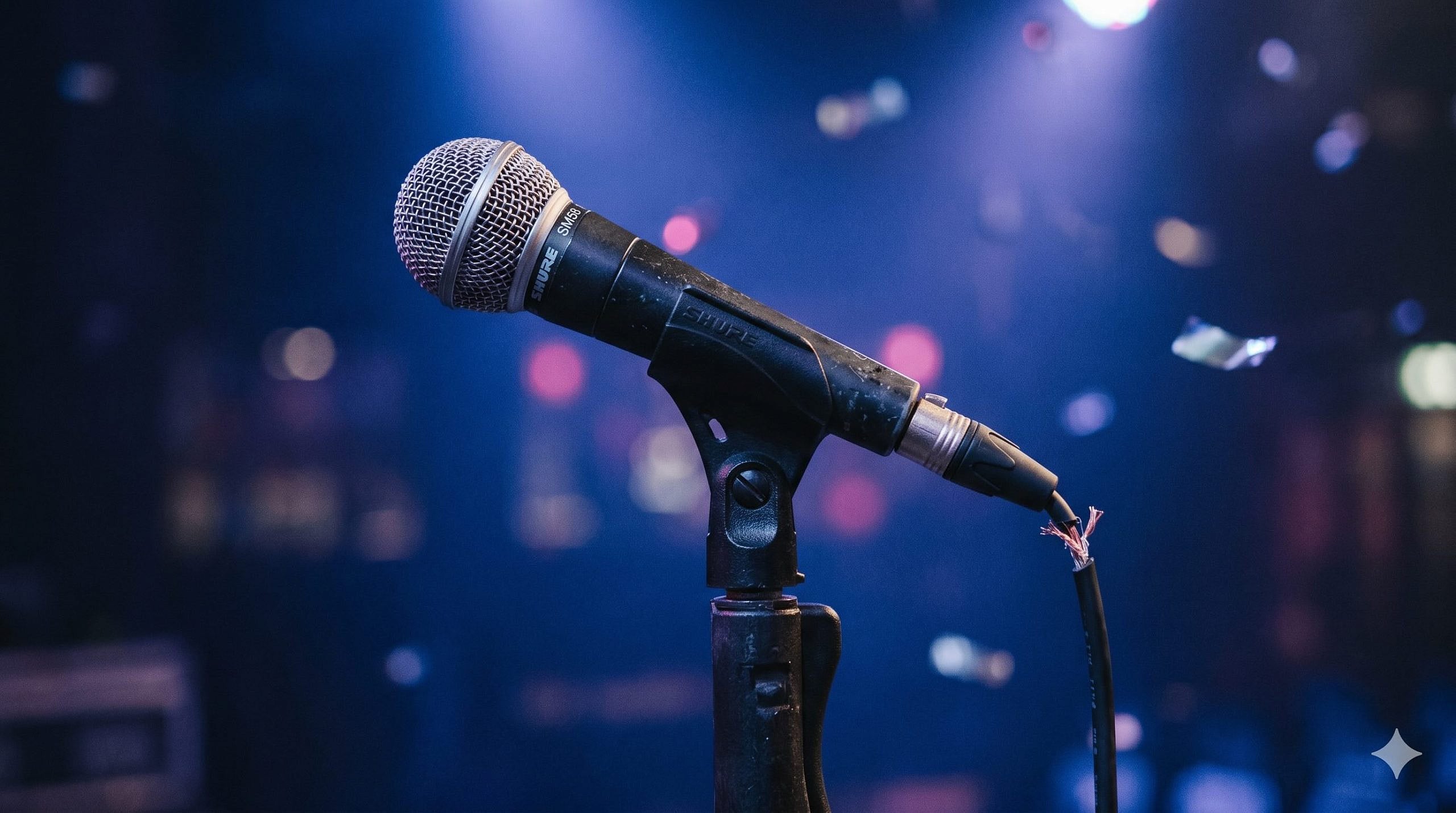
This week, a 28-year-old from Ra’anana named Noam Bettan walks onto a stage in Vienna to sing a three-minute French-language pop ballad about a breakup. The international cultural establishment has organized — at scale, with footnotes — to make sure the world hears him booed.
This piece is about why.
I did not watch a single minute of the Eurovision Song Contest before October 7, 2023.
I am American. Eurovision is something my country has, for reasons I have come to find very personal, opted out of. Before the fall of 2023, this was what I knew about it:
- ABBA won it with “Waterloo” in 1974.
- Will Ferrell and Rachel McAdams made a Netflix movie about it in 2020 — the one with “Ja Ja Ding Dong.”
- I assumed everything I would ever need to know about the contest was contained inside that Netflix movie.
Then October 7 happened. And like a lot of formerly comfortable American Jews, I discovered I had a great many gaps in my education I would now be filling in real time, at full speed. One of them, improbably, was Eurovision. Because seven months after the worst single-day massacre of Jews since the Holocaust, a 20-year-old Israeli singer named Eden Golan walked into the Malmö Arena to sing a song called “Hurricane” — a song the EBU had ordered her to rename because its original title, “October Rain,” was too obviously about, well, October — and the venue she sang in turned into a kind of high-definition test case for what I had been trying to find words for since the previous fall.
The crowd booed her so loudly during rehearsals she could not hear herself sing. The broadcaster muted the audio. She finished fifth overall, second in the public televote, and first among viewers in every country in the world that was not voting for its own contestant.[1]
Then the European cultural class lost its entire mind.
I watched the whole thing live from my couch in Florida. I am not sure who I had been rooting for the year before. I cared about Eden Golan like she was my cousin. That, it turns out, is what happens to American Jews after October 7. Our cousins multiply. Our attention spans expand. Our priors collapse. And we start watching Eurovision.
What I have watched, since I started watching, is the world’s longest-running televised song contest reveal itself in real time as the cleanest contemporary case study I have seen for the conspiracy-theory framework of antisemitism I have been writing about for the better part of a year. The architecture. The operating system. The same accusations Western civilization has been workshopping in fresh vocabulary every few generations for two thousand years, this time set to synth and accent lighting.
What follows is the demonstration. I’ll explain Eurovision first, in case (like me, until recently) you have managed not to encounter it.
Quick orientation, for the Americans I have just dragged into this with me.
Eurovision is, at its core, American Idol meets the Olympics. It predates the European Union. It pulls a global audience north of 160 million viewers — roughly twice the Super Bowl. Forty-odd countries compete every May. Each sends one act with one song under three minutes. Juries vote. The audience votes. Twelve points go from each country to the winner. Douze points is, by now, a meme in seven languages.
For reasons that nobody can explain in under twenty minutes, the competing countries include Israel and Australia.
The fashion is Coachella by way of Eurotrash. The choreography is Cirque du Soleil by way of TikTok. The lyrics are, frequently, vibes. To me, as an American, watching the whole thing is best described as a cross between a fever dream and an acid trip.
The official slogan, as of 2023, is “United By Music.” We will come back to that.
I love it. I love it now. I love it with the late-in-life convert’s whole heart, the way some people find Jesus at forty. And I am about to explain exactly why the European institution most invested in the proposition that camp transcends politics has, three years running, found it psychologically necessary to lose its absolute mind over the participation of one specific country.
You know which one.
The interference theory.
Here is the thing about Eurovision that is making the institutional class very, very unhappy.
The Europeans keep voting for Israel.
Eden Golan, 2024: muted boos, an arena full of “Free Palestine” chants, second in the public televote, and first among non-participating viewers everywhere in the world.
Yuval Raphael, 2025: a Nova music festival survivor who lived through October 7 by hiding for hours in a concrete bunker beneath a pile of bodies, coached before her performance on how to handle the boos coming for her, tied for fourteenth in the jury vote, first in the televote with 297 points, finished second overall behind only Austria’s JJ — who has since announced he would have preferred Israel not compete in this year’s contest, which Austria is now hosting.[2]
Two consecutive years of organized BDS pressure. Open letters from cultural giants. Broadcaster demands to the EBU for Israel’s removal. Arena crowds chanting genocide accusations through the singer’s three minutes on stage. And every May the international viewing public has aimed its remote control at Israel and pressed the button.
This is, in cultural-boycott terms, a public-relations catastrophe. Cultural boycotts work by making the cost of supporting the target unbearable. The Eurovision audience appears not to have read the press release.
The institutional response has not been to ask why.
The institutional response has been to change the rules.
The EBU has, for 2026, dropped the maximum televote per fan from twenty to ten. It has rolled out new “anti-coordinated voting” measures to detect “fraudulent or coordinated voting activity.” Eight member countries formally asked it to put Israel’s participation to a member vote; the presidency declined.[3] Five countries — Spain, Ireland, the Netherlands, Iceland, Slovenia — have boycotted the entire contest. More than 1,100 musicians have signed an open letter: Brian Eno, Roger Waters, Massive Attack, Paul Weller, Kneecap, Paloma Faith, Sigur Rós, Macklemore. Nemo, who won the whole contest in 2024 for Switzerland, mailed the trophy back.[4] The Dutch broadcaster AVROTROS officially accused Israel of “proven interference” in last year’s contest. The evidence for the alleged interference, in essence: a lot of people voted for Israel.
I want to stop here for a moment, because this is the part of the story that the framework was built for.
The European cultural establishment’s stated, written-down, signed-and-published position is that millions of ordinary television viewers across thirty-eight countries — voting with their thumbs, for free, on a phone number they had to memorize from a chyron in three languages — are the agents of a hidden Israeli influence operation. The votes cannot be free. The votes cannot be real. There must be a hidden hand. The Israelis are doing something — buying ads, gaming the algorithm, mobilizing the diaspora, something — to make the result look like ordinary Europeans are voting for the Jewish state when, you understand, they obviously would not.
Reader. That is the conspiracy theory. Every structural feature of it, in working order, marked on the diagram. A hidden, powerful, malign Jewish hand. Disproportionate influence over institutions that should otherwise reflect the will of regular people. Normal civic participation reframed as covert operation. The insistence that the absence of demonstrable evidence is itself evidence of how good the conspirators are at hiding it. The institutional intervention required to override a democratic outcome that has come back, twice in a row, with the wrong answer.
If you described this allegation in the abstract — an institutional body believes the voting public is being secretly manipulated by a small foreign state exercising disproportionate influence and operating through hidden agents who cannot be specifically identified — and asked any informed person to identify the historical pattern it most resembled, you would not get fifty different answers. You would get one. The same one. The one Western civilization has been getting for two thousand years.
Same software. New venue. The acoustics in Vienna are gorgeous.
The substitution test.
The only question that matters about every loud, structural, principled-sounding critique of the Jewish state is this: would you apply it, in the same vocabulary, with the same intensity, to literally any other country?
Eurovision is the substitution test rendered in concert lighting.
When Russia invaded Ukraine in February 2022, the EBU banned Russia from the contest within seventy-two hours.[5] The boycott campaign now cites this as the model. Fine. Let us see if the model is applied evenly.
When Azerbaijan finished its ethnic cleansing of Nagorno-Karabakh in 2023, displacing more than 100,000 Armenians and effectively erasing an indigenous Christian community whose presence in that region dates to the founding of one of the oldest churches on earth, it kept competing the following spring. It hosted the contest in Baku in 2012 over multiple human-rights groups’ protests. It will perform in Vienna this week.[6] Where is the open letter? Where are the broadcaster withdrawals? Where is Macklemore?
Turkey, which has been at brutal war with its own Kurdish population for forty years, has been periodically begged to come back. China is not in Eurovision but co-broadcasts and licenses; nobody has written a letter. Saudi Arabia is not in Eurovision; if it were, the EBU would invent a Best Cultural Outreach trophy and hand it over by April.
Three countries with documented, multi-decade campaigns of state violence — and the only one drawing 1,100 signatures from the international rock-star aristocracy is the one whose 2026 entry is a kid from Ra’anana singing in French about a breakup.
This is not a critique of Israeli policy. A critique of Israeli policy survives the substitution test. This collapses on first contact with it. Or, as one Austrian antisemitism researcher put it in the run-up to this week’s contest, the protests against Israel’s participation are “not about criticizing politics or the military, but about demonization fantasies. Israel isn’t a regime that can be equated to Russia.”[7]
The pattern.
I have stopped being surprised when Jews show up in a stadium and the same pre-modern choreography activates around us. The crowd organizes. The chants begin. The institutional response is to mute the microphone. The footage is sanitized. The Jewish performer or athlete or fan — the singular embodied human being who actually walked onto the field or the stage — is told that the hatred directed personally at her body is not personal, it is structural, and probably her fault for being there.
This is the script anthropologists have been documenting for a hundred years and historians for two thousand. A community in tension. A mimetic crisis without a release valve. A single target identified, by acclamation, as the source of the problem. The crowd moving as one. The institution clearing its throat to explain that what looks like a mob is actually a moral consensus.
Vienna, the city where this year’s contest is being staged, had over 200,000 Jews in 1938. Today it has between ten and fifteen thousand.[8] Roughly three-quarters of every antisemitic incident logged in Austria, per the country’s official Jewish community, is Israel-related. The thing the city is doing this week is not new. The city has done it before. The city has, in living memory, done it with substantially higher stakes than a Saturday-night televote.
Wiener Stadthalle — the same arena hosting Noam Bettan and Israel this week — is also the venue where, in 2015, the Russian competitor was booed by the audience after Putin’s annexation of Crimea, and the EBU deployed anti-booing noise-cancelling technology to scrub the dissent from the broadcast.[9] Same software, deployed again in Malmö 2024 to mute the boos for Eden Golan. That particular feature, the Austrian broadcaster announced this past December, will not be used in Vienna in 2026. “Our task,” the executive producer said, “is to show things as they are.”
Translation: the booing will be audible this year. The booing was always going to be audible. The only variable was who, this year, the institution would let the world hear get booed.
Two thousand years of Western civilization, and the answer is still always the Jews, in slightly better lighting.
The rebrand.
The boycotters insist this is new.
The 1,100-signatory letter is at pains to position itself as a principled response to a specific war, on behalf of a specific people, against a specific government, in service of a specific cause. It uses the word “structural.” It uses the word “decolonial.” It uses the phrase “art-washing.” It calls the EBU’s tolerance of Israeli participation “hypocritical.” It is, in its own self-description, a brand-new ethical reckoning that owes nothing to the older hatreds.
This is, of course, exactly what every iteration of the operating system has said about itself.
The medieval European who blamed his Jewish neighbor for poisoning his well believed his complaint was empirical and principled — a response to specific contamination, on behalf of specific Christian children, brand new. The early modern moralist who blamed his Jewish neighbor for the rise of finance capitalism believed his complaint was structural and analytical — a response to specific economic conditions, brand new. The Soviet propagandist who recast Israel as a settler-colonial outpost of American imperialism, beginning in 1967, framed it as the cutting edge of progressive anti-imperial analysis — and shipped the vocabulary, translation-ready, to every left-wing movement on earth. Brand new.[10]
Each generation believes its complaint is the principled one. Each generation believes its specific reasons make the comparison to prior generations unfair. Each generation is wrong in the same way.
The Eurovision boycotters have, between them, called the Russia ban a precedent, the Israeli broadcast a “whitewash,” the voting public an “influence operation,” and the contest itself a vehicle for the “art-washing” of “genocidal Israel.” They have written it down. They have signed their names to it. They believe, sincerely, that they have arrived at the structural critique that, this time, finally captures the unique evil they are responding to.
It is the same complaint. The accusations rotate every century — well-poisoner, banker, Bolshevik, colonizer, now vote-rigger — and every generation that signs onto the current rotation believes its version is the principled one. Every generation has been wrong.
The vocabulary changes. The architecture does not.
The case.
Noam Bettan, the 28-year-old from Ra’anana I mentioned at the top, was born to a French Jewish family from Grenoble.[11] He won the twelfth season of Israel’s HaKokhav HaBa. His Eurovision song, “Michelle,” was co-written, in part, by Yuval Raphael — last year’s contestant, the one who came in second after surviving her own version of all this.
The song is — I cannot stress this enough — a French-language pop ballad about leaving a toxic relationship and choosing yourself when the situation around you has stopped being one a healthy person would remain inside.
The international cultural establishment has decided that that is the song over which it is going to stage its public meltdown.
The metaphor wrote itself. The metaphor mailed itself in. The metaphor declined to participate in the boycott of the metaphor.
This week, Noam walks onto a stage in Vienna to sing a three-minute pop song in three languages. The Spanish broadcaster is not airing it. The Irish broadcaster is replacing it with reruns of Father Ted. The Slovenian broadcaster is, instead, airing documentaries about Palestine.[12] The official Eurovision “fan cafés” — twenty-one Viennese cafés assigned to host the supporters of each competing country — initially had no host for Israel. Out of forty countries in the contest, Israel was the only one no Viennese café would publicly claim. A Jewish-heritage Vienna bar owner ultimately volunteered to put a sticker on her door and shakshuka on the menu.[13]
This is the kind of detail that produces the temptation to make this piece a call to action. Vote for him. Press the button. Send him your douze points. I want to resist the temptation, because the case Noam Bettan is making, by walking onto that stage at all, is much larger than one Saturday-night vote.
The Eurovision boycott campaign organized at scale in early 2024, when more than a hundred Israeli hostages were still being held in Gaza. The boycott persisted through the May 2024 contest. Through the May 2025 contest. Through the October 2025 ceasefire that returned the surviving hostages. Through the January 2026 return of the final hostage remains. Through every adjustment in Israeli posture, military operation, ceasefire term, election, and governing coalition. It has never adjusted in response to a change in Israeli action — because it was never about Israeli action.
It is, exactly as the framework would predict, contingent on Israeli existence.
That is what is being demonstrated on a stage in Vienna this week. Not a song contest. Not even a song-contest controversy. A textbook walk-through of the operating system: the same hidden hand, the same disproportionate influence, the same scapegoat. The same accusations the medieval moralists, the early modern theologians, the racial pseudoscientists, the Soviet propagandists, and now the 1,100-signatory cultural class have each, in turn, been certain were finally the principled and structural ones.
The vocabulary changes. The costumes change. The arenas change. The thing underneath does not.
You can see it now. That is the only thing that has ever changed anything.
–-
Notes:
[1]On Eden Golan’s 2024 reception, the muted broadcast audio, and the final tally — fifth overall, second in the public televote behind Croatia, top of the “Rest of the World” televote for non-participating countries, and top public marks from fourteen participating countries — see Israel finishes 5th as Switzerland wins Eurovision in Malmo (Times of Israel, May 12, 2024); Israel gets top public vote from 14 countries in Eurovision (Times of Israel, May 12, 2024); Audio Analysis: Eurovision Broadcaster Muted Sounds of Crowd Booing and Shouting “Free Palestine!” (The Intercept, May 17, 2025).
[2]On Yuval Raphael’s 2025 placement: 60 jury points (tied for 14th place) and 297 televote points (1st place), finishing second overall behind Austria. See Israel’s Yuval Raphael comes in 2nd at Eurovision, propelled largely by popular vote (JTA, May 19, 2025); Voters turned out in droves for Israel at Eurovision, but the juries… not so much (Times of Israel, May 18, 2025). On Raphael’s survival of the Nova festival massacre, see Eurovision turns off anti-booing technology and turns up the controversy (Chatham House, March 16, 2026). On JJ’s expressed preference that Israel not compete in 2026, see Clashes over Israel again define Eurovision — this time under the shadow of the Holocaust (The Forward, May 11, 2026).
[3]On the EBU’s December 2025 decision to allow Israel to participate, the reduction of the maximum televote per fan from 20 to 10, and the “anti-coordinated voting” measures, see Israel cleared for Eurovision 2026 in EBU vote (Times of Israel); Eurovision opens in Vienna amid scrutiny over Israel’s participation and voting campaigns (JTA, May 11, 2026).
[4]On the artist boycott letter, the broadcaster withdrawals (Spain, Ireland, the Netherlands, Iceland, Slovenia), AVROTROS’s “proven interference” statement, and Nemo’s returned trophy, see Eurovision 2026: Over 1000 artists call for boycott for ‘normalising’ Israel’s genocide (Middle East Eye, April 21, 2026); contemporaneous reporting at JTA and the Times of Israel. On Ireland’s RTÉ replacing the Eurovision final broadcast with reruns of Father Ted, see Irish TV to air Father Ted instead of Eurovision final in protest against Israel’s inclusion (The Guardian, May 5, 2026).
[5]The EBU announced Russia’s exclusion on February 25, 2022, the day after Russia’s full-scale invasion of Ukraine began. The 2026 boycott letter expressly invokes the Russia ban as a precedent the EBU is hypocritically refusing to apply to Israel. The cases are not analogous: Russia, an EBU member, invaded another EBU member, Ukraine, in an unprovoked war of aggression, while Israel, an EBU member, was itself attacked on October 7, 2023 — in the worst single-day massacre of Jews since the Holocaust — and has been fighting a war it did not start, in part to recover hostages taken that day. More than one hundred of those hostages were still being held by Hamas in Gaza at the time of the May 2024 Eurovision contest in Malmö, when the cultural boycott campaign against Israel’s participation first organized at scale. Hostages were still being held at the May 2025 contest in Basel. The final hostage remains were returned to Israel on January 26, 2026 — three and a half months before this year’s contest opened in Vienna. The boycott campaign continues regardless. Even setting that distinction aside, the substitution test is not satisfied by applying a standard to one other country; it is satisfied only when the standard is applied evenly to all of them.
[6]On Azerbaijan’s 2023 offensive in Nagorno-Karabakh and the resulting displacement of more than 100,000 ethnic Armenians, see contemporaneous Human Rights Watch and Amnesty International reporting. On the protests surrounding the 2012 Eurovision contest in Baku, see contemporaneous BBC and Reuters coverage.
[7]Isolde Vogel, a researcher at the Documentation Center of Austrian Resistance, quoted in Clashes over Israel again define Eurovision — this time under the shadow of the Holocaust (The Forward, May 11, 2026).
[8]On Austria’s pre-1938 Jewish community of more than 200,000 (10% of Vienna’s population) and the current community of 10,000–15,000, almost all in Vienna; and on the Israelitische Kultusgemeinde finding that approximately three-quarters of antisemitic incidents in Austria are Israel-related, see Clashes over Israel again define Eurovision — this time under the shadow of the Holocaust (The Forward, May 11, 2026).
[9]On Polina Gagarina’s 2015 booing at the Wiener Stadthalle and the EBU’s deployment of noise-cancelling technology to scrub the broadcast, and on ORF executive producer Michael Kroen’s December 2025 announcement that the technology would not be used in 2026 — “Our task is to show things as they are” — see Eurovision turns off anti-booing technology and turns up the controversy (Chatham House, March 16, 2026).
[10]On the historical sequence of antisemitic accusations across Western tradition — the medieval blood-libel and well-poisoning charges, the early modern Jewish-finance accusations, the racial pseudoscience of the 19th and 20th centuries, and the Soviet anti-cosmopolitanism campaign that, beginning in the mid-1960s, recast anti-Zionism as the leading edge of progressive anti-imperial discourse — see David Nirenberg, Anti-Judaism: The Western Tradition (W.W. Norton & Co., 2013); Izabella Tabarovsky, Demonization Blueprints: Soviet Conspiracist Antizionism in Contemporary Left-Wing Discourse, Journal of Contemporary Antisemitism (2022).
[11]On Noam Bettan’s background, his win of HaKokhav HaBa season 12, and the song “Michelle” — co-written by Nadav Aharoni, Noam Bettan, Tzlil Klifi, and Yuval Raphael — see Eurovision 2026: Meet Israel’s Noam Bettan and his song Michelle (Aussievision); Facing a mixed reception at Eurovision, Noam Bettan is ready ‘to enjoy the journey’ (Times of Israel).
[12]On Slovenia’s stated reasons for withdrawal and its decision to replace Eurovision finale coverage with documentaries about Palestine, see contemporaneous coverage of the RTV Slovenia announcement (December 2025).
[13]On the ORF and Viennese Coffee House Association’s “Eurofan Café” program, the initial absence of any café assigned to Israel, and Lisa Wegenstein’s volunteer effort at Kantine in the Museumsquartier, see Clashes over Israel again define Eurovision — this time under the shadow of the Holocaust (The Forward, May 11, 2026).