Humble with a declining sense of humor.
United We Stand – Divided We Fail (Again)
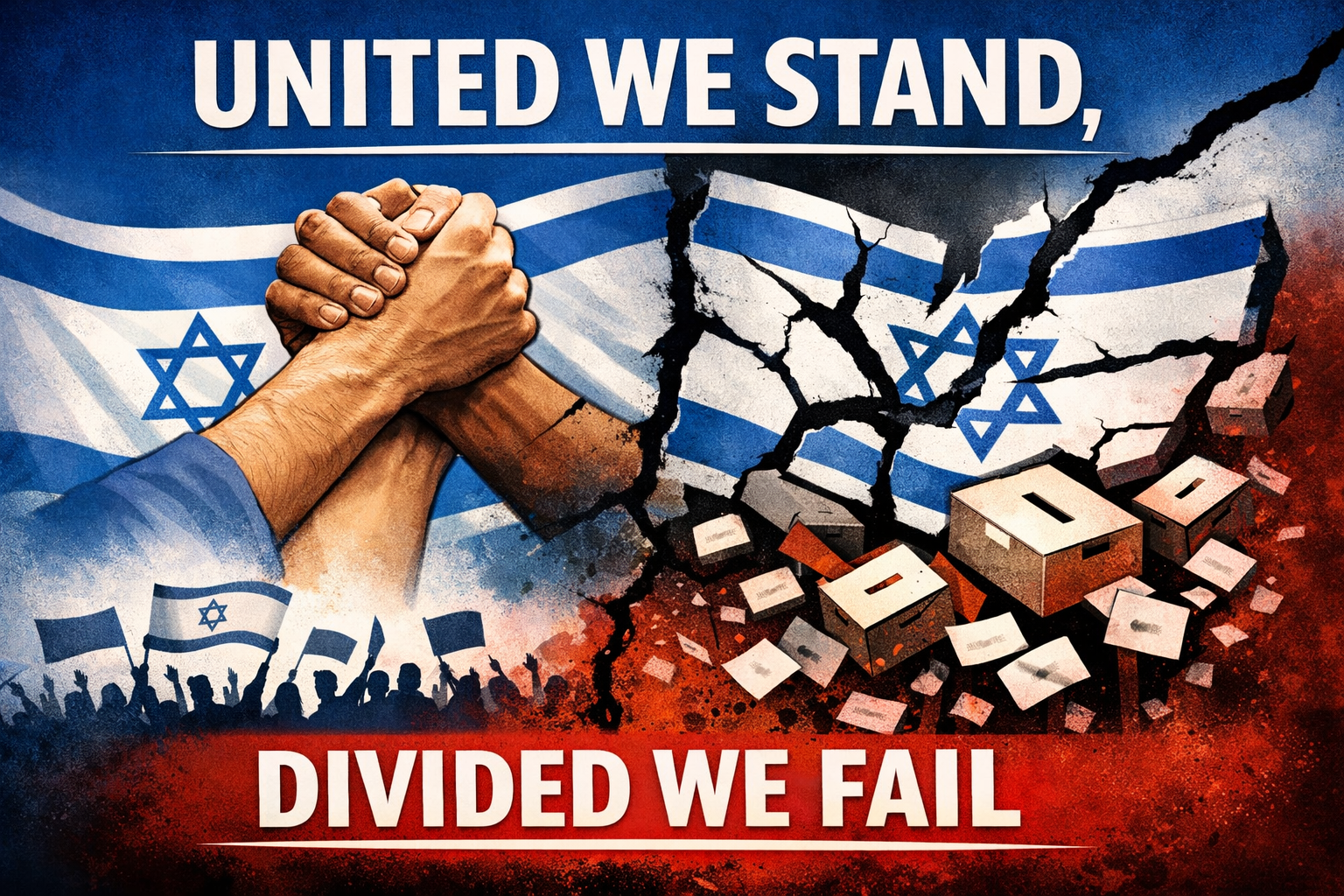
Computer-generated image by Alan P. Gross
The Urgent Need for Opposition Unity in Israel
Israel’s opposition faces a moment of truth: unite or lose – again. As the next election approaches, time is running out not only for opposition leaders but for Israeli democracy itself. This election will not be decided by speeches or ideology, but by arithmetic – the unforgiving math of votes, thresholds, and seats. If the opposition enters the race fragmented, it will fail. The lesson is no longer theoretical. The cost of ignoring it has become existential.
In Israel’s parliamentary system, power belongs to those who maximize votes – not those who merely articulate principles. The right-wing bloc understands this. It suppresses internal rivalries, forms alliances, and runs joint lists to ensure that votes are converted into seats.
The opposition does the opposite. It splinters—protecting party brands, leadership ambitions, and ideological purity at the expense of victory. This fragmentation creates a dangerous gamble: that parties hovering near the 3.25% electoral threshold will somehow survive. History shows that too often, they do not.
A vote cast for a party that fails to cross the threshold is not just wasted—it actively strengthens the ruling coalition. These votes are effectively transferred to the other side, distorting the electorate’s true will. Polls may show a majority favoring change, yet election night delivers continuity – not because voters changed their minds, but because opposition votes were scattered and squandered.
In the last election alone, approximately 300,000 votes were lost this way. That number is not marginal. It is decisive.
The Cost of Division
Fragmentation has become a recurring political tragedy. Hopes for change were dashed – not by public apathy but by poor strategy. The message to opposition leaders should now be unmistakable: unity is not a luxury. It is a prerequisite for governing.
Ignoring the electoral threshold is political malpractice. Any strategy that tolerates parties drifting near or below it is not opposition at all—it is inadvertent assistance to the ruling coalition.
If the opposition is serious about replacing the current government, it must get its act together now. A united electoral bloc must be formed well before the next election. One framework. One strategy. One clear promise to voters: every vote for change will count.
Unity requires compromise. It demands difficult negotiations over placement, messaging, and leadership. But the alternative – another divided run and another lost election – is far more damaging.
The Essential Role of Arab-Israeli Political Parties
There is no viable path to victory without the full inclusion of Israel’s Arab-Israeli political parties—nor should there be.
Arab-Israeli citizens are not a peripheral constituency; they are a central pillar of Israel’s electorate. Excluding Arab parties is not only unjust – it is politically self-defeating. The numbers simply do not add up without Arab-Israeli participation.
Arab-Israeli voters have repeatedly demonstrated political maturity, pragmatism, and a willingness to engage constructively in parliamentary life. The opposition must respond with genuine partnership – not symbolic gestures, conditional legitimacy, or last-minute appeals. Inclusion must be real, respectful, and unconditional.
Unity Without Uniformity
Unity does not require ideological conformity. It requires prioritization.
The immediate goal is clear: replace a government that has weakened democratic norms, deepened social divisions, and governed by crisis rather than vision. Policy debates and ideological disagreements can – and must – resume afterward. But first, change must be achieved.
That change will require leadership. It will demand placing the national interest above personal ambition. It will require discipline, restraint, and political courage from those who claim to offer an alternative.
Stakes for Democracy
Voters are exhausted. Cynicism is rising. Another fragmented opposition run will not be forgiven.
The choice before opposition leaders is stark: unite and govern—or remain divided and protest their own irrelevance. The future of Israeli democracy depends on this decision. Unity is no longer just a strategy. It is a civic imperative.
And Finally . . .
United we stand. Divided we fail.
The opposition must decide – now – whether it intends to shape Israel’s future or continue lamenting its own impotence. The time for excuses has passed. Only a united front can deliver the change that so many Israelis seek – and that Israel urgently needs.
Related Topics
Related Posts