
Unprecedented U.S. Aviation Chaos: Nationwide Air Traffic Control Failure
November 13, 2026 — Developing Story
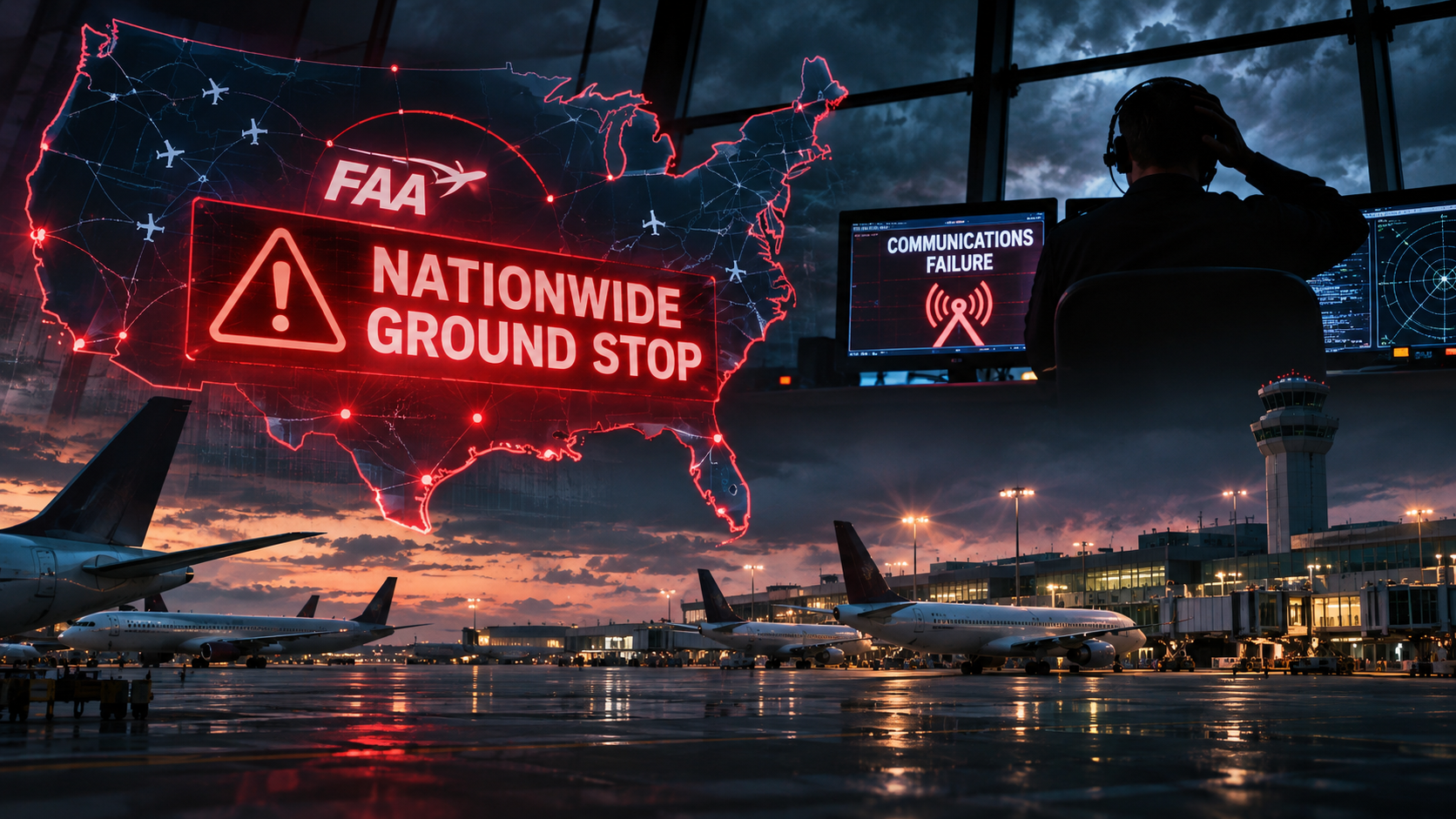
The Federal Aviation Administration (FAA) ordered a nationwide ground stop on Friday after a major communications failure reportedly affected the country’s 22 regional air traffic control centers, disrupting thousands of flights across the United States.
Transportation Secretary Sean Duffy confirmed that technicians were investigating the failure. According to the Associated Press, the nationwide ground stop was scheduled to remain in effect until at least 11 p.m. Eastern Time, although authorities could modify the restrictions as conditions evolved.
By 2:30 p.m. Pacific Time, more than 9,900 flights had been delayed and approximately 900 canceled, according to FlightAware data cited by the Los Angeles Times.
The nationwide suspension is historically significant. On September 11, 2001, authorities halted civilian aviation following the terrorist attacks. On January 11, 2023, a malfunction in the FAA’s Notice to Air Missions (NOTAM) system temporarily grounded departures.
Friday’s emergency is different: it involves reported failures in communications supporting active air traffic control. Whether a simultaneous disruption of this magnitude has occurred before remains unclear.
The greatest immediate concern is aircraft already airborne. Although the ground stop prevents additional departures, aircraft in flight must still be safely managed and brought to their destinations or alternative airports.
Disrupted communications can complicate aircraft separation, altitude instructions, and coordination between control sectors. Audio recordings from the Chicago regional center reportedly indicated failures affecting radio frequencies and automated aircraft handoffs.
Aircraft unable to land at their intended destinations may require holding patterns or diversions, increasing fuel consumption and pressure on flight crews. Commercial aircraft have emergency procedures and collision-avoidance systems, but these safeguards do not eliminate every operational risk.
Emergency authorities, airport rescue services, and hospitals near major airports should prepare for potential aviation accidents in the hours following the communications failure, particularly while aircraft already airborne continue operating under disrupted air traffic control conditions.
Authorities reported that all aircraft already airborne had been accounted for and were continuing to land under established safety procedures. No accidents directly attributed to the disruption had been confirmed.¹
The incident also exposes longstanding weaknesses in America’s aviation infrastructure. Congress allocated approximately $12.5 billion in 2025 toward modernization, while Duffy has estimated that another $30 billion may be needed.
Separately, Microsoft 365 experienced a global service disruption affecting Outlook, Teams, and other applications. Microsoft attributed its outage to network infrastructure changes and stated that it had found no evidence of malicious activity or involvement by artificial intelligence.
Homeland Security Secretary Markwayne Mullin confirmed that some communications systems remained operational while others had become overwhelmed. Authorities reported no indication of a malicious attack, although the definitive cause remains unknown. Investigators have not ruled out a possible connection to the Microsoft outage.
Three questions now demand answers: What failed first? Why were so many regional centers affected? And why did backup systems not prevent a nationwide ground stop?
For the United States, the immediate challenge is restoring safe flight operations. The longer-term challenge is determining how a communications failure could disrupt an aviation network on which millions of passengers depend.