Up from Punxsutawney
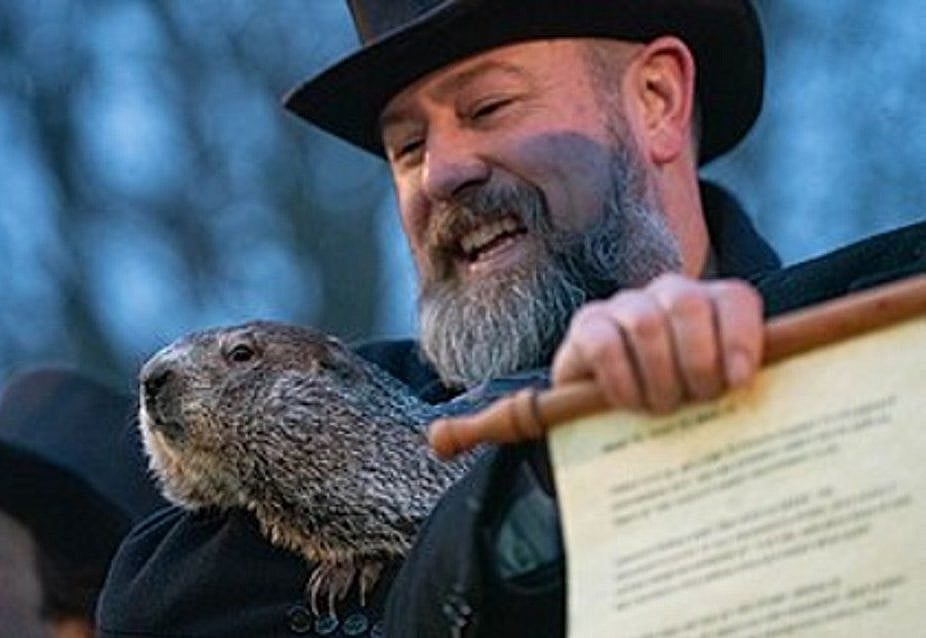
If Punxsutawney sounds not just silly but familiar, that is because Punxsutawney Phil, the famous groundhog, shows up there every February 2nd to predict when winter will end, based on whether he sees his shadow. (His track record is spotty, but even AI makes mistakes.)
Dad took this job because that’s what one kind of Jewish boy did to make extra money. Instead of tending bar or caddying at the golf course, Jewish boys who knew nusach and had ancillary shul skills copped gigs for the High Holidays.
What did Dad do there? Most everything. He davened Mincha, Ma’ariv, Shacharit, Musaf, and Ne’ila. He blew shofar. As Mom used to say later, “When he was done, they gave him a broom, and he swept the place up.”
What were Jews doing in Punxsutawney? Living, working, raising families. In Pennsylvania, Jews lived in Philadelphia, Allentown, Harrisburg, and Pittsburgh, but also in many small towns without famous groundhogs. They opened furniture and dry goods stores and kosher butcher shops. And they built shuls. Not little shtiblach. Big, solid buildings, to show they had arrived.
My father was born in Hazleton, Pennsylvania. (The founders misspelled Hazel.) This is in the northeast part of the state, near Scranton, anthracite coal country. His father, my Zeyde Feivel, answered an ad in a New York Yiddish newspaper for a melamed, a teacher. There he stayed 50 years, terrorizing generations of Jewish boys into learning how to daven and leyn.
His wife, my grandmother, passed away four years before I was born and is buried in Hazleton. In Dad’s last years, when he could no longer drive, I drove him to visit his mother’s kever during Chodesh Elul. When we got off Route I-84 and headed south on Pennsylvania Route 309, at every sign pointing to a nearby town, Dad would say, “They had a shul,” “They had a shul.” Or sometimes, “Drifton. No shul.” Some towns with shuls were small communities. People came into the big town, Hazleton, for the High Holidays.
Much later, one of our sons was a rabbi in Kansas outside of Kansas City. There too people would come in from out on the prairie to daven and say Yizkor.
I was born in the opposite, southeast corner of Pennsylvania, in Uniontown. They called it that because it was incorporated on July 4, 1776.
Dad started his rabbinical career in towns in Ohio and Indiana. The shtelle in Uniontown was a step up. Uniontown was the county seat of Fayette County, which in the early 20th century was the richest county in the US. Pittsburgh coal barons had built mansions there.
Jews moved in to continue the work they had done in Europe: open stores to cater to the Poles, Slovaks, and Hungarians who had come to work in the mines. The coal there was bituminous, soft coal. Pretty much everything in town was covered with soot, including the pitch black tree trunks. When we used to visit my grandparents in New York, I would ask, “Why are the trees brown?”
Ten years ago, I found myself back in Uniontown. I visited what had been my father’s shul.
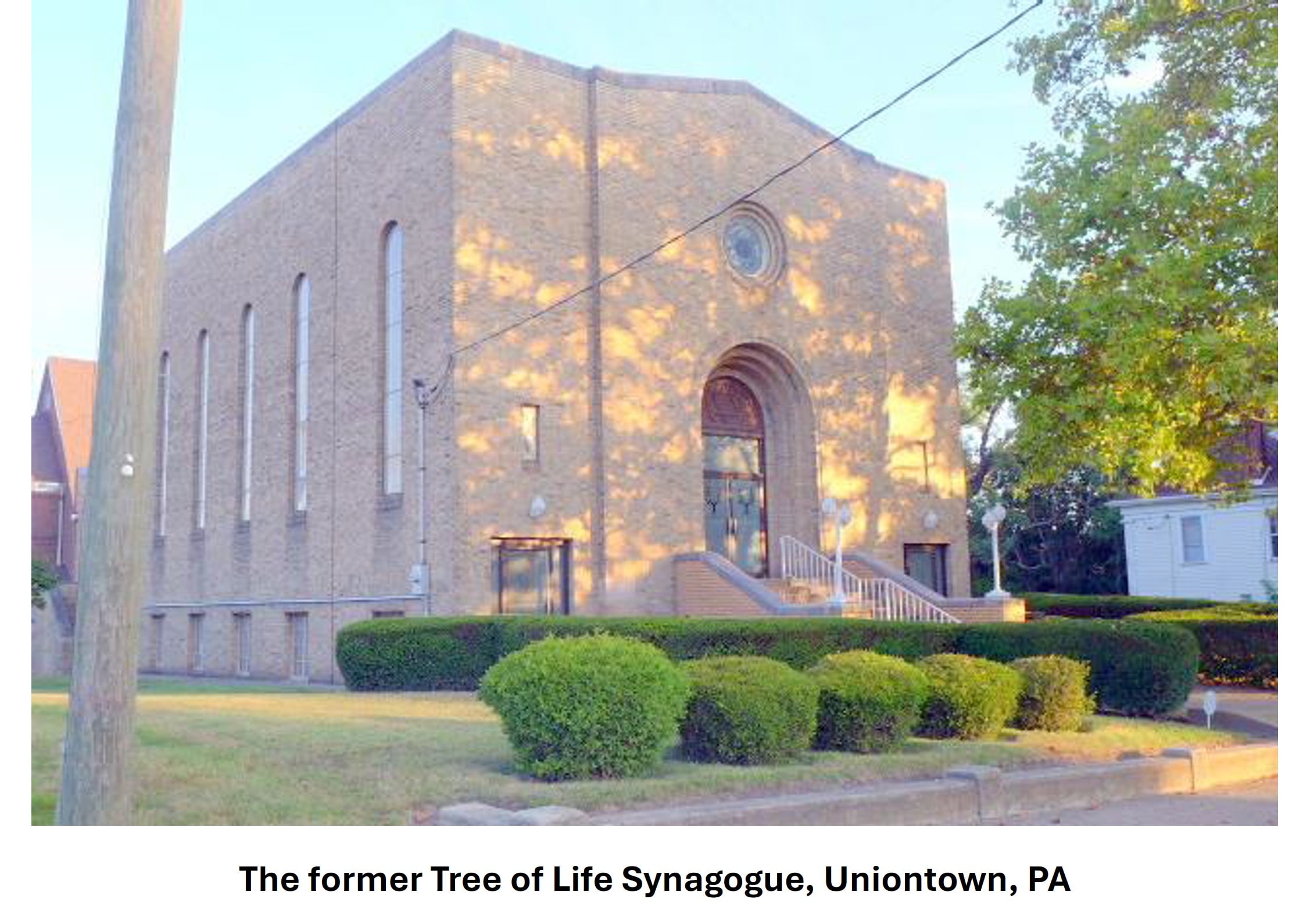
This was now a church run by a pastor who earned his living as a social worker. His parishioners were all women from the Caribbean who worked in the hotels up on the mountain.
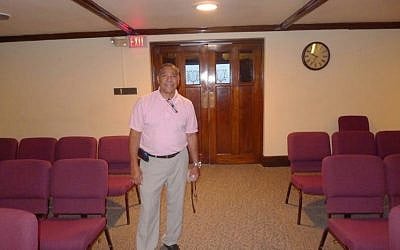
The pastor welcomed me when I stopped by, explaining that the building’s Jewish origins were of interest to him. When I emerged from his office into the sanctuary, I met two rows of women singing hymns and introduced myself. “I was born here,” I said, “My father was the rabbi in this place.” They looked at me with utter bewilderment, as though I had dropped in from another world. Which in a sense I had.
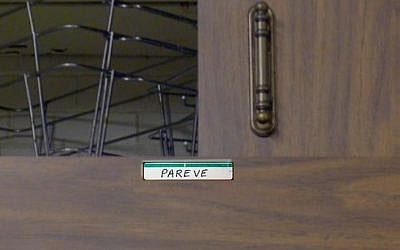
Downstairs there remained a handsome, well-equipped kitchen, unused for decades. Heavy dinnerware filled the cabinets. Back in the ’40s, the Sisterhood had no doubt catered large gatherings, for shul dinners or communal celebrations.
On one of the cabinets there was a sticker that read: “Pareve.” Clearly too small and obscure to bother removing.
There were shuls not just in Uniontown, but in little towns all around it: Masontown, Brownsville, Connellsville, each stocked once upon a time with Sifrei Torah. These too were substantial buildings, put up in the early part of the last century.
To visit what was once the shul in Connellsville, we needed directions, as now it was the Apostolic Holiness Church.
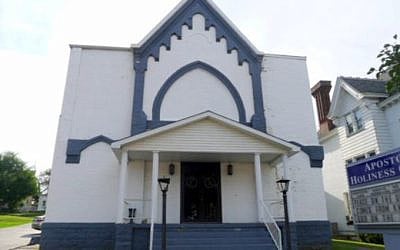
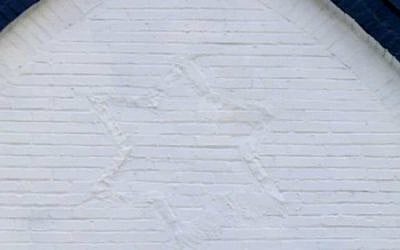
We looked for clues to its original purpose. The cornerstone was painted over and illegible. Staring at the façade finally detected what we were looking for, barely visible above the triangular pediment:
On one of Dad’s trips back to Pennsylvania when he still drove, he and my Mom stopped in at McKeesport, near Pittsburgh. At one point that town had quite a substantial Jewish community.
As luck would have it, the McKeesport Jewish community was gathered that very day to celebrate the 70th wedding anniversary of its oldest members. The large crowd included generations of the celebrants’ descendants. Most of them were not Jewish.
I don’t know about the whole state of Pennsylvania, but all the small-town shuls, from south of Pittsburgh down to Cumberland in the Maryland Panhandle, are closed, their communities gone.
* * *
Rather than end with a somber farewell to a small slice of small-town American Jewish life, I will instead tell a tale, this one with an upbeat ending, of one more obscure Pennsylvania burg with a lot of syllables: Shenandoah.
Dad’s brother Chaim, for whom one of our sons is named, chose one of the other jobs available to Jewish boys who wanted to keep Shabbat. He became a chazen-shaychet (חזן שוחט, pronounced Lithuanian-style.) His first post was in Youngstown, Pennsylvania, the second in Shenandoah, 17 miles south of Hazleton. Chaim also leyned in and led the shul, which had no rabbi at the time.
Shenandoah lies in a valley. I recall as a boy sitting in the back seat as we drove down the mountain on a clear day. On the road before us floated a fleecy white cloud, as though we were descending from the heavens.
The shul in Shenandoah has an attractive building. But there are no Jews left in town to see or use it.
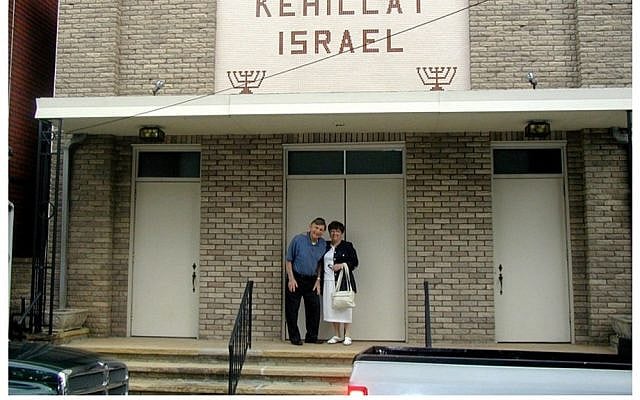
The Shenandoah Shul, Rabbi Irving and Stella Rockoff
On one of our trips to Hazleton, we took alng Chaim’s widow, my Aunt Stella. Stella was a remarkable woman, brimming with wit, musicality, and penetrating intelligence. When she served for decades as executive secretary of the Rabbinical Council of America, Stella came to know—and be known by—most every Orthodox rabbi in the US and many in Israel.
Stella was born in the Beis Yisroel neighborhood of Jerusalem, next to Me’ah She’arim, in 1921. Because her family could not make ends meet, they moved to Williamsburg, Brooklyn, six years later. There Stella became best friends with my mother. They married brothers and stayed close all the years.
Aided by her family, Stella returned to Israel in 2023. At 101, she was the second-oldest recorded returning olah.
Nefesh B’Nefesh notified the press, and arranged a gala welcome at Ben Gurion Airport.
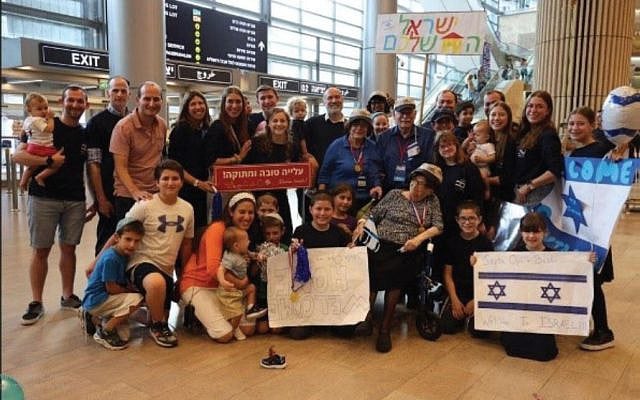
Stella lived happily among her Israeli family until earlier this year, when she passed away at age 104. Meantime, her large Israeli family had grown even larger.
Every one of them is Jewish.