Urban Renewal: an Updated Land Redemption Strategy
It’s time for the next frontier of Jewish philanthropy
A Pushke
That’s what my Yiddish-speaking grandma called the tin Blue Box found everywhere in Israel and the diaspora when we were young. A coin by coin, harnessing the collective force of Jewish givers to build the young state of Israel. This practice, taken from the beautiful tradition of the Tzedakah box, took place when the paramount goal was the redemption of land for the future Jewish state.
For decades, the narrative of Jewish philanthropy has been deeply intertwined with the soil of Israel. First, it was used to acquire strategic lands, laying the foundations of the Jewish Yishuv, and later, it helped to establish towns that were instrumental in absorbing the hundreds of thousands of Olim from across the globe in places like Ofakim, Ashkelon and Kiryat Shmona.
This philanthropy was the bedrock of Israel’s national infrastructure.
The Modern Crisis: Crumbling Legacies and Exposed Lives
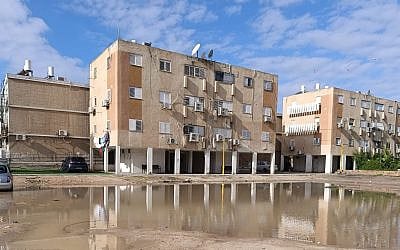
Today, the central challenge is no longer acquiring raw land. Yet many peripheral towns built rapidly to house waves of immigrants are now facing a quiet crisis. Walk through the older neighborhoods of Ofakim, Ashkelon or Kiryat Shmona – you’d see the toll of decades of neglect:
Crumbling buildings, highly vulnerable to earthquake damage, and more critically, in Israel’s volatile security reality, these old buildings, constructed before the First Gulf War of 1991, lack a reinforced safe room. Families in these peripheral neighborhoods – often among Israel’s most socioeconomically vulnerable – are therefore physically exposed to both earthquakes and rocket fire.
The Market Failure of Urban Renewal
At first glance, the solution seems obvious: urban renewal. Indeed, Israel is undergoing a reconstruction boom in which old structures on low density lots are demolished and replaced with modern, reinforced buildings equipped with safe rooms.
The benefits are substantial. Homeowners receive new, larger and safer apartments; neighborhoods attract new residents; infrastructure and public spaces are upgraded; Developers, in turn, gain new business opportunities; From an environmental standpoint – housing supply increases without expanding further into undeveloped land.
However, this urban renewal boom is profoundly unequal. The vast majority of redevelopment is concentrated in high-demand central districts: According to the Israeli Government’s 2025 report, a third of Israel’s new housing units are sourced in reconstruction – 90% of them are concentrated in the Tel Aviv Metropolitan area.
Why? Economics.
In the periphery, market economics meets lower property values that erode developer margins and make projects appear riskier to lenders. Projects that are financially viable in Tel Aviv can remain frozen in a place such as Ofakim.
The consequences go beyond buildings. Urban renewal can increase the value of a family’s largest financial asset – their home – while improving the public realm around it, serving as an effective catalyst for social mobility. Yet the communities most exposed to security and seismic risks, and those that could benefit most from rising household wealth, are precisely the ones the market is least able to serve. A bleak chronicle of widening socioeconomic gaps.
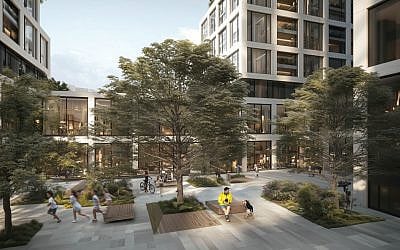
An evolving strategy for Land redemption
This is where philanthropy can play a distinctive role.
The battle in Israel’s physical building in the 21st century is not about buying raw land; it is about strengthening the communities already living on it and enabling development and progress.
Philanthropic capital can help correct the market failure by absorbing precisely the slice of risk that prevents commercial capital from entering. Blended-finance tools such as impact loans, guarantees or other forms of catalytic capital can lower financing costs and reduce risk for developers and lenders. Philanthropy does not need to finance entire projects. Its value may lie in unlocking much larger pools of private capital and turning otherwise frozen projects into viable ones.
This is still a largely empty field – and an opportunity for philanthropy to design it. Manof, an innovative nonprofit developer that uplifts Israel’s poorest neighborhoods through a model that pairs real estate investment with comprehensive social support, is leading the charge to do just that. Operating directly in the periphery’s urban-renewal market, it has developed a blended-finance model that combines philanthropic capital with commercial financing to unlock projects that would otherwise remain unviable.
It’s time for more Jewish philanthropists to follow suit.
The early pioneers understood that land was more than a resource; it was the foundation on which a society could be built. A century later, the challenge of land redemption does not mean purchasing another dunam, but rather ensuring that the communities already living on it are safe, resilient and able to thrive.
The blue Pushke asked generations of Jews to turn scattered coins into the physical foundations of a state. Today, philanthropy can play a different but equally catalytic role: using its capital to unlock investments the market will not make on its own and strengthen Israel’s vulnerable communities.