
Useful allies, unnecessary risk
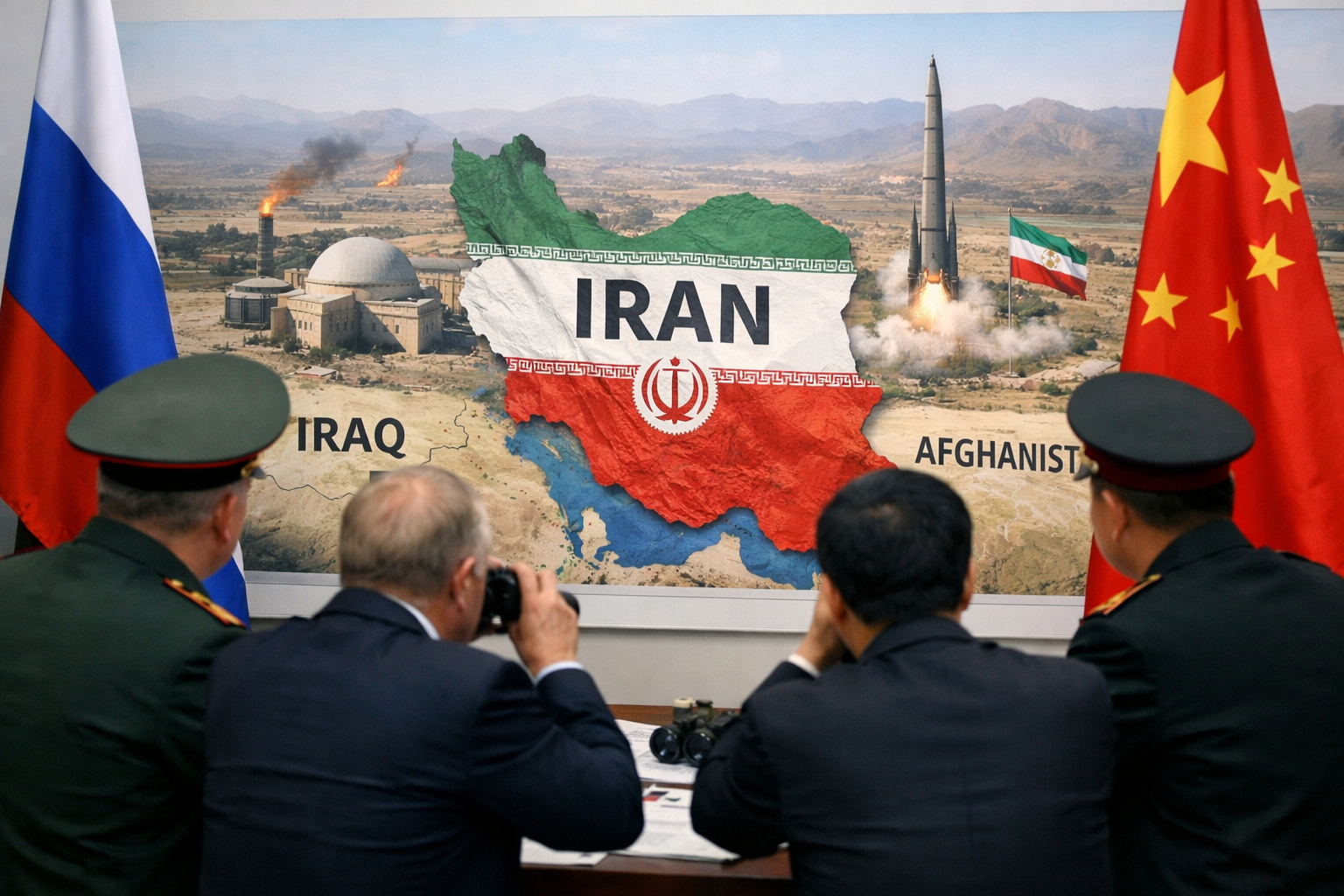
The Iranian crisis confronts Beijing and Moscow with a dilemma of the revisionist powers: to take advantage of a partner that blocks the West, without paying the price of an overt show of solidarity at a time when pressure is rising. Iran is for them a lever—geopolitical, energy, diplomatic—but it is not an ‘ally’ in the strict sense of the term. And it is precisely when Washington shows its muscles (military posture, coercive signals) that the real nature of this relationship appears: transactional, asymmetrical, prudent.
1) The illusion of ‘axis’: coalition, not alliance
The idea of a structured axis between China, Russia, and Iran as a nearly mechanical block became common in the West. In reality, we are more faced with a coalition of circumstances: convergence on American anti-hegemony, occasional technical-military cooperation, and opportunistic use of sanctions to create different circuits. But an alliance requires a rare thing: the acceptance of a shared risk. However, neither Beijing nor Moscow has any interest in turning the Iranian file into a credibility test comparable to a collective defense clause.
For China, the essence of competition is elsewhere: trade, technologies, Taiwan, and access to value chains. For Russia, the priority remains strategic survival on its main front, with a diplomatic and military capital already under constraint. Iran is important, but not vital to the point of justifying a direct escalation against Washington.
2) Beijing: stability first, escalation never
The Chinese posture obeys a simple logic: securing the system that allows enrichment, not breaking it. Beijing can denounce the ‘American “adventurism,'” call for de-escalation, and plead for sovereignty. But at the decisive moment, China avoids becoming part of a military gear. Why? Because a surge around Iran means risk premia on shipping, rising energy costs, threats on trade routes, and increased pressure on Chinese partners.
China, therefore, has a “boom” strategy: to calm the game, present itself as a main and responsible power, preserve its channels with all parties, and keep Iran standing enough to remain a partner—but not hot enough to lead Beijing into an open confrontation.
3) Moscow: extend the usefulness of Tehran without attaching oneself to it
Russia sees in Iran a useful piece: diversification of partnerships, strategic depth in the Middle East, economic and politico-military opportunities, and the ability to complicate the Western game. But Moscow also knows the cost of heavy alliances. Therefore, the Kremlin adopts a balanced support strategy that includes principled speeches against interference, technical cooperation, and diplomatic symbols, all while maintaining a vigilant focus on safeguarding its assets and avoiding escalation that could force them to make a decision.
If American pressure rises, Moscow retreats to the instinct of strategic survival: minimizing exposure, preserving exits, and maintaining an ambiguity that allows it to monetize its role—mediator, supplier, “technical guarantor”—according to the evolution of power relations.
4) The real dilemma: save Iran or save their interests?
The dilemma’s main issue is not moral; it is structural: Iran is a useful partner as long as it is predictable. Yet a prolonged internal crisis, a militarization of the confrontation with Washington, or an uncertain transition makes Iran less an asset than a systemic risk. Beijing and Moscow must therefore do two things at the same time:
Prevent a chaotic collapse that would open the door to regional instability and energy disruption and prepare for the after in case…
This doesn’t mean they “abandon” Iran; it means they do what all pragmatic powers do: cover the risk. Support becomes conditional, discrete, and reversible.
Loyalty has a price, and Iran has an invoice.
In the Iranian moment, China and Russia reveal an uncomfortable truth for Tehran: in a transactional coalition, solidarity is never automatic. Beijing and Moscow want an Iran that resists sufficiently to remain a pole of nuisance against the West, but not to the point of igniting the international system. Between a useful ally and an unnecessary risk, they will always choose their interests. And it is there that the game is played, not at “the end” of an axis, but in its reality: a partnership of convenience, not a pact of fate.