Vaerá 2026 — The era of the hardened heart
Vaerá 2026 — The era of the hardened heart
We do not live in a time of ignorance.
We live in a time of hardening.
That is the brutal turn that defines our age.
For centuries the human being could excuse himself by saying: “I didn’t know.”
Today that phrase no longer works.
We know about climate collapse.
We know about digital addiction.
We know about the epidemic of loneliness.
We know the system is sick.
And yet… we continue.
Not for lack of evidence.
But for something darker:
because the heart has learned to close without ceasing to function.
That is Vaerá.
That is 2026.
I. Revelation as excess
In Vaerá, HaShem does not bring information.
He brings presence.
But even that collides with an unexpected obstacle:
the heart can become impermeable to light.
That is the terrifying mystery of the text:
truth appears… and the system does not collapse.
It hardens.
The same thing happens today.
Never has there been so much information available.
Never so much evidence.
Never so many diagnoses, books, podcasts, therapies.
And yet, modern humanity does not awaken.
It saturates.
And in saturation the worst happens:
consciousness does not open.
It defends itself.
Thus the new Pharaoh is born:
not a tyrant with a whip,
but a mind that has learned to protect itself from truth.
II. The algorithm as teacher of hardness
Modern hardening has a particular signature.
The feed is not designed to make you true.
It is designed to make you reactive.
Tribal.
Predictable.
Hardening looks like this.
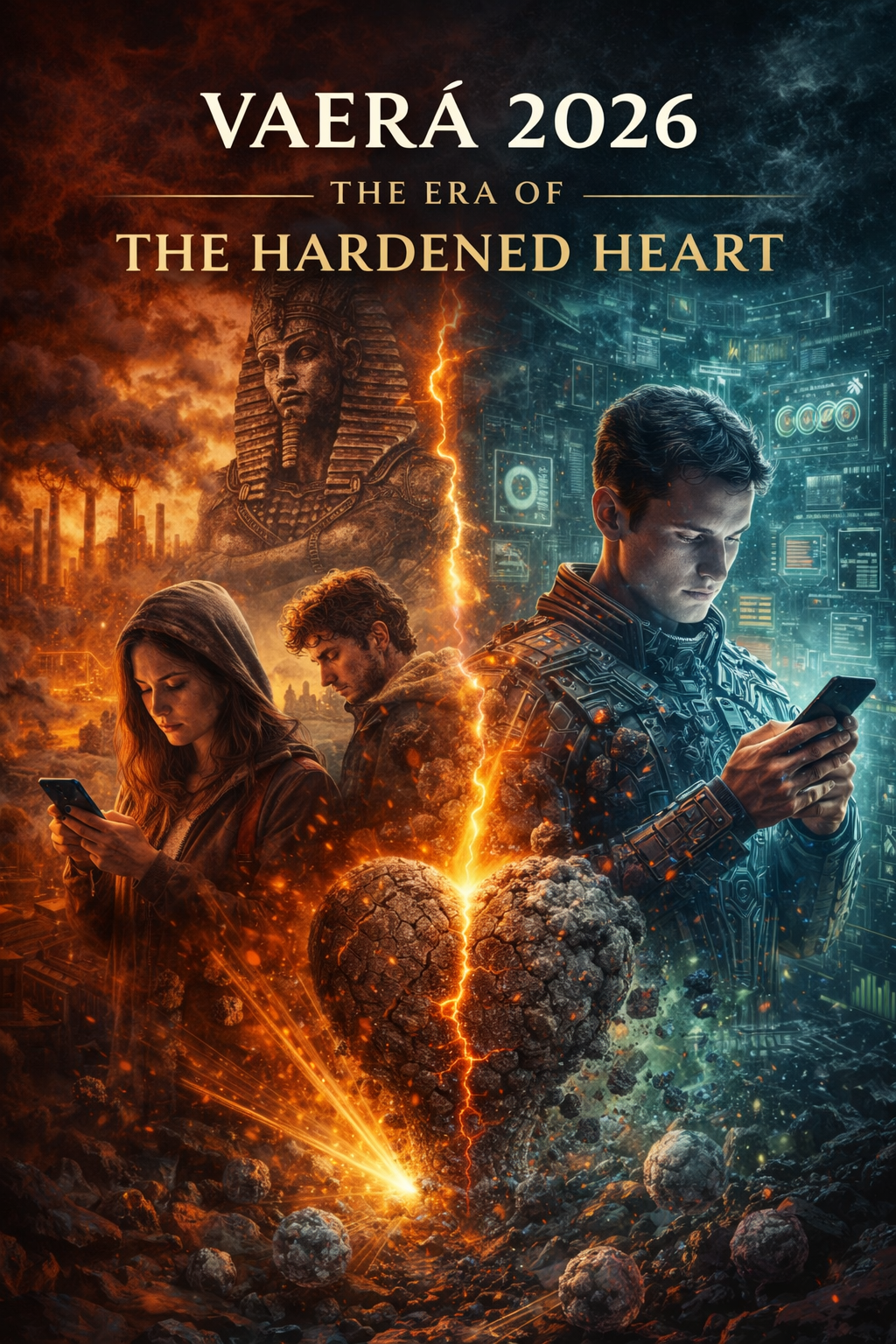
You can see suffering and feel nothing.
You can see injustice and turn it into entertainment.
You can see tragedy and scroll.
You can see decadence and call it “normal”.
No one needs to chain you anymore.
It is enough that you do not feel.
And the most unsettling thing:
today the system does not need to censor truth.
It only needs to turn it into content.
When truth becomes content, it stops transforming.
It becomes one more thing.
One more frog.
One more hailstorm.
III. Mi-kotzer ruach: the people without air
Vaerá says the people do not listen because of mi-kotzer ruach.
Lack of spirit.
Lack of air.
That today is literal.
Contemporary humanity has no inner air because it lives inside continuous pressure.
Constant notifications.
Economic demand.
Hyperstimulation.
Loneliness disguised as connection.
Perpetual comparison.
Cheap dopamine.
Chronic fatigue.
It is not lost.
It is exhausted.
And when someone is exhausted, even hope becomes heavy.
Not because it is false.
But because there is no space left to receive it.
That explains something hard:
Today there are people who could awaken…
but they are too tired to do it.
The people do not need more information.
They need air.
IV. Pharaoh 2026: identity as prison
The core of Vaerá is Pharaoh.
Pharaoh sees.
Pharaoh suffers.
Pharaoh confesses.
And he closes again.
That cycle defines the West.
We live in the empire of “I already know”.
“I already know it harms me.”
“I already know it’s toxic.”
“I already know I have to change.”
And yet we continue.
Why?
Because closure is no longer ignorance.
It is identity.
Many people today do not defend an idea.
They defend a self.
And when truth threatens the self, the self becomes Pharaoh.
It would rather break the world than surrender.
That is hardening:
a consciousness that chooses its prison because leaving would destroy its narrative.
V. The plagues as symptom
In Vaerá, the plagues are not punishment.
They are exposure.
Today the plagues are not frogs.
They are mass burnout.
A fertility and family crisis.
Chronic anxiety.
Obesity and anorexia at the same time.
Emotional dissociation.
Spiritual collapse disguised as freedom.
Reality fractures.
And the world responds with more consumption.
That is Pharaoh:
confusing anaesthesia with life.
And here is the cruellest point:
The plagues do not destroy the system.
They only expose it.
The system falls only when a person stops belonging to it.
VI. Moshe 2026: the voice without negotiation
In Vaerá, Moshe changes.
He does not become strong.
He becomes channel.
That today means something precise:
To be spiritually adult is to stop negotiating with self-deception.
Moshe 2026 is the human being who does not argue with his own addiction.
Who does not negotiate with his compulsion.
Who does not use discourse to avoid truth.
Who does not turn the wound into identity.
He speaks from a place deeper than fear.
He no longer wants to convince.
He no longer wants to be liked.
He no longer wants to be understood.
He only wants to be true.
That is what the system cannot tolerate:
a person who no longer needs its permission.
VII. The fidelity that insists
In Vaerá, HaShem insists even when nobody can believe.
That is the news of 2026.
Because modern humanity believes everything depends on emotional state:
“If I feel inspired, I change.”
“If I have motivation, I act.”
“If I feel good, I do teshuvá.”
Vaerá destroys that lie.
Redemption does not depend on your mood.
It depends on a fidelity that works beneath.
Your soul can be closed.
Your life can be saturated.
You can be broken.
And yet… the light insists.
That insistence is the only thing that saves.
VIII. Closing: the only possible Exodus
Vaerá 2026 does not say: “The world will be fixed.”
It says something more brutal:
The lie cannot hold forever.
Truth does not ask permission.
It does not ask for consensus.
It does not ask for comfort.
It insists.
It strikes.
It returns.
It pierces.
Until closure becomes visible.
And when it becomes visible, you can no longer say: “I didn’t know.”
That is where the real Exodus of our time begins.
Not leaving a country.
Leaving hardening.
Not leaving a system.
Leaving the self that clings.
Freedom today is not information.
It is permeability.
It is feeling again.
Listening again.
Breathing again.
Because the hardened heart can survive…
but it cannot live.
And this is what Pharaoh never understood:
Truth does not need you to accept it.
It only needs you to stop running.
And if you do not stop running…
it will reach you anyway.