


I believe in independent, clear, and courageous journalism – especially where injustice is being silenced
Venezuela and Beyond: What the U.S. Naval Surge Really Means
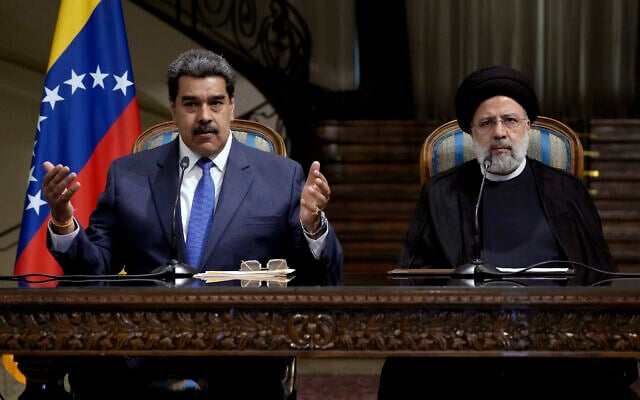
Venezuela's President Nicolas Maduro, left, speaks in a joint news briefing with his Iranian counterpart Ebrahim Raisi at the Saadabad Palace in Tehran, Iran, June 11, 2022. (AP Photo/Vahid Salemi)
The United States has deployed a significant military contingent to the Caribbean and Pacific regions, including eight warships, two nuclear-powered submarines, military helicopters, aircraft, and approximately 8,000 personnel. Officially, the operation is framed as part of Washington’s ongoing counter-narcotics efforts, but experts suggest broader geopolitical motivations.
According to Axios, the naval deployment near Venezuela may serve multiple purposes beyond anti-drug operations. The force reportedly includes seven surface vessels with 4,500 personnel and one submarine. While the U.S. frames this as counter-narcotics enforcement, it coincides with Washington’s longstanding opposition to Venezuelan President Nicolás Maduro, who is offered a $50 million reward for capture.
Maduro swiftly condemned the deployment as “imperialist aggression,” claiming it violates Venezuela’s sovereignty. In response, he activated approximately 4.5 million members of the national militia and mobilized additional forces along Colombia’s border. Maduro also sent Venezuelan military and diplomatic envoys to the UN, warning that Washington’s actions threatened regional peace. International allies of Caracas, including Cuba, China, India, and Belarus, publicly supported Maduro and denounced the U.S. deployment.
Strategic stakes
Analysts see several strategic goals behind Washington’s move: containing China in the Pacific, limiting Russian influence in Latin America, and securing critical trade and energy routes.
Yet this move also carries serious risks. Maduro’s robust military response illustrates Caracas’ determination to signal sovereignty and resist U.S. pressure, creating a high-stakes standoff.
Geopolitical implications
The deployment sends clear signals: To allies: Washington demonstrates it can project power rapidly and maintain military dominance. To adversaries: Moscow and Beijing are reminded that U.S. presence in the Western Hemisphere remains a strategic reality, not negotiable. To regional actors: Latin American governments are warned against undermining sovereignty norms, highlighting the U.S.’s willingness to act when key interests are threatened.
While framed as counter-narcotics enforcement, the U.S. naval deployment clearly carries broader strategic aims. Maduro’s mobilization of militia and border forces demonstrates that Venezuela views the move as a direct challenge to its sovereignty. Analysts suggest that Washington’s actions reflect not only regional security concerns but also potential preparation for political leverage or regime pressure in Caracas. The situation remains volatile, with significant escalation risks for the Caribbean and broader Latin America.