

Victory ’45: the End of the War in Eight Surrenders
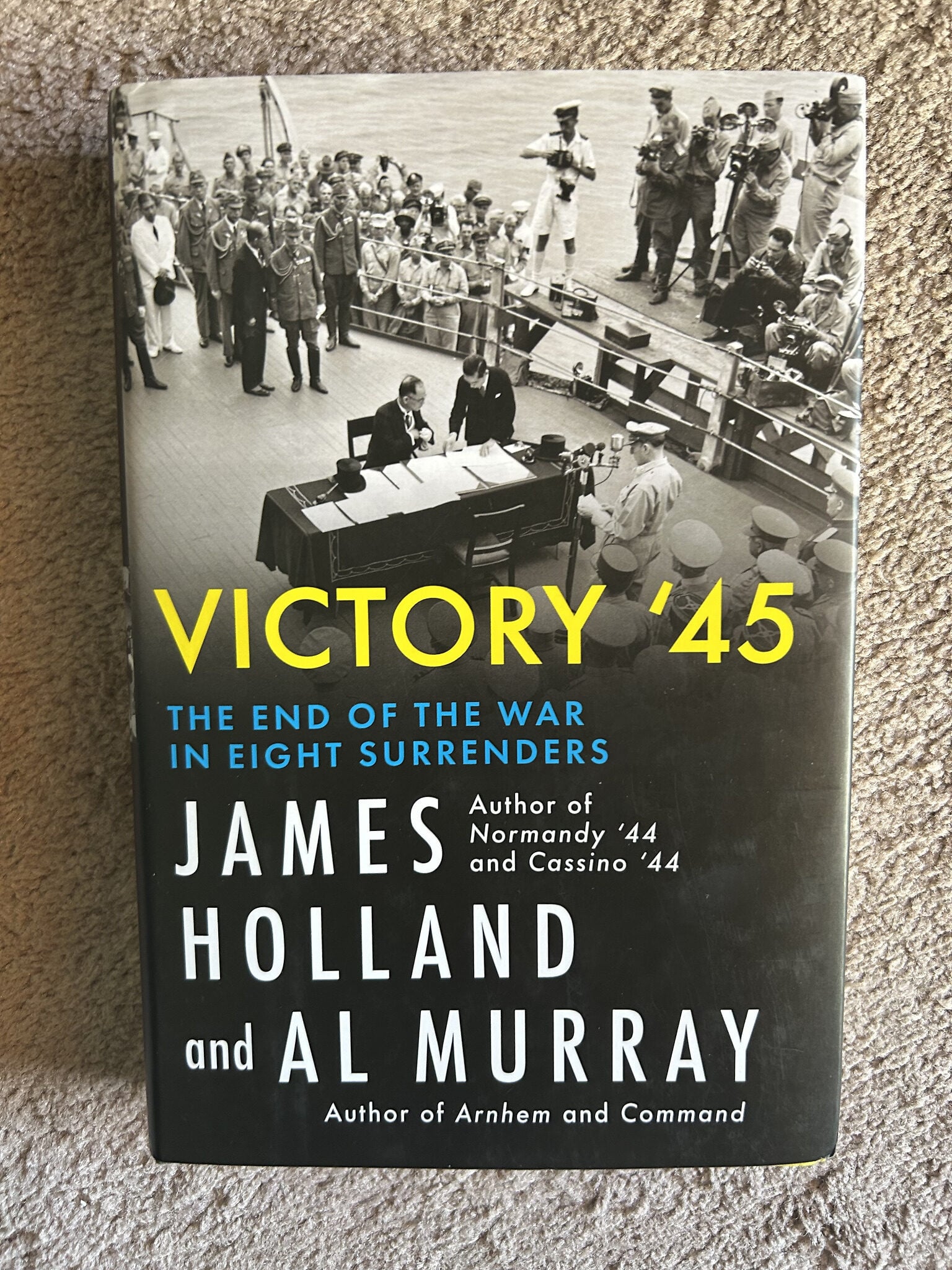
The concept of unconditional surrender imposed by the victorious Allies on the defeated Axis powers at the end of the Second World War was first enunciated by U.S. President Roosevelt at his meeting with Churchill in Casablanca in 1943. That had been the requirement imposed by General Ulysses S. Grant on the Confederate force he had defeated in the American Civil War.
The authors, James Hollamd and Al Murray, detail the circumstances leading up to each of the surrender ceremonies that brought the global conflagration to an end, as well as the various individuals involved on each side and the interaction between them. The first chapter depicts the surrender of Berlin to the Russians in May 1945 and the last describes the surrender of Japan to the USA in September 1945. There were surrender ceremonies in Italy, northern and southern Germany and, of course, Japan. Eight separate surrender ceremonies all in all.
We are given a detailed account of the devastation of Berlin as perceived by the invading Soviet troops, the events leading up to Hitler’s suicide in the Fuhrerbunker, the experiences of a young Hitler Youth recruit hastily enlisted as part of a makeshift fighting force, and the brutal reprisals by Russian troops for the carnage wreaked on Russia and its population by Hitler’s forces. The surrender of Berlin was not achieved in a straightforward way as in-fighting and mutual hostility between Hitler’s generals constituted an obstacle to the final agreement. Obergruppernfuhrer Karl Wolff did his utmost to secure a non-unconditional surrender while jockeying for supremacy over his rival Ernst Kaltenbrunner, but he was unable to achieve his objective. Ultimately it was another rival general, Helmuth Weidling, who signed the unconditional surrender of the city. The account of the privations endured by a Jewish boy, Hugo Gryn (later Rabbi Gryn), and his father as they endured deprivation and forced labour through several concentration camps, among them Auschwitz and Mauthausen, ending with several forced marches, serves to illustrate the fate of millions of innocent Jewish people.
The account of British General Montgomery, ‘Monty’ as he was known, and his eccentric camp headquarters set up on the Luneberg plain just outside Hamburg provides an insight into the customs and habits of that great soldier. Monty’s idiosyncrasies were well-known from his time as commander of the troops fighting Rommel in the Tunisian desert, among them his determination to share the privations endured by his troops, his adherence to a nine-thirty bed-time, the spartan nature of his own accommodation and his constant need for cigarettes. It was only by his threatening to resume hostilities that he finally got the delegation of German generals, led by von Friedeberg, to sign the unconditional surrender document, thereby stealing a march on the Russians in their push for the unconditional surrender of the German troops in Berlin.
The final chapter describes the hard-won surrender of the Japanese fighting force after the destruction of Hiroshima and Nagasaki by the newly developed atomic bomb. It follows a lengthy and graphic account of the privations endured by British and American prisoners of war in Japanese camps. The surrender ceremony held on board the impressive USS Missouri in Tokyo Bay was watched by massed US troops and representatives of the press, and even involved the participation of the emaciated US General Jonathan M. Wainwright who, together with many thousands of fellow-soldiers, had endured starvation, cruelty and abuse at the hands of his Japanese captors. The Japanese Foreign Minister Shigemitsu, who signed the surrender document (which was not quite unconditional as it allowed the Emperor to continue in his role of supreme ruler of Japan) wept as he signed, and later committed suicide, in accordance with the Japanese concept of Bushido – surrender as disgrace. What a contrast with the polite, creative and welcoming nature of modern Japanese society.
The book concludes with a chapter entitled ‘Postscript,’ which sums up the cost of the cataclysmic global conflict and seeks to assess its influence on our lives to this day. The statement which summarizes it all reads: “What is striking….is the astonishing delusion and arrogance of the vanquished and the incredible determination, dedication and bravery of the victors,” serving as an inspiration to us all.