
Viral, not vital: What Hadar Muchtar’s politics tell us
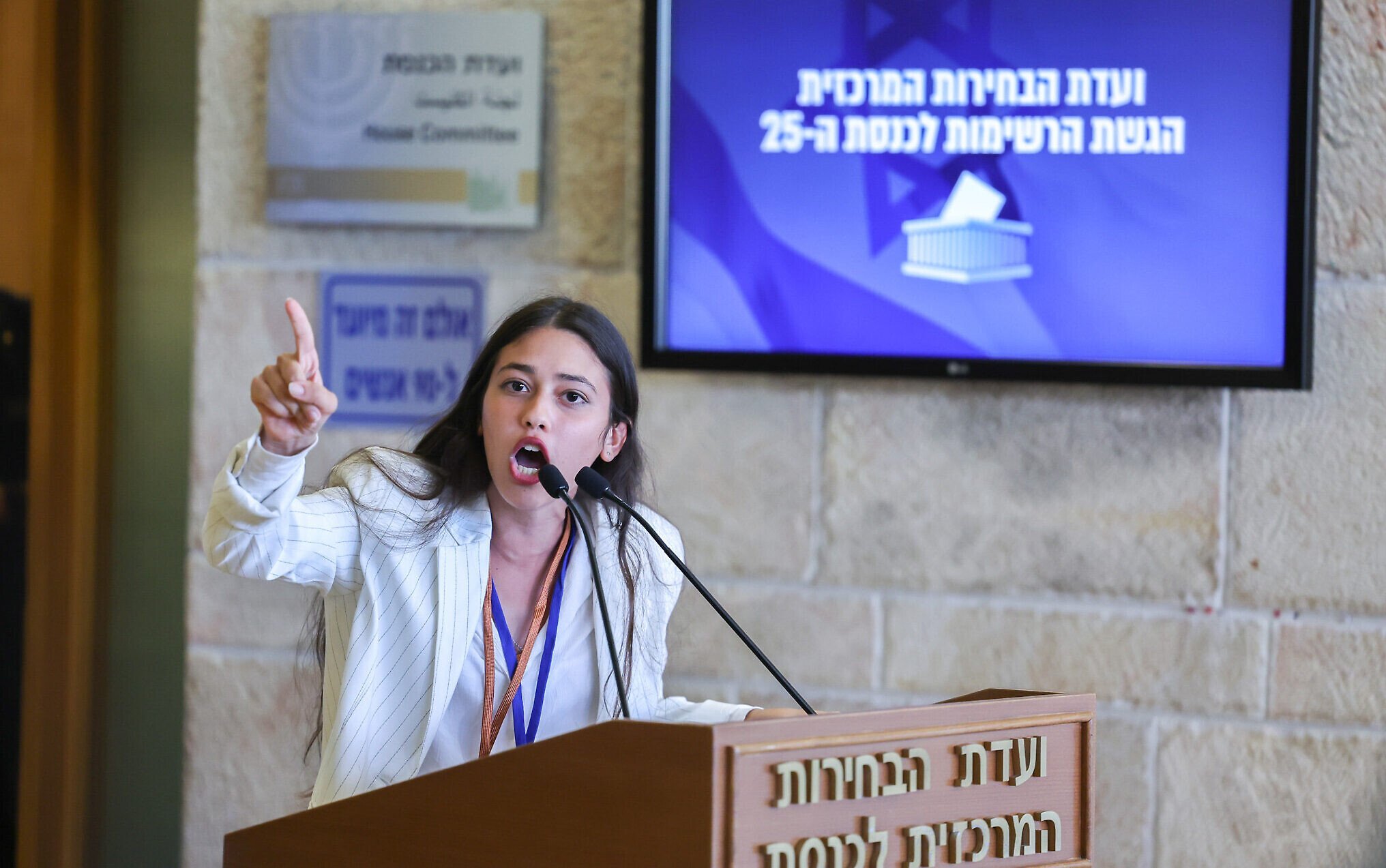
In 2022, Hadar Muchtar burst into the public consciousness with the launch of her Fiery Youth party, promising to tackle the cost-of-living crisis head-on. Her slogans were catchy, her TikTok presence unstoppable, and for a brief moment, she seemed like the voice of a new generation. But two years later, her political résumé reads more like a highlight reel of attention-seeking stunts than a record of legislative impact. Muchtar collapsed during a televised hunger strike, accused the IDF of being more corrupt than politics, and failed to get her party across the electoral threshold. Now, with her recent inclusion in the Likud party, a move she announced just this week, the question isn’t whether she’s serious. It’s whether we’re still supposed to take her seriously.
Muchtar has become more than just a provocateur. She’s a symbol of what happens when performance overtakes policy, when political communication is reduced to an algorithmic gamble. Her public persona is the byword of what media scholar Julia Sonnevend calls in her 2024 book Charm. These techniques of performing authenticity, demasking, breaking routine, restaging, and equalising can be used to connect leaders to citizens. But in Muchtar’s case, they mostly serve to mask the absence of substance.
Take, for example, her supposed authenticity. Muchtar presented herself as an everywoman, a young Israeli struggling with rent, representing the voiceless youth. However, that image unravelled when it emerged she was listed as the owner of a four-room, sea-view apartment in Haifa. She struggled to explain the matter, claiming that the apartment was “on her name, but not hers,” a bizarre phrase that became a meme overnight. She claimed her father had purchased it as his “pension investment,” but that didn’t stop the Israel Tax Authority from investigating the transaction. When pressed on the matter during interviews, she scoffed, “Even if I had two or three apartments, I’d still be here to influence.” The performance cracked, but the cameras kept rolling.
Muchtar also attempted demasking, another Sonnevend technique, by sharing a story of being socially ostracised during her military service in Unit 8200. She described being boycotted, sitting alone during breaks, blamed for “thinking differently.” But her story fell apart under scrutiny. She falsely claimed the only Ethiopian in the unit was “cleaning toilets,” and painted all Unit 8200 soldiers as elite, central-Israel leftists, as a smear that drew public backlash. These statements weren’t revelations of vulnerability, not as such, as they were calculated provocations dressed in personal anecdotes. This fairytale resulted, ultimately, in a deeper credibility crisis.
If there was one moment that perfectly crystallised Muchtar’s transformation into pure spectacle, it came this week on YouTube. She appeared on Between Two Rivers, a bizarre and controversial online talk show hosted by Ido Blau, a media entrepreneur who has made a career out of blurring the lines between provocation and parody. Blau’s show, which recently drew criticism for hosting Israeli erotic OnlyFans stars in between interviews with politicians, is often more about baiting virality than substance.
Muchtar’s segment was no exception. She role-played as a news anchor, delivering outlandish forecasts about her future political takeover, including shutting down media outlets and threatening a “nuclear holocaust” if Arabs refused to enlist. The skit, clearly designed to shock, instead triggered widespread ridicule across social media, with even right-leaning commentators calling it “PR suicide.” What was intended as a moment of restaging, the creation of a friendly, curated environment, turned into a self-own in real time.
Of course, Muchtar’s antics don’t exist in a vacuum. They reflect the systemic transformations of Israeli politics in the digital age, a terrain I explore in my forthcoming monograph The Promised Web. Four key shifts frame Muchtar’s rise and fall, including generational role reversal, political mobility, dependence on digital platforms, and the trivialisation of discourse.
First is generational role reversal. In the past, youth were expected to absorb political wisdom from older generations. Today, younger voices like Muchtar are creating their narratives, but often fall short without the responsibility or depth those roles require. She’s loud, visible, even charismatic in some ways, but her rhetoric rarely reflects policy knowledge or political consistency. Compare that to the legacy of Dafni Leef and the 2011 social justice protests, which, despite their flaws, engaged in sustained grassroots organising. Muchtar’s campaign, by contrast, never advanced beyond the screen.
Second is political mobility, the ability to transform social media clout into political capital. We’ve seen it succeed with figures like Abir Kara, who moved from the “I am Shulman” movement into a Knesset seat. Even Itzik Shmuli, who rose from student union leadership into the Labour Party, built on real policy engagement. Muchtar, though, has yet to translate influence into infrastructure. Her Fiery Youth party failed, and her Likud membership may be her last shot at legitimacy, but Likud is not a safe playground. It’s a battlefield, and Muchtar’s reliance on spectacle may backfire when pitted against the machine politics of seasoned operatives.
Third, there’s platform dependence. Muchtar is a creature of the feed. Her politics live and die by engagement metrics, among Instagram stories, TikTok cuts, and YouTube clips. But the attention economy is fickle. It rewards provocation, not perseverance. In The Promised Web, I describe this as a “degenerative migration”, a shift where digital space absorbs politics but offers only fleeting rewards. Her media footprint is large, but her institutional footprint is non-existent.
And finally, trivialisation. Political discourse is now often flattened into algorithmic bait. Muchtar’s soundbites about the IDF, her sweeping generalisations about Arabs and Haredim, and her reckless comments on Unit 8200 aren’t about starting conversations, as they’re about dominating the feed. Her populism has no thesis, no cause, no endgame. It’s all performance, designed to stir outrage, not to govern.
In this sense, Muchtar represents a particularly shallow version of populism. Think of Donald Trump or Boris Johnson, both indeed populists, but ones who built ideological movements and captured institutions. Muchtar’s populism, by contrast, is episodic and brittle. It’s not about building anything. It’s about staying visible.
As Israeli politics faces pressing issues like war, economic instability, and democratic erosion, the rise of pseudo-politicians like Muchtar is more than a sideshow. It’s a distraction. Her story is not one of revolution, but of regression. Her charisma may keep her trending, but it won’t keep her credible. What’s left is not a leader, but a cautionary tale. A performer in a system that no longer demands substance. And if we continue to reward the performance, we risk forgetting what politics is for.