Visiting the sick – this patient’s perspective
Until I became the patient, I never truly understood the mitzvah of bikur cholim, visiting the sick. I had always thought of it as clearly a very positive thing to do – it is a mitzvah – and is a largely selfless act of going to see those who are in need of “chizuk”/strengthening. It is simply a good thing to do.
Then I got sick – a very specific type of sick – a terminal illness which is progressive, relatively quick and for which there is no cure. It is called PSP – Progressive Supranuclear Palsy – and is a neurological condition that shares some similarities with Parkinson’s but has the added benefit of the same protein (TAU) as Alzheimer’s. It is a truly special concoction — a cocktail I would never have ordered off the menu.
I am in year six of the illness and it has a life expectancy of somewhere between 6-10 or 6-12 years, so I am in the zone and according to the doctors am following the path, probably ahead of plan.
It has physical and mental symptoms caused by the damage it does to the brain – it makes you more apathetic like Alzheimer’s, causes cognitive dysfunction (which has been minimal for me so far), and has huge movement issues related to balance, optical vision, and slowness of gait – all of which means I am in a wheelchair with a full-time carer at 50.
So, now I think about bikur cholim differently. I have a whole new perspective.
As a religious person, I looked at the rules and found the following – Section 8 of the Shulchan Aruch, Yoreh De’ah 335:
One should not visit those suffering from intestinal illness, nor eye ailments, nor head ailments. Similarly, any patient for whom speech is difficult and exertion is harmful — one should not visit in the patient’s presence, but rather enter the outer room and enquire whether the surroundings need to be swept and sprinkled before him, and similar matters; one listens to his suffering and prays for mercy on his behalf.
I don’t have an intestinal illness but I have the other two, and the truth is that I don’t want visitors all the time. I want to rest and be with my family and closest of friends, and sometimes I want to be by myself.
Dignity is hugely important to me. I don’t want visitors showing up when I am not dressed properly or am feeling off.
Most importantly, I don’t want what I call Toxic Positivity: “It will be OK” or “There will be a miracle.”
It is not that I don’t want a miracle – of course I do – but we are taught not to rely on them. More so, I believe G-d has put me in this situation for a reason, and I have a real sense of purpose – perhaps to write articles like this and on my PSP blog benlazpsp.com – and I have to make the best of it, not beg for a “Get Out of Jail Free” card. My whole life has been one of being blessed by G-d. I have a healthy and amazing family, and I don’t want to make life about G-d delivering some kind of Hail Mary. There are far more deserving people than I.
Yet there are visitors who will insist on statements such as the ones above, or others such as “Person X has it worse,” “We all die sometime,” or “You just need to stay positive.” It doesn’t help. It adds to the burden rather than lifting it.
So what does good bikur cholim actually look like?
The Talmud itself gives us the answer — and it is not what you might expect.
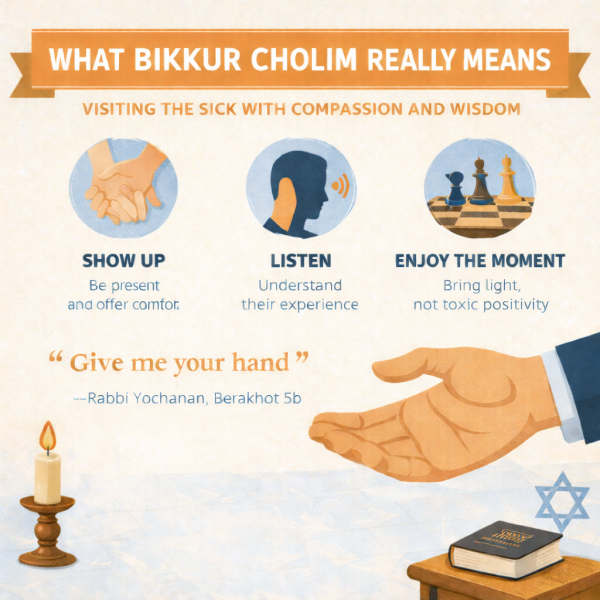
In Tractate Berakhot (5b), Rabbi Yochanan visits his sick student, Rabbi Hiyya bar Abba. He asks him: “Are your sufferings welcome to you?” The student replies honestly: “Neither they nor their reward.” Rabbi Yochanan does not challenge him. He does not offer theology, or promises of recovery, or remind him to stay positive. He simply says: “Give me your hand.” The student gives him his hand — and is healed.
No sermon. No miracle promises. No toxic positivity. Just presence. Just a hand extended in genuine human connection.
The Talmud is telling us something profound: the most powerful act of bikur cholim is not what you say — it is that you show up, you see the person, and you meet them exactly where they are. That can also be by phone; by voice message, as one friend does particularly well; and by WhatsApp, as long as you don’t get annoyed when I don’t respond.
Let me give very positive two examples from my own experience that illustrate this perfectly.
A rabbi came to visit me and we had a genuinely useful discussion about end-of-life planning – a topic I deeply needed to discuss with someone qualified and compassionate. He didn’t shy away from the reality of my situation. He met me where I was. That visit was a gift.
Then there are the close friends who come to play chess with me. They don’t lecture me. They don’t offer unsolicited theology. They bring light conversation, genuine warmth, and they focus on something I can actually enjoy in the moment. They leave me feeling better than when they arrived. That is bikur cholim at its finest. They also are willing to cancel at the last minute if I am not in the mood and I am grateful.
The mitzvah is a very important one – but the person you are visiting has to want you to come, and the very worst thing you can do is upset and stress them.
It is not a science, it is an art. It is EQ – a degree of “emotional intelligence.” And some people have more of it than others.
I am not writing this to turn people away. I am writing this to remind people that the mitzvah is to uplift the sick person – not to offer unsolicited theology, false comfort, or lessons in gratitude to someone living with a progressive terminal illness that has no treatment and no cure.
Come with presence. Come with humility. Come with chess (or Rummikub or Splendor etc.).