


Wait with art
In this blog, I have written repeatedly about “the pleasures of Jew hate” as a major driving force behind the “criticism of Israel.” I regard the Palestinians as victims of Jew hate because the desire to experience the pleasures of Jew hate has led the world to embolden their most destructive leaders instead of demanding what is truly pro-Palestinian: peaceful co-existence with Israel.
I have recently watched “Screams before Silence,” the documentary about sexual violence on October 7:
I now feel the need to revise “the pleasures of Jew hate” to “the pleasures and the relief provided by Jew hate.” Why relief?
I know that each one of the victims in “Screams before Silence” could be me or my loved ones. And I imagine that for people who feel fundamentally different form the Jews, it must be a relief to feel that such things could not happen to “me or my loved ones.”
It is not only on the border with Gaza that people like “me” are targeted. Consider the following compilation of hate from the Passover period (the traditional time of blood libels) from Columbia University:
About going back to Poland: “Dirty Jew, go to Palestine” is what my grandfather (my mother’s father) and other Jews had to endure from their neighbours in Poland—not to mention “Juden Raus,” which has led many Jews who would have not otherwise left Europe to the British mandate of Palestine.
About going back to Belarus: Esther, my grandmother’s sister (on my father’s side), was raped (probably gang raped) there when she was picking mushrooms in the forest during the revolution and soldiers came across her. She died as a result of her injuries a short time after. Her father’s name was Mordechai, and they called her Esther because of the Purim story—Esther and Mordechai as saviours of the Jewish people.
And why are they sending us back to Poland and Belarus when many people of my grandparents’ generation came to Israel from the Arab world—in many instances because they were kicked out?
Also, what is the logic of shouting at Jews in North America to go back to Poland or Belarus? By being in North America, are we not already freeing Palestine of our presence? Or have they decided to free North America of Jews as well?
Bragging that October 7 will happen 10,000 more times means that it will have to be exported outside of Israel because there aren’t that many people in Israel available to murder, rape, torture and kidnap.
The words of Khymani James, one of the protest organizers who I believe is now banned from campus, also deserve attention:
Meet Khymani James, a student leader of Columbia University’s anti-Israel Gaza Solidarity Encampment who openly states that "Zionists don’t deserve to live"
He made the comments during a meeting with the school that he live-streamed.
We put together the highlights: pic.twitter.com/JFlxnRkNC2
— Daily Wire (@realDailyWire) April 25, 2024
I worry about well-intentioned people who come under the spell of such organizers. Lessons in recognizing the signs of emotional abuse and controlling behaviors seem to be in order.
One thing that strikes and stresses me about Israel hate is the fiction—the fictionalized nature of so much of it. I grew up in Israel. My parents, my siblings and their families live in Israel—but I cannot recognize the place that I know in much of the rhetoric that has been circulating about Israel. I read once that antisemitism is attractive to some creative people because it allows plenty of room for the imagination to run wild and roam into a fairy-tale landscape of knights who slay dragons. Using the timeless tropes of Jew hate, Israel haters have created a fictional monster that they call Israel.
In fact, Israel haters in the West are much better positioned to bully and emotionally abuse Jews who love Israel than Jews who live in Israel, with whom they typically have no direct contact. Ironically, they direct their bullying toward Jews who have “freed Palestine” of their presence by living in North America.
Looking at my life so far, in many ways I have done exactly what haters say that they want an Israeli to do. I grew up in a left-wing atmosphere that was critical of Israel and I left Israel—except that instead of Poland I went to Canada. I have thus freed Palestine of my presence at a young age, and at a rather significant emotional cost to me. I miss very much being close to my parents and siblings, despite the good fortune of having a loving husband and children in Canada and work that I love. So what is the haters’ problem with me? Must I hate Israel too? Must I objectify and dehumanize people whom I love in order to gratify the bullies? Anecdotally, I have noticed that I have much more stress and fear about Israel haters in the West compared to people in Israel I spoke to who hear about the hate rallies but do not seem to fear them much. This is because what the haters really love to do is to bully the Juden in their midst. Targeting actual Israelis who live in Israel—or making things better for the Palestinians—is not their real focus in my opinion.
And suppose that the haters make our lives in North America so intolerable that we feel we cannot bear it anymore. Where do they think we might go? To Poland? To Belarus? Or to a place that we love and where we often have a family and a support system? Indeed, by creating an atmosphere of constant stress and harassment for Jewish people in North America, the haters are increasing the chances that more Jewish people will move to Israel.
Essentially, too many people have figured out that the pleasures of Jew hate are to be had as long as three rules of thumb are followed: 1) assert that you are not an antisemite; 2) drop names of Jewish people who agree with you and 3) replace the word Juden with the word Zionist. Do these three things—and you will have a punching bag called “Israel” that is stuffed with delicious fictions.
Is this fictionalization of Israel a stain upon the human imagination? Does it mean that the imagination is dangerous because it can quickly deteriorate into art as propaganda—or just crass propaganda without art?
Turning away from the fictions spun by the haters, which conjure up an Israel that I do not recognize and that exists to satisfy their need to feel superior, I seek true art. I would like to believe that the imagination, and especially the amazing human ability to create art, is one of the things that will help us to return to a more peaceful and constructive world.
In the aftermath of October 7, some artists felt unable to create. Theodor Adorno said that to write a poem after Auschwitz is barbaric—and it is as if on October 7 art died a second death on the border of Gaza.
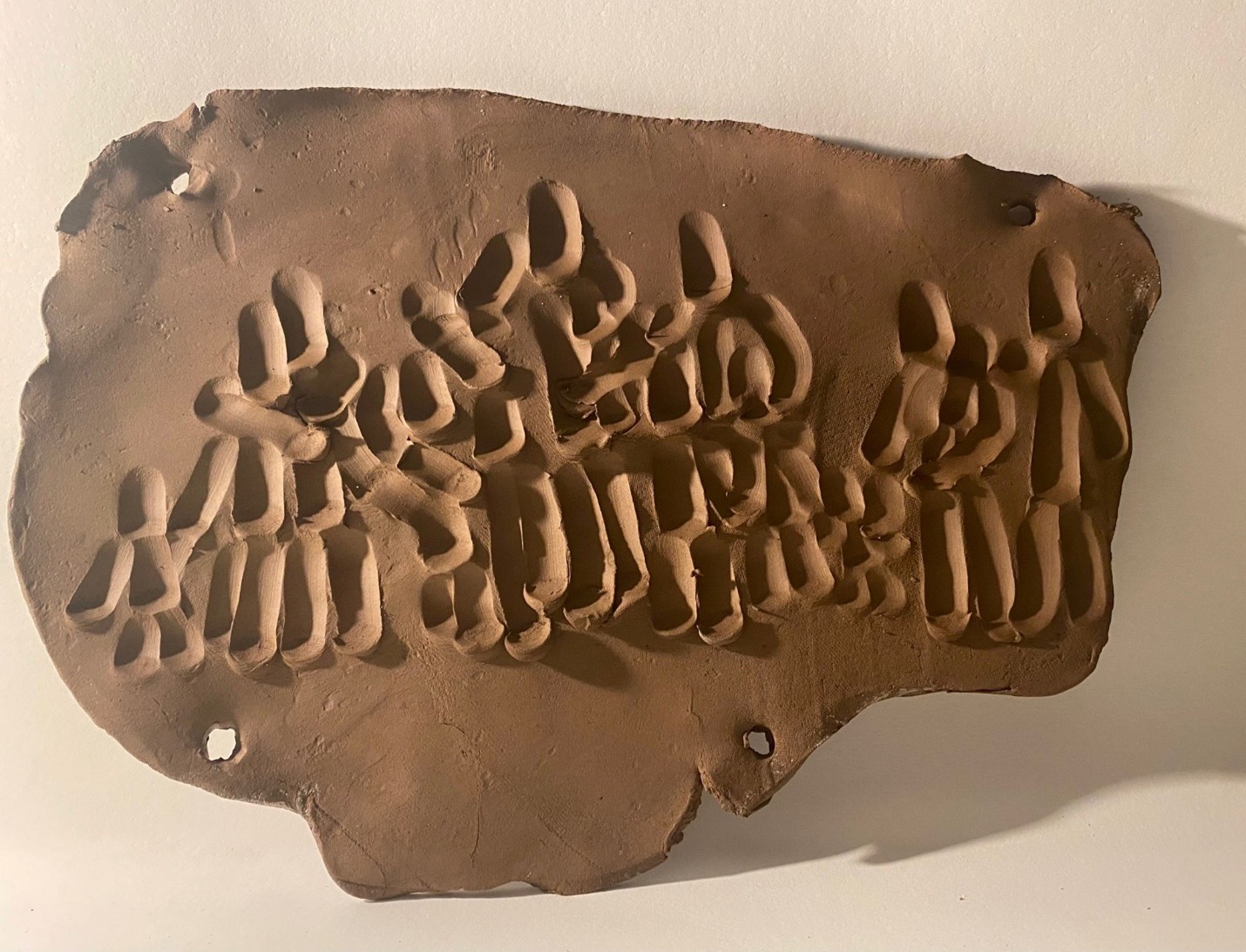
Shortly after the catastrophe, the Israeli artist Yael Oren-Sofer has created a striking series “when you cannot paint” (fingers on clay):
כשאי אפשר לצייראצבעות על חמר, נובמבר 2023
Posted by Yael Oren Sofer on Saturday, November 11, 2023
In an email conversation about the piece that is depicted on this blog, Oren-Sofer wrote (translated from Hebrew), “this is one of the first pieces in the series. Only at a later stage I created from observing specific situations.” This early piece was less specific but was based on situations that affected many people on October 7 and its aftermath: “I thought a lot about the hostages, but also about the people in the safe rooms and in different situations on the day of the massacre—about all the people who gathered together and took shelter together and were terrified and hurting together: families at funerals, evacuees in hotels, the soldiers, and the female surveillance soldiers at the bases [whose warnings based on observations of the Gaza fence were ignored and many of whom were killed or kidnapped], and also the Gazans from the other side of the fence. Part of what I wanted to convey is that pain, fear, distress and the desire to draw comfort from human closeness seem similar in many of the situations that this war has conjured up.”
When I spoke with artist Marie-Claude Delcourt about art after October 7, she remembered something that one art critic said about Michal Rovner’s video exhibition in the Whitney Museum in 2002 “we live in an uncertain galaxy, somewhere between memory and the wait.” Delcourt’s interpretation of the quote is, “I don’t believe such a horrific event is the end of History, because evil cannot win in the end. What we don’t understand—the why and the unanswered questions about this unthinkable horror, and, rooted in our collective memory, the horrors of the Shoah—can somehow be powerfully expressed through art. And art can also bring us together, beyond words and beyond the immediate reality, in the wait for this space and time we cannot yet see, but we are longing for, united in the common faith that this time and space WILL come.”
Twenty years ago, Delcourt wrote a poem in the style of Aloisus Bertrand, the nineteenth-century French poet who wrote Gaspard de la nuit (an allegory for the devil) using a lot of medieval vocabulary. Delcourt’s poem depicts a future (or past) dystopian world, where a wind of hope rises before the end. The last verses of the poem make a reference to Jerusalem:
“Je connais une patrie qui ne nous trahit pas, je connais une ville au remparts imprenables, je connais des promesses qui toujours sont tenues.”
“I know a country that doesn’t betray us, I know a city with impregnable ramparts, I know promises that are always kept.”
As I read “promises that are always kept” in Delcourt’s poem, the words bring ancient comfort to my soul. One promise that I hope will be kept is that actual human beings be allowed to live in Israel in peace—without being fictionalized into demons.
When people in the West who experiment with the pleasures of Jew hate meet an actual human being who is originally from Israel, sometimes they might experience cognitive dissonance.
On the one hand, they “know” that Israel is evil.
But on the other hand, despite my declared love for Israel, the person in front of them does not seem particularly demonic.
To deal with these contradictions, some people create fictionalized and overly rigid distinctions in their minds:
Sometimes they sharply distinguish between the past and the present: in the early days, Israel was a place of nobility and moral integrity. But now it has succumbed to blood thirst (I have never met a person in Israel who struck me as blood thirsty—although all human beings have weaknesses and flaws and every country has its criminals).
More often, Israel is sliced not into past and present but into “good people” on the one side and “right-wing extremists” on the other side.
None of my loved ones in Israel are right wing, and there are indeed some destructive ideas among the right—but the assumptions that are made about the demonic forces at play in Israel are highly fictionalized.
With the forces of the imagination at play, we are thus thrown into a game in which we have to plead in vain with people who assert moral superiority to believe that we were educated to seek peace.
The following video resonates with what I have found myself trying to explain many times:
https://www.youtube.com/watch?v=-z0LJXM8p18
However, I have also come to resent my own tendency to want to “prove” that I grew up in the milieu of the Israeli left, that no one in my family has voted for Bibi, etc. What about people who grew up in the milieu of the Israeli right, most of whom are decent people—do they deserve to be hated?
The more I try to “prove” my virtue to people who hold fictionalized views of Israel, the more morally inferior I feel compared to most actual Israelis who deal with the challenges of living in Israel.
Oren-Sofer’s “when you cannot paint” gives me foundational comfort, and her words about the comfort that people can offer each other when they come together has sunk deep into my soul. One night, I dreamt that I was in Israel and had just walked into a gathering in a living room in an apartment.
I assumed that it was a party or celebration of some kind, and I came bearing a gift in a basic, brown gift bag.
In the dream, I had no idea what was inside the gift bag I was holding. I handed the bag to a woman in her 30s who looked very kind and soulful but sad—and was a stranger to me.
The woman smiled at me with characteristic Israeli warmth, accepted the bag from me and took out what turned out to be inside—a blue outfit for a newborn baby.
Holding the onesie in her hands, the woman started crying her heart out—sobbing with growing, heartbreaking intensity.
I did not immediately understand why. “C’est tellement mystérieux, le pays des larmes!” (“It is so mysterious, the land of tears!”) wrote Antoine de Saint-Exupéry in Le Petit Prince – The Little Prince.
One by one the people in the room turned toward the crying women to comfort her with skill and warmth that seemed to come naturally to them—and turned away from me.
I stood in my place away from them—isolated and self-disgusted.
The gravity of what I had walked into then became apparent: what seemed like a party was actually a gathering of October 7 survivors. And the baby had been murdered.
The setting of the dream was probably inspired by the interviews that have been filmed with survivors, who sometimes sit in living rooms that they have been displaced into and share their stories.
The gross, inappropriate materialism of the gift that I unknowingly offered to the dead baby was a symbol of my disconnection and inability to provide real togetherness and comfort.
The dream left me with a visceral feeling of moral inferiority, of social awkwardness, of dislocation, of inability to connect on a real human level. Perhaps this is what the haters want.
And perhaps this is one of the reasons that we have art—to remind us that things can be better.
Oren-Sofer’s piece, which I have spent time looking at and feeling strongly about, has given me the feeling of connection and belonging.
Intuitively, the material reminds me of art pieces made from clay that my father created when he was a child and teenager and that used to adorn my grandparents’ home in Jerusalem—art made during Israel’s first generation as a modern sovereign state. My grandmother, the one whose sister Esther was attacked in the forest in Belarus, always kept clay in the modest home. She would buy a hard block of clay and wrap it in a wet towel to soften it. The transformation of the hard block into pliable raw material was a source of awe to my father. When my sister, brother and I were children, we used to study with fascination my father’s childhood clay creations made before he later started sculpting in wood—a clay lion, a pregnant woman made of clay with another woman, her younger self, embracing her and—in the aftermath of the 1967 war—a clay sculpture of old Jerusalem surrounded by walls and by amputated human limbs. The day after the Six Days War ended, as people rejoiced with victory, my father, then 17 years old, was in Jaffa street in Jerusalem on the way to see the Old City. On that seventh day, he saw an open command car passing by filled to the brim with the a tall pile of the bodies of dead soldiers, with a single soldier guarding over them. As he applied fingers to clay some weeks later, he thought about the human tendency to forget about the pile of dead bodies and talk instead about heroism and victory.
In 13 Art Materials Children Should Know, Narcisa Marchioro notes that “the first known examples of recorded writing are on clay tablets, which were engraved by Sumerian scribes in what is now Iraq” (p. 12).
In its foundational simplicity “When you cannot paint” recalls even older times. It reminds me of the title of the first chapter (about prehistoric art) of Charlotte Mullin’s A Little History of Art—“First Marks.”
In A Little History of the World, E.H. Gombrich writes about prehistoric people:
“They invented something else that was wonderful too: pictures. Many of these can still be seen today, scratched and painted on the walls of caves. No painter alive now could do better. The animals they depict don’t exist any more, they were painted so long ago. Elephants with long, thick coats of hair and great, curving tusks – woolly mammoths – and other Ice Age animals. Why do you think these prehistoric people painted animals on the walls of caves? Just for decoration? That doesn’t seem likely, because the caves were so dark. Of course we can’t be sure, but we think they may have been trying to make magic, that they believed that painting pictures of animals on the walls would make those animals appear. Rather like when we say ‘Talk of the devil!’ when someone we’ve been talking about turns up unexpectedly. After all, these animals were their prey, and without them they would starve. So they may have been trying to invent a magic spell.” (7-8)
Can imprinting fingerprints on clay to depict a community of people who come together to comfort each other also cast a magic spell?
For me, it does. It reminds me that human warmth exists even though the pleasures of Jew hate feel like ice. Art has the power to make the things we need appear out of an apparently barren landscape. For that reason, today—I choose to wait for better times with art.
Quote are from Marchioro. Narcisa. 13 Art Materials Children Should Know. Prestel and Gombrich, E. H. A Little History of the World (Little Histories) (p. 7). Yale University Press. Kindle Edition.