The views expressed herein are solely mine.
Walls Do Not Divide—They Keep Israel Alive
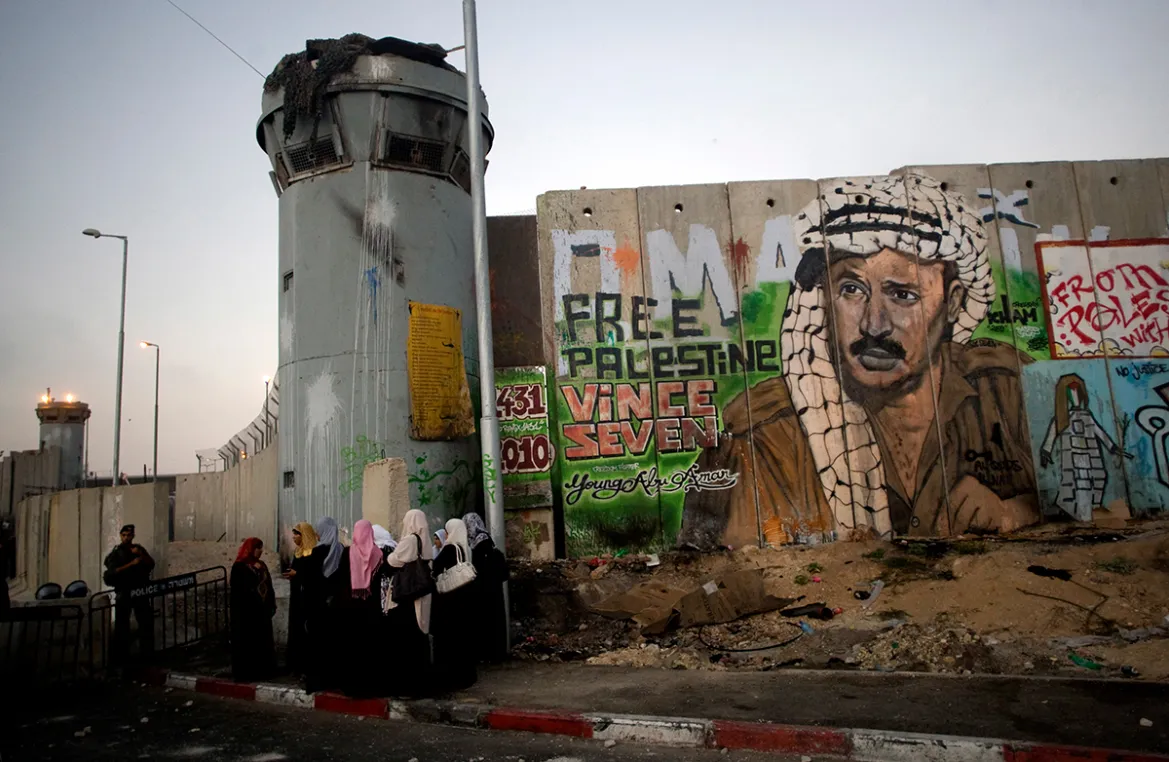
Israel's separation barrier covered in graffiti, one depicting the late Palestinian leader Yasser Arafat at the Qalandiya checkpoint between Jerusalem and the West Bank city of Ramallah. [File: Sebastian Scheiner/AP]
Critics of Israel toss around moral theatre like confetti.
They point to the walls, fences, and checkpoints threading across the West Bank and see “apartheid” — conveniently forgetting that in a never-built future Palestinian state, many claim they won’t live beside a single Jew. At the same time, Israel already counts more than 1.2 million Arab-Israelis.
But the Jewish State sees something starker than optics: survival.
What the international commentariat labels “occupation” is in reality the architecture of deterrence — the cold, unsentimental infrastructure that keeps Jewish children alive when diplomacy fails.
Since the Second Intifada (2000–2005), over 1,000 Israeli civilians have been murdered in terror attacks launched from the West Bank.
Buses, cafés, supermarkets — no target was too vulnerable.
When Israel erected the Security Barrier in 2002, suicide bombings plunged by more than 90%, according to the Israeli Ministry of Defense and confirmed by a RAND Corporation study.
The wall did not grant peace; it created distance — the only dialect terror understands.
Yet the same Western governments that built fences after the 2015 migrant surge now demand Israel tear hers down.
Spain fences off Melilla. Greece fortifies Evros. The U.S. erects barriers along the Rio Grande.
However, when Israel fortifies its frontier against gunmen from Jenin or Qalqilya, it is branded “inhumane.”
The hypocrisy is not just staggering — it is pathological.
The irony deepens when you consider this: while criticism rains down on Israel’s fence that protects its citizens, hardly a peep is heard about Egypt’s far more forbidding wall between Gaza and the Sinai.
Unmistakably, this infrastructure is not merely a fence to stop violence. It is a barrier whose deeper purpose is to isolate Palestinians and block them from reaching “Arab / “Brotherhood” territory.”
Egypt’s infrastructure is comprised of steel and concrete, featuring deep tunnels and surveillance sensors. Even recent reports show Egypt building a walled enclosure near Gaza capable of housing over 100,000 people, with barriers clearing ground and trenching infrastructure to keep Gazans from slipping into Sinai.
Meanwhile, Israel’s barrier in that front is a defensive wall primarily separating the Strip from Israel — not sealing Palestinians off from the wider world the way Cairo’s blockade does.
In 2025 alone, the United Nations Office for the Coordination of Humanitarian Affairs (OCHA) recorded more than 1,000 new Israeli security “obstacles” in the West Bank: checkpoints, gates, earth mounds, and barriers. Automatically, Western media labeled that as “collective punishment.”
What they omit is why those structures exist: hundreds of intercepted terror plots, dozens of armed cells dismantled, multiple cross-border infiltration attempts foiled by the Israel Defense Forces (IDF) and Shin Bet.
Thus, each checkpoint is not a symbol of domination — it is the residue of prevention.
While many lament “Palestinian freedom of movement”, they conveniently ignore that in 2023 alone, more than 5 million crossings by Palestinians into Israel for work and trade occurred, according to the Coordinator of Government Activities in the Territories (COGAT).
Therefore, the wall does not block opportunity — it filters it.
It separates workers from bombers, civilians from killers.
That distinction is what allows coexistence to survive, even in hostility.
Here is the cruel truth: the fewer walls Israel builds, the more graves it digs.
Every time restrictions ease, Hamas or Palestinian Islamic Jihad exploits the gap.
This is not conjecture — it is a decades-old pattern.
As a matter of fact, current data shows terror activity surged by 300 % in areas where checkpoints were relaxed during the Oslo years, according to the Jerusalem Center for Public Affairs.
Hence, behind each slab of concrete stands a moral riddle the West refuses to confront: must a democracy die to appear virtuous?
Jerusalem’s answer is — and must remain — no.
Self-defense is not oppression. It is civilization.
Israel’s walls are not built out of hate but out of memory — of buses blown apart, of families buried in synagogues, of mothers identifying their children by their shoes.
Yes, walls are ugly. But reality in the Middle East is uglier.
And until the Palestinian leadership chooses to build something other than martyrdom posters, Israel’s walls will stand — not as barriers to peace, but as monuments to life in a region that all too often worships death and not peace and freedom.
Related Topics
- 2025 Hostage Deal
- Anti-Zionism
- Antisemitism
- Egypt
- Gaza
- Gaza Border
- Gaza Disengagement
- Gaza Strip
- Greece
- Hamas
- Intifada
- Islam
- Israel At War
- Israeli Foreign Policy
- Jerusalem
- Middle East
- Palestinian Statehood
- Palestinians
- Peace Builders
- Peace Process
- Spain
- Terrorism
- The Arab World
- Trump Peace Plan
- United Nations
- West Bank
Related Posts