
Wars Do Not End the Way Trump Thinks They Do
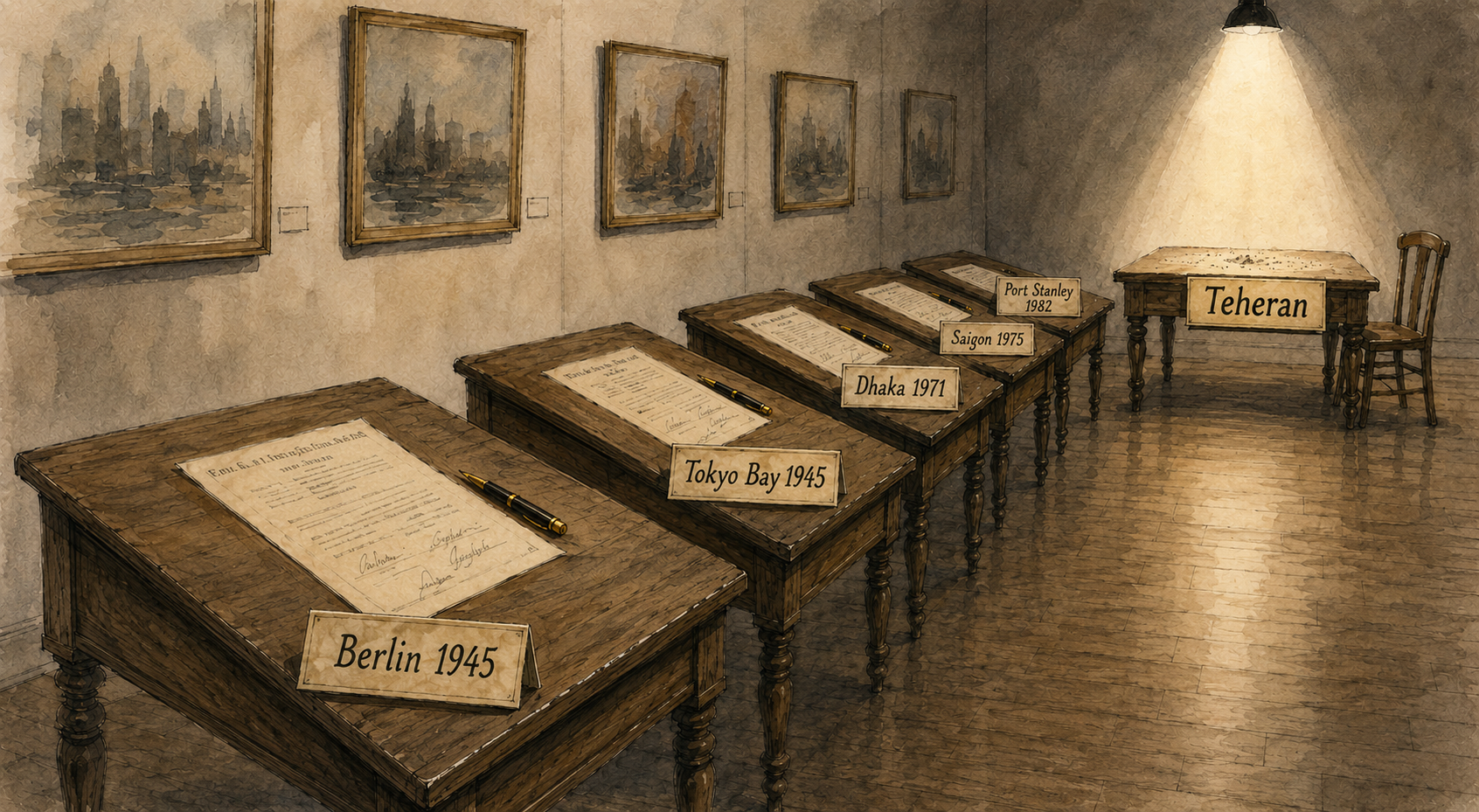
The demand is documented and can be stated precisely. In June 2025, during the twelve-day war in which American bombers struck three Iranian nuclear sites, Trump published a single line in capital letters on Truth Social: “UNCONDITIONAL SURRENDER!”
In March of this year, at the opening of the current war and following the death of Iran’s supreme leader in the initial strikes, he restated the demand, specifying that the United States would not halt its military campaign under any other condition. The content of the demand was defined in May: Iran’s enriched uranium is to be transferred to the United States for destruction, or destroyed in place under international supervision, and the Strait of Hormuz is to be reopened without conditions. The consideration offered is sanctions relief.
The instrument selected to produce this outcome is economic. A naval blockade has operated since April, Iranian crude exports have fallen to approximately zero, and the economy is undergoing its deepest contraction in decades.
The strategy therefore rests on a proposition that can be tested against the historical record: that sustained economic pressure, absent other conditions, induces a government to surrender an asset it defines as existential. The record available for testing consists of the interstate wars fought since 1900. Civil wars are excluded, since the bargaining structure between governments and internal insurgencies differs in kind. Classified by mode of termination, the cases sort into four categories.
Category one: termination without surrender. This is the largest category in the sample.
- Korea, 1953. Armistice without treaty; the belligerents remain formally at war seventy-three years later. The outcome was nonetheless asymmetric: the northern war aim, unification by force, failed, while the American aim, containment, was achieved.
- The Arab-Israeli wars of 1948, 1967 and 1973. Ceasefires in every case, surrender instruments in none. The asymmetry of objectives determined the reading of the result. The Arab coalitions required the elimination of a state to achieve their war aim; Israel, defending a coastal corridor fifteen kilometers wide at its narrowest point, required only its own continuation. Survival was the objective, and the ceasefires delivered it.
- Iran-Iraq, 1980-88. Eight years, deaths on the order of one million, termination on the prewar border. Both governments claimed victory; the analytical consensus assigns it to neither.
- The Gulf, 1991. The clearest case of victory without surrender. The stated objective, expulsion of Iraqi forces from Kuwait, was achieved in six weeks, after which operations ceased by decision. Saddam Hussein governed for a further twelve years. The limitation was deliberate: his removal would have required the occupation of Baghdad, which was outside the objective.
Category two: withdrawal by the militarily superior party. France retained battlefield control in Algeria and withdrew in 1962, defeated politically. Britain and France prevailed at Suez in 1956 and withdrew within months under American and Soviet pressure. The United States signed the Paris accords in 1973 and departed. Military superiority is not a predictor of a signature.
Category three: negotiated peace following battlefield reverse. Portsmouth in 1905, Riga in 1921, the Moscow Peace of 1940, which cost Finland roughly a tenth of its territory. In each case the defeated state ceded territory and retained its existence.
Category four: formal surrender. Across the full sample, the unambiguous cases number five. Each is listed with its proximate trigger.
- Germany, 1945. Territory bisected, western armies across the Rhine, the Red Army in Berlin, the head of state dead by suicide. The instrument was signed when no functioning German state remained.
- Japan, 1945. Hiroshima on August 6, the Soviet declaration of war on August 8, Nagasaki on August 9, the emperor’s personal intervention on August 15. The historiography remains divided on the relative causal weight of the atomic bombings and the Soviet entry; both positions accept that the surrender carried one condition, retention of the throne. The settlement preserved the single institution the leadership defined as non-negotiable.
- East Pakistan, 1971. Indian forces reached Dhaka in thirteen days with air supremacy established and the Bay of Bengal closed to relief. Approximately 93,000 personnel entered captivity. The surrender was that of an encircled command; the Pakistani state survived intact.
- South Vietnam, 1975. Patron withdrawal. Congressional aid cuts preceded the collapse of the Central Highlands front; the American evacuation concluded on April 29 and the surrender followed the next morning.
- Argentina, 1982. An isolated garrison at Port Stanley without possibility of resupply. The mainland was never threatened, so the surrender cost a territory, not the state. The governing junta fell within days.
Five cases yield a consistent set of conditions: ground forces present or imminent, encirclement without prospect of relief, or the withdrawal of an indispensable patron. In all five, the trigger was physical and immediate. Economic pressure appears in none of them as the proximate cause. The nearest approach is the 1918 blockade, which contributed to German collapse through mass civilian starvation, and even there the outcome was not a surrender by the government under pressure: the Kaiser abdicated and fled to the Netherlands, and a successor revolutionary government signed the armistice.
One further variable is required, because the classification does not explain why two comparable military positions terminated differently. Germany could not surrender while its leadership lived; the governing ideology preferred national destruction to capitulation, and orders to destroy German infrastructure were issued as the fronts closed. Japan could surrender because its leadership identified an institution within its own belief system that surrender would preserve. The capacity to sign was determined not by the military position but by whether the demanded concession was separable from what the leadership defined as the state’s essential core.
The Iranian case can now be evaluated against these findings, and it offers the additional advantage of a prior stress test.
The war with Iraq killed on the order of one million people. Iraqi chemical weapons were employed against Iranian troops and missiles struck Iranian cities, and the leadership nonetheless rejected UN Security Council Resolution 598 for a full year after Baghdad had accepted it, characterizing a ceasefire as treason. When Khomeini accepted in July 1988, he described the decision in writing as more deadly than drinking poison. The terms accepted merit attention: a ceasefire on the prewar borders, prisoner exchanges, no reparations, no territorial loss, no change of government. Those terms, resisted through eight years at that human cost, fall within category one, the least demanding termination mode in the classification. The system that accepted them remains in power.
The present campaign, scored against the conditions identified above:
- Ground forces: none present, none contemplated.
- Encirclement: the Revolutionary Guard is degraded from the air and not surrounded.
- Patron withdrawal: China and Russia remain in place.
- Separability: the demanded object is 440 kilograms of enriched uranium, which the government treats as the guarantee of its own survival. Argentina could cede islands and retain the state. No configuration exists in which Tehran cedes the stockpile and considers the state retained.
The third of these warrants a word, since it decided three of the five surrenders. Japan capitulated once the Soviet entry closed its last path to a mediated peace; South Vietnam fell after Washington cut its aid. The variable is whether a great-power sponsor withdraws at the decisive moment. For Iran it runs the other way: China still buys the crude that clears the blockade and shields Tehran at the Security Council, and Russia remains a military and diplomatic partner. The sponsor that would have to vanish is instead still present.
The demand belongs to category four. The instrument belongs to no category: it is the single mechanism that has not produced a surrender in the full sample. The mismatch admits one additional observation, drawn from the Israeli cases and inverted. Where the war aim of a government is its own continuation, any siege that fails to remove it is a siege it has withstood, and duration accrues to the defender.
The oldest documented record of siege outcomes states the same two terminal conditions. In 597 BC, Jehoiachin surrendered Jerusalem to the Babylonians, was deported, and lived; the Babylonian court records him receiving rations at the king’s table. Eleven years later Zedekiah refused, held through eighteen months of famine, and lost his sons, his sight, the city and the Temple. No third outcome is recorded.
The current strategy assumes Tehran will behave as Jehoiachin. The observable record of the Islamic Republic, across forty-seven years, an eight-year war under chemical attack, and the past five months of blockade, is the record of a government that has selected the other precedent.
Wars do not end the way Trump thinks they do. They end the way Zedekiah’s did, or they do not end at all.