Washington Mediates Historic Israel-Lebanon Framework Agreement
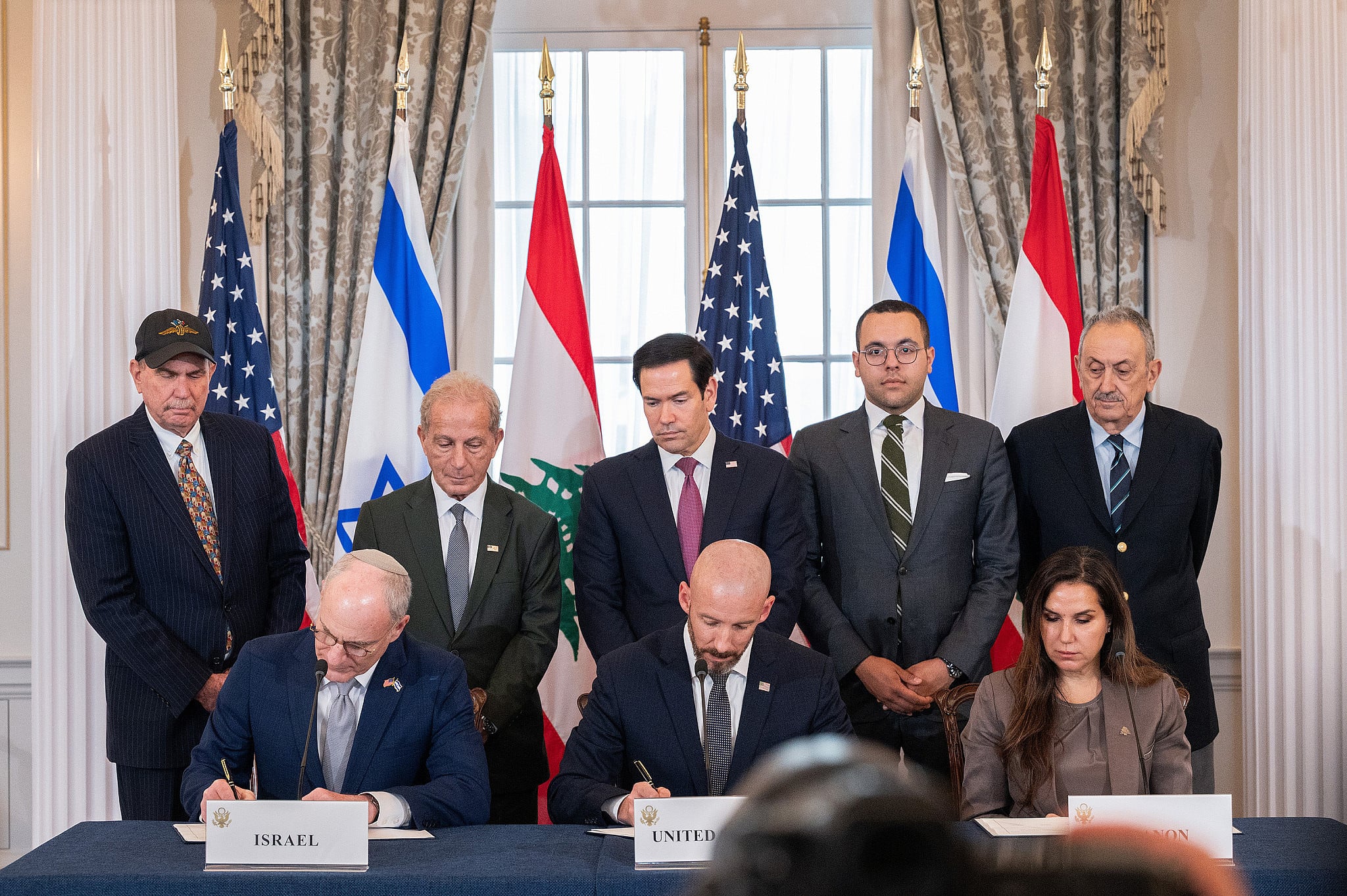
In a remarkable turn of events, Israel and Lebanon have signed a historic framework agreement in Washington, a move that many analysts are hailing as the most significant diplomatic breakthrough between the two countries in years. The agreement includes a mutual acknowledgment of each nation’s sovereignty and sets up a pilot program for the gradual withdrawal of Israeli forces from certain areas in southern Lebanon, with the Lebanese Armed Forces stepping in to handle security.
The significance of the agreement was underscored by US Secretary of State Marco Rubio, who announced that Washington had successfully facilitated a framework accord between the sovereign governments of Lebanon and Israel. His remarks reflected the central message of the deal: that sustained diplomacy, backed by international support, can create opportunities for stability even in regions long defined by conflict and mistrust.
SECRETARY RUBIO: "We're happy to announce a framework agreement between the sovereign government of Lebanon and the government of Israel, with the mediation and support of the United States of America." pic.twitter.com/0Zbd9HRKmh
— Department of State (@StateDept) June 26, 2026
Analysts are optimistic that this agreement could pave the way for a fresh chapter in Israeli-Lebanese relations, as long as Hezbollah is kept from reestablishing its military presence in the areas vacated by Israeli troops.
The signing ceremony at the US State Department signals a renewed effort to replace decades of hostility with a framework built on security, sovereignty, and practical cooperation. For a region that has witnessed repeated cycles of conflict and missed opportunities, the agreement offers a rare moment of cautious optimism.
U.S. Secretary of State Marco Rubio’s statement announcing the Israel-Lebanon framework agreement (full text):
Today’s signing of the Trilateral Framework between Lebanon, Israel, and the United States marks another major milestone in President Trump’s effort to bring lasting… pic.twitter.com/dZ19SYgv0t
— Ariel Oseran أريئل أوسيران (@ariel_oseran) June 26, 2026
The border separating Israel and Lebanon has long been one of the Middle East’s most volatile frontiers. Generations have grown up with the reality of military confrontations, rocket attacks, retaliatory operations, and political tensions that seemed impossible to overcome. Against that backdrop, the Washington agreement stands out not because it promises immediate peace, but because it attempts to create conditions under which peace might eventually become possible.
One of the most significant aspects of the framework is its emphasis on mutual recognition of sovereignty. While such language may appear routine in diplomatic documents, it carries profound importance in a region where questions of territorial control and political legitimacy have often fueled instability. By formally acknowledging each other’s sovereignty and territorial integrity, both governments are taking a step that would have seemed unthinkable only a few years ago.
????????????????????????????READ HERE THE FULL TEXT: The Israel-Lebanon framework agreement brokered by the Trump administration:
TRILATERAL FRAMEWORK BETWEEN THE UNITED STATES OF AMERICA, THE STATE OF ISRAEL, AND THE REPUBLIC OF LEBANON
The Government of Israel and the Government of Lebanon,…
— Barak Ravid (@BarakRavid) June 26, 2026
Equally important is the security arrangement outlined in the agreement. The gradual withdrawal of Israeli forces from designated areas in southern Lebanon, coupled with the deployment of the Lebanese Armed Forces, reflects a broader objective: strengthening state institutions while reducing the space for non-state armed actors to operate. For Lebanon, this presents an opportunity to demonstrate that its national army can effectively secure territory and uphold state authority. For Israel, it offers the prospect of a more stable northern border without the constant threat of armed escalation.
Israeli Prime Minister Benjamin Netanyahu hailed the Lebanon framework agreement as a major achievement for Israel, emphasizing that Israeli forces will remain in the southern Lebanon security zone until Hezbollah is disarmed and any threat to Israel is eliminated. He described the deal as a setback for Iran’s influence in Lebanon, while supporting the gradual deployment of the Lebanese Armed Forces in designated pilot areas. Netanyahu stressed that Israel’s foremost priority remains the security of its citizens and borders.
Israeli Prime Minister Benjamin Netanyahu on the Lebanon Agreement:
“Citizens of Israel, before the Sabbath begins, I want to share with you a major achievement for the State of Israel.
As you know, we have been conducting negotiations in Washington between representatives of… https://t.co/cNvGxyK5rI pic.twitter.com/FqJShTws6H
— גיא עזריאל Guy Azriel (@GuyAz) June 26, 2026
However, the success of the agreement will ultimately depend on a challenge that has shaped regional politics for decades: Hezbollah. Israeli Ambassador Yechiel Leiter said to the press that Israel will maintain a presence in southern Lebanon until the Lebanese Army demonstrates it can take over.
???? Israeli Ambassador Yechiel Leiter said to the press that Israel will maintain a presence in southern Lebanon until the Lebanese Army demonstrates it can take over.
• Under the deal, Israel will maintain a presence in designated security zones in southern Lebanon until… pic.twitter.com/1vnM7ZtUqi
— This Is Beirut (@ThisIsBeirut_) June 26, 2026
The framework’s containment provisions recognize what many policymakers have long argued—that sustainable stability in southern Lebanon requires preventing Hezbollah from rebuilding military infrastructure in areas vacated by Israeli forces. This will not be easy. Hezbollah remains deeply embedded in Lebanon’s political and security landscape, while Iran continues to view the organization as a key element of its regional influence. Any effort to limit that influence will face resistance and require sustained international support.
I commend @SecRubio and the Administration for advancing this framework agreement, and it is my hope this will lead to greater security and stability in Lebanon and the Middle East.
For decades, Hezbollah has been a malign cancer undermining Lebanon's sovereignty and terrorizing…
— Darin LaHood (@RepLaHood) June 27, 2026
Still, diplomacy is often about managing difficult realities rather than waiting for perfect conditions. The architects of this agreement appear to understand that lasting progress will come through gradual confidence-building measures rather than sweeping declarations. The framework is therefore less a final settlement than a carefully constructed starting point.
The role of Washington in facilitating the agreement also deserves attention. Despite frequent criticism of American policy in the Middle East, the United States remains the sole superpower capable of bringing adversaries to the negotiating table and providing the assurances necessary for implementation. The agreement reflects a broader belief that diplomacy backed by credible security guarantees can achieve results where confrontation alone cannot.
Republican Senator Tom Cotton welcomed the Israel-Lebanon framework agreement, praising President Trump and Secretary Marco Rubio for securing what he described as an important step toward curbing the influence of Hezbollah and Iran in Lebanon. Cotton argued that the deal strengthens efforts to limit the reach of Tehran-backed groups and reinforces Lebanon’s sovereignty.
Hezbollah savages have American blood on their hands. I applaud President Trump and @SecRubio for forging this important agreement that will restrain Iran’s terrorist proxy.
Let me be clear: Tehran has no future in Lebanon. https://t.co/HOs2ui8c0b
— Tom Cotton (@SenTomCotton) June 26, 2026
For Lebanon, the potential benefits extend beyond security. The country continues to face profound economic and political challenges, and any effort to restore state authority could contribute to greater stability and investor confidence. A calmer southern border may create opportunities for economic recovery and strengthen public trust in national institutions.
For Israel, this framework presents a valuable opportunity to ease tensions along a border that has been a flashpoint for decades. The Middle East has seen many hopeful initiatives stumble under the burden of conflicting interests and regional rivalries. This history should inspire a sense of realism. However, it shouldn’t stop us from acknowledging genuine progress when it happens.
The Washington-mediated agreement between Israel and Lebanon isn’t the final chapter in a conflict, nor does it promise everlasting peace. What it does provide is something just as important: a route away from conflict and towards a more stable future. In a region where diplomatic chances are often eclipsed by crises, that’s a significant accomplishment.
Whether this agreement becomes a turning point or another unrealized promise will depend on the choices made in the months ahead. For now, however, it stands as a reminder that even the most entrenched disputes can produce openings for dialogue when leaders are willing to pursue them.