Grammy and Emmy nominated singer-songwriter, author, essayist
Watching Batsheva Dance Company: A Personal Reflection
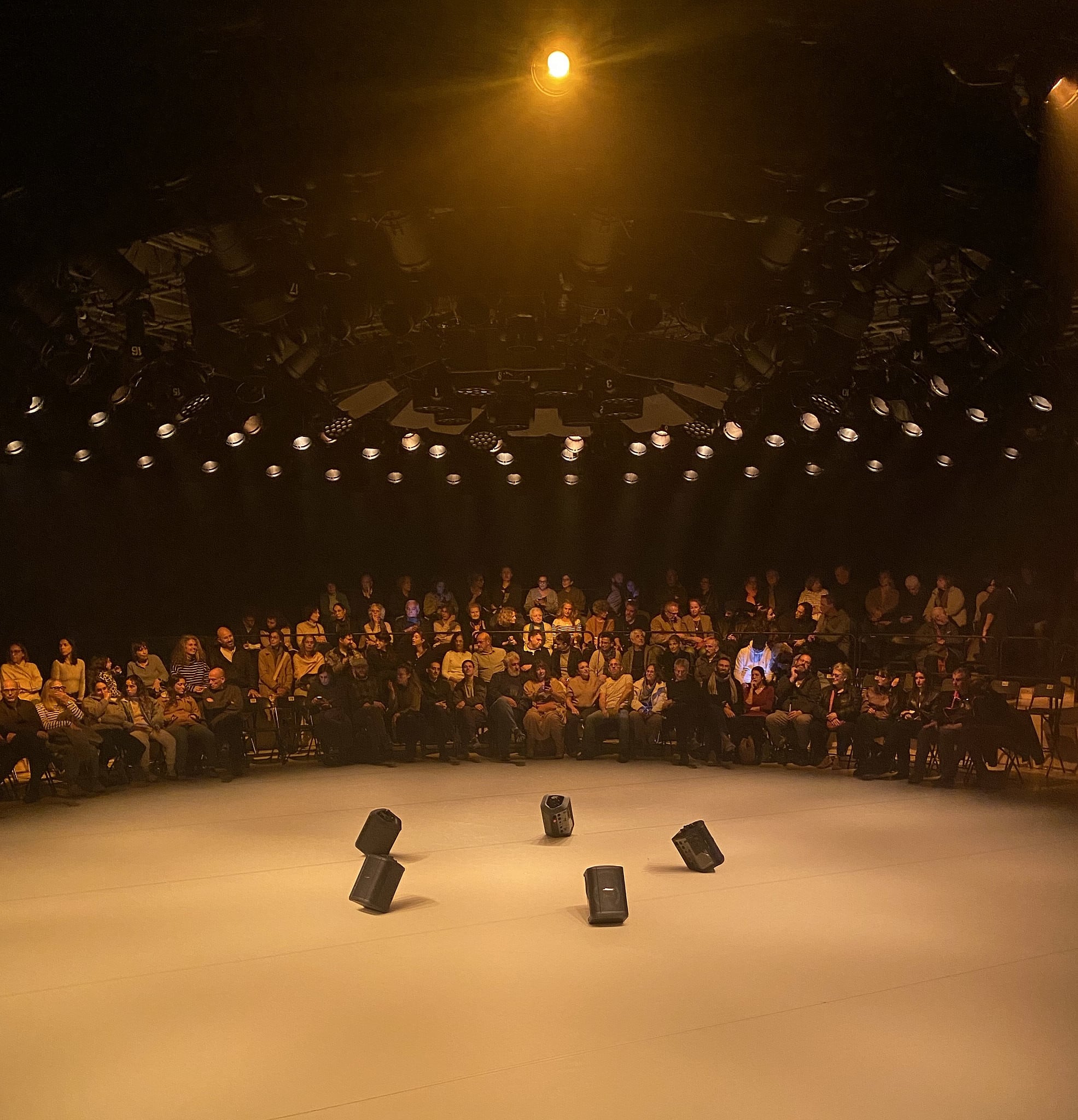
Pre-performance photo from my seat at the Suzanne Dellal Center in Tel Aviv. (No photography was permitted during the performance)
What follows may resemble a review, but it is, in fact, a personal reflection on something so inspiring it has already begun to shape the way I view my own performance potential. That, I think, is the highest praise I can offer.
Batsheva Dance Company occupies both a lauded and a peculiar position in the international arts world. It is among the most respected contemporary dance companies anywhere. Invited, studied, and revered, it also carries a kind of freight that few artists are asked to shoulder. Because it is Israeli, and because it has never disavowed that fact, Batsheva has at times been targeted by boycott movements abroad. At certain performances, for example, protesters have carried signs reading “Don’t dance with Zionists.” None of this is addressed explicitly in Zō, the work my wife and I saw last week. And yet the sensation of bodies in motion, of expression tested, constrained, and then released, feels inseparable from this moment. At its heart, Zō is a portrait of an innate and universal tension: the temporal contending with the spiritual.
Ohad Naharin, who has led the company since 1990, has never been interested in didactic art. His contribution (arguably his revolution) has been Gaga: not a technique in the conventional sense, but a way of listening to the body from the inside, placing sensation, impulse, and contradiction over display.
Zō, along with composers Tai Rona and Max Waratt, was far more than a dance performance. Dance was fundamental, of course, but it felt more like the canvas upon which sound, voice, silence, and collective tension were continuously layered and scraped away.
The work is staged entirely in the round. There is no privileged vantage point, no stable “front.” You see the dancers’ faces and then their backs—their power and their vulnerability in equal measure. There were perhaps twenty young, and ferociously gifted dancers. Not only dancers, but full-bodied performers: actors, vocalists, presences.
They began slowly, circling under dim light, looking directly into the audience’s eyes. Not aggressively. Not theatrically. Just there. It was quietly unsettling. You had the sense of being seen rather than entertained.
Soon they gathered into a tight cluster—a mass that could have been many things: a community, a threat, a family, a swarm, a burial site. The ambiguity was not coy; it was essential. Like life itself, it refused to resolve into a single meaning.
I kept thinking of something Joni Mitchell once said—that if someone listens to her songs and thinks about her life, the song has failed. A good song sends you back into your own experience. That’s what this did. I have no idea what Naharin intended in any literal sense. I only know that he wanted us to feel: deeply, bodily, without instruction. And that I did. I laughed, gasped, at times I wept.
There were moments of violent, jerking movement, convulsions that suggested seizures or electrical overload. It is extraordinarily difficult to make that kind of motion both believable and beautiful at the same time. But they did. For me, it echoed the current state not only of Israel, but of the world: wonder and despair coexisting, confusion reigning, truth itself feeling strangely liquid—fungible, unstable, unreliable.
The music mattered. Tai Rona and Max Waratt’s electronic score was dense and physical: deep bass you felt in your chest, Middle Eastern rhythmic DNA, occasional funk, and long passages where music dissolved into texture—wind, low tones, vibration, almost nothing. It didn’t accompany the dancers; it inhabited them.
The dancers used their voices. There was shouting, pleading, chanting—the performers using a language that, at least to my ears, sounded like every language and no language. You’d think you recognized something, only to realize you didn’t. For me, that felt deeply poignant. A theatrical world rendered indescribable—and, in its indescribability, a replica of the world as it always was and always will be. Words often fail. The language of bodies and music never does.
At several points, dancers collapsed to the floor, motionless, as if dead. Then, slowly, one or two would rise. I couldn’t help but think of resurrection—of stubborn life returning. Given how present death is in the Israeli psyche right now, the image landed hard.
The use of darkness was fearless. The lights went completely out several times, and stayed out longer than comfort allows. Near silence. Just a trace of sound. You could feel the audience wondering, Is this still happening? It was. And it was necessary. It forced patience. Reflection. The recognition that things unfold on their own timetable.
I won’t give away any secrets, but the ending to this potent emotional journey was both surprising and oddly funny—something created collectively that was beautiful, absurd, and awe-inducing.
And then everything stopped. No resolution. No moral. No answer.
To my sensibility, it felt exactly right. Only a supremely confident artist ends that way. As if to say: I’m not going to explain this to you. Take it home. Let it work on you.
Zō also became a way for me to understand and to reaffirm that even in so-called “secular” Israeli society, there exists a desperate need to connect with a transcendent force. I would call that God.
I’ve known art like this before—music, books, paintings, performances that initially left me thinking, Is this even allowed? And then they stayed. They lingered. They crept into dreams.
This one will too.
Related Topics