We are not hiding
Last fall, I traveled to Washington, DC, for the premiere of “Centered Joe Lieberman,” a documentary about the life and legacy of Senator Lieberman, at The Library of Congress.
Upon arrival at Union Station, I needed to use the bathroom. Standing in the men’s room with my back to the door, I heard someone shouting behind me: “You can’t hide. We see you.”
Having lived in New York for nearly 30 years, I have become somewhat immune to unexpected loud noises and inappropriate public outbursts. But I was not prepared for what came next.
“You Jews cannot hide. I know you people. Rashi, Rambam. I know you people. You cannot hide.”
Without turning around, I knew this stranger was talking about me. And yet, I was wearing a kippah and yellow lapel pin in support of the Israeli hostages, so clearly I wasn’t hiding.
A wave of vulnerability swept over me as I realized that I knew nothing about this accuser or his intentions. Taking a deep breath, I turned around, headed to the sink to wash my hands, and exited the bathroom. This middle-aged, well-dressed man and I even locked eyes as I passed by him, with his body somewhat blocking my path. In an almost rhythmic fashion, he repeated with increasing intensity: “You Jews cannot hide. We see you!”
He was a like a one-man protest rally, holding me accountable for an entire people.
Even as I crossed the concourse, he fixed his gaze on me and persisted with hate-filled vitriol for almost two minutes. I looked for a police officer, but there was no one to be found. I don’t know what they would have done anyway. After failing to find a cop, I decided, while emotionally bruised and momentarily shaken up, it was best to move on.
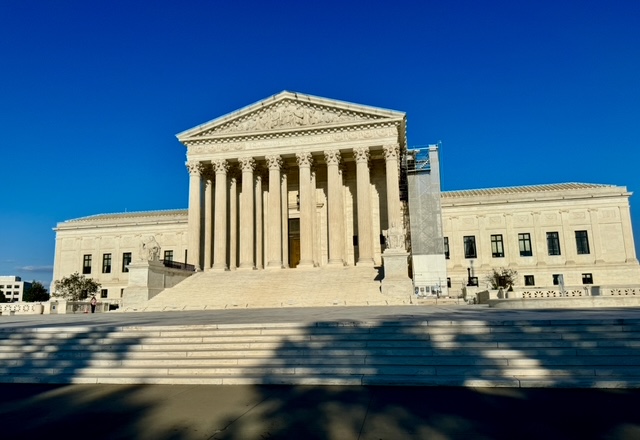
As I walked by the Supreme Court on route to the Library of Congress, I was reassured by how the rule of law protects all citizens and minorities, including American Jews.
I hadn’t given this “hate incident” much thought. That is, until last Wednesday, when two young people who worked for the Israeli embassy — Yaron Lischinsky and Sarah Lynn Milgrim — were murdered at the Capital Jewish Museum. Suddenly, this incident in Union Station in September, less than a half-mile away from a museum turned crime scene, flooded my consciousness.
What I cannot shake is the realization that, as this man harassed me publicly for my faith, not one soul stood up, not one voice spoke out in my defense. No one even asked me if I was okay.
A wound I thought had healed was reopened as I was reminded of Dr. Martin Luther King’s words: “There comes a time when silence is betrayal.” At that moment, I felt betrayed by my fellow citizens in our nation’s capital.
The dramatic rise in antisemitism over the past few years, let alone since October 7th, cannot be ignored. Verbal and physical threats in schools, campuses, online, and in the public square are disheartening because they run counter to America’s visionary spirit as expressed by George Washington: “To bigotry no sanction, to persecution no assistance.”
Having faced antisemitism growing up in suburban Boston, perhaps, I, too, like the bystanders at the train station, accepted this behavior as commonplace. But every time we minimize these hate-filled aggressions, we unwittingly normalize them.
History shows that antisemitism commonly lets loose broader currents of hatred that can undermine our democracy and the bonds in our goal of becoming “a more perfect union.” That antisemitism has long represented society’s metaphorical canary in a coal mine should sound the alarm beyond the Jewish community.
Civic Spirit, the organization for which I work, firmly believes that civic education can enable our society to overcome these challenges. Civics is a vehicle to create informed and engaged citizens, build confidence in American democracy, and shape our country’s future leadership.
If I ever get a chance to speak to the man who harassed me at Union Station, I will correct the tirade he slung my way. We are not hiding!
The age of anxious, downtrodden Jewish archetypes — Bontche the Silent, Tevye the Milkman, Leopold Bloom, and David Lurie in Herman Wouk’s Inside, Outside — is over. Jews may have needed to hide in the past, but the latest generations of Jews have emerged from the shadows and, despite recent security warnings from Israel’s National Security Council about hiding their identity, are standing upright for all the right reasons. Not because we are fearless, but because we are faithful to our Jewish heritage and America’s promise.
While Jewish American Heritage Month 2025 is winding down with a tangible sense of somberness, anxiety, and distress, the story of American Jewry is truly about hope, resilience, and perseverance in the face of adversity. These Jewish values — and many others highlighted in the documentary about Senator Lieberman — can help us all embrace the best of what America has to offer and reach new heights together, as neighbors, with a sense of common cause.
The journey will not be smooth, and will take some time, but I am confident that together Americans of all races, backgrounds, and faith can arrive at a destination that bespeaks the ideals of its name: Union Station.