The Third Story
We Don’t Walk Away
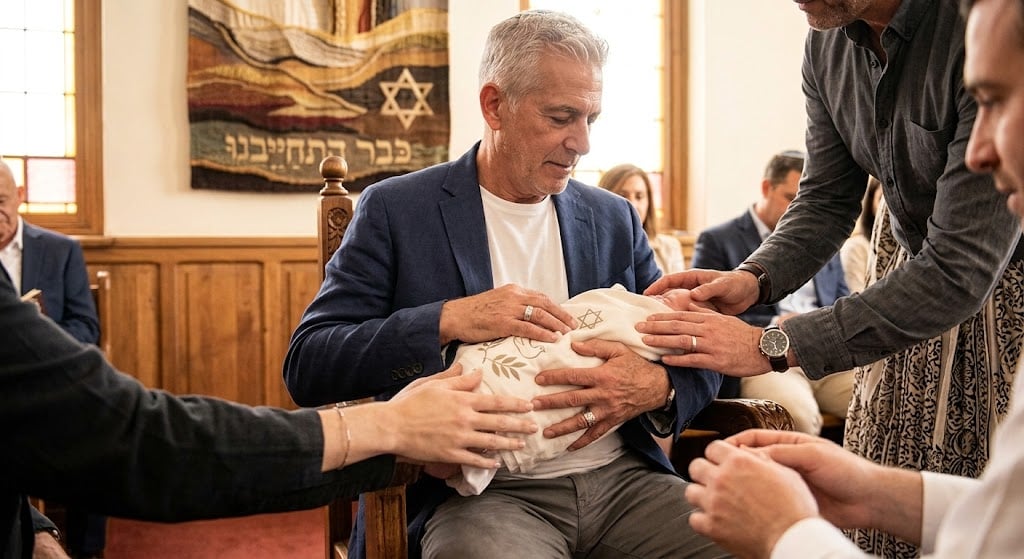
Created by Gemini AI 8.20.26
For more than 40 years – having stepped into this sacred calling when I was barely more than a young man myself – I have had the profound privilege of serving as a mohel. Over those four decades, standing at cradle after cradle across every conceivable spectrum of Jewish life, I have witnessed a recurring truth that defies conventional sociological theory:
You can meet a Jew who has not stepped inside a shul in 30 years, who observes no traditional dietary laws, and who identifies as a resolute secularist. But hand that same person an eight-day-old son, and they will almost invariably reach out to bring him into the covenant.
In Elul, the season of teshuvah (return), we do not construct a new persona; we uncover who we already are.
Why? Because when intellectual arguments and ideological labels are stripped away, nearly every Jew shares one unspoken, visceral boundary: no one truly wants to write themselves -or their child – out of the book of our people. We don’t walk away.
The data bear this out with astonishing clarity. In Israel today, roughly 45% of the Jewish population identifies as completely secular, yet between 97% and 98% of all Jewish families choose to circumcise their newborn sons. Sociological studies reveal that secular parents rarely make this choice out of a formal desire to fulfill halakha; nearly four out of five cite it as an indispensable anchor of national, cultural, and historic identity. In a society where Jewishness is simultaneously peoplehood, nationality, and family, brit milah functions as the physical entry point into the collective tribe. Even in Israel, where small fringe groups promote “intact” alternatives under the modern banner of Western individualism and bodily autonomy, that overwhelming consensus barely budges.
Critics from across the liberal and secular spectrum point out that reducing circumcision to a private consumer or medical choice fundamentally misunderstands Jewish existence. Judaism has never conceptualized identity merely as an abstract philosophical agreement or a set of intellectual checkboxes. It is a covenant written onto the body itself – an inescapable, physical entanglement with a shared destiny. Our survival across centuries of dispersion occurred precisely because we bore a tangible, shared commitment. Brit milah is not an ideological compliance test; it is the embodied anchor of our mutual responsibility to one another.
This physical dimension of covenant is not reserved solely for men. While the sign of the brit is sealed into the male flesh on the eighth day, our Sages teach that Jewish women are born mahulah—intrinsically complete, already embodying the covenant within their very being (Avodah Zarah 27a). For women, the covenantal reality is not marked by an external cut, but realized through the profound, physical capacity to bring forth and nurture the next generation. The mother’s body is the sanctuary where the continuity of Am Yisrael is physically sustained and passed forward, making her physical essence the living bridge across Jewish history.
As we enter the month of Elul, this primal instinct of covenant and continuity takes on profound spiritual depth.
While the famous acronym for E-L-U-L is the poetic Ani L’dodi V’dodi Li (“I am my beloved’s and my beloved is mine”), the commentary of the Ba’al HaTurim highlights a more foundational verse:
את לבבך ואת לבב — אלול
“And Hashem your God will circumcise your heart and the heart of your offspring, to love Hashem your God with all your heart… so that you may live.” (Devarim 30:6)
In biblical thought, an orlah is an obstruction – a layer that numbs feeling and blocks connection. Physical milah removes an obstruction on the eighth day, establishing belonging before an infant has formed a single opinion, political stance, or theological doctrine. It asserts that our place in the Jewish family is unconditional, preceding our doubts and our intellect. Sefer Devarim reminds us that the physical sign is an open invitation to a lifetime of internal spiritual work: milat halev, the intentional opening of the heart. It challenges us to peel away the cynicism, complacency, and emotional armor that keep us detached from God and from our fellow Jews.
In Elul, the season of teshuvah (return), we do not construct a new persona; we uncover who we already are. Standing by the infant’s side, watching a father and mother bring their son into the covenant, I see that truth anew every single time. Beneath all modern noise lies the deepest Jewish yearning: to open our hearts to the covenant of our ancestors, and to ensure that the chain of generations remains unbroken.
Related Topics
Related Posts