Rabbi of Tamid Palm Beach
We Forgot How to Pray
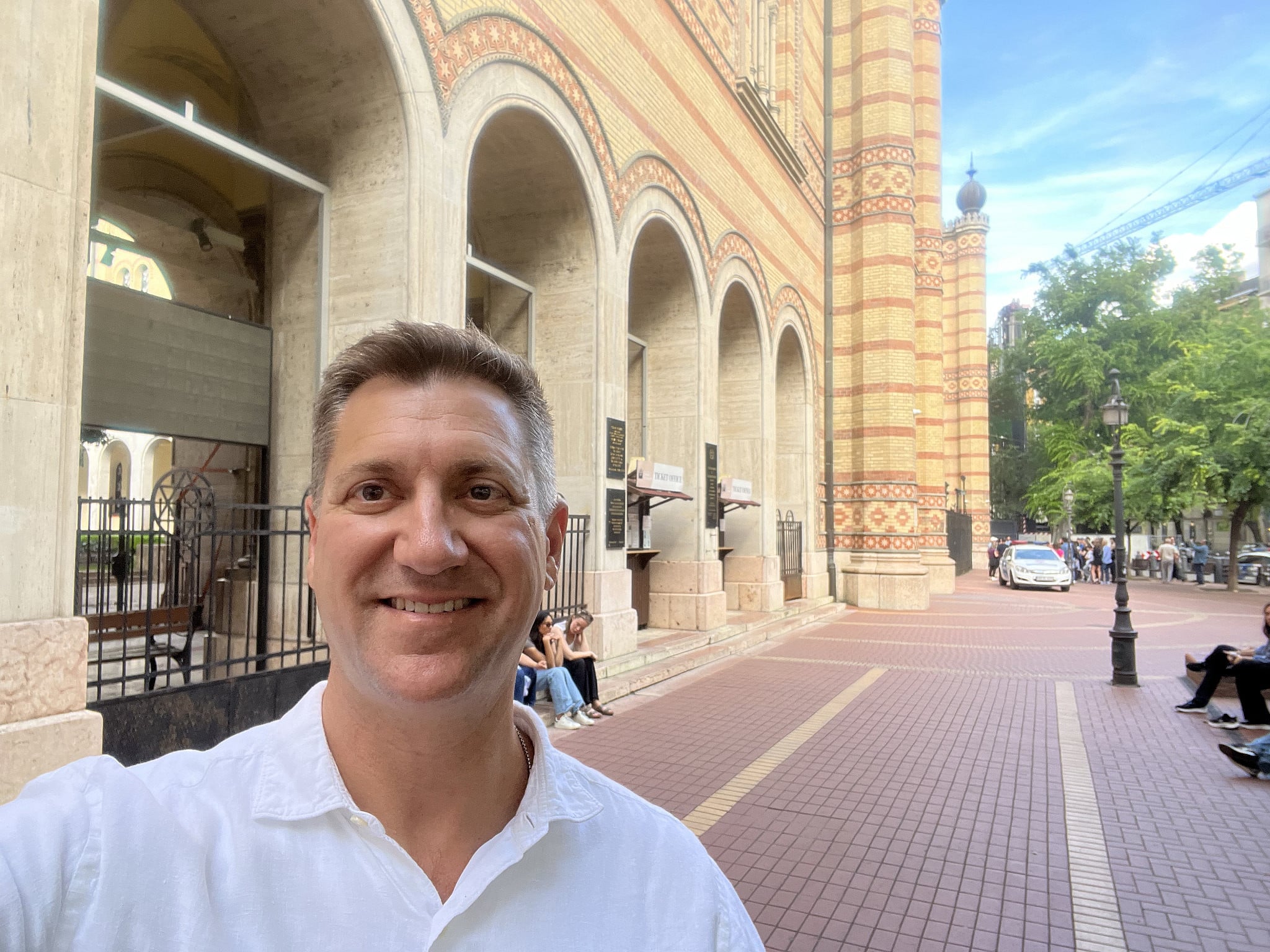
Standing outside the Dohany Street Synagogue in Budapest, the largest synagogue in Europe, second largest in the world. Photo by Feivel Strauss
While visiting Europe’s largest synagogue, I realized one real danger for Jews isn’t anti-semitism, it’s that most Jews no longer know how to talk to God.
Last week I visited the largest synagogue in Europe. Fortunately, I was able to daven there with the loving and welcoming morning Shabbat minyan…and even was invited up for an aliyah to the Torah. Imagine an orthodox minyan with an organ! The rabbi, the chazzan and the choir were in great spirits. I even stood next to the choir and “joined” them trying to follow the conductor. My voice was not exactly on key, but I followed the timing and saw the conductor and choir smiling at me. I felt a bit at home, wondering if my great-great grandparents sang these tunes with this beautiful accent.
The Dohány Street Synagogue in Budapest is breathtaking. Soaring ceilings. Ornate details. It once served a vibrant Jewish community that at one point comprised 25% of Budapest. It stands as the largest synagogue in Europe seating 3000 congregants and second largest synagogue in the world. Today it is largely a museum, visited mostly by tourists carrying cameras, not prayer books, during the week. (No cell phones are allowed there on Shabbat!)
I couldn’t stop thinking: how does this happen? How does a building that magnificent become empty?
I know why it happened there. The Shoah saw to that, and decades of communism afterward made sure the silence held. This building didn’t lose its worshippers slowly. They were taken.
And yet standing there, what I felt wasn’t only grief for what was done to Hungarian Jewry. It was a harder, more uncomfortable question about communities that were never touched by either horror.
Why are our synagogues in America so empty?
Nobody murdered us into these half-filled sanctuaries. No regime banned our prayer books. We have safety and freedom, the ability to build whatever Jewish life we wanted and in many places we built buildings nobody comes to talk to God in. The reasons are many: assimilation, the suburbs, the slow secularization of American life. But underneath all of them sits one I think we don’t talk about enough.
Have we forgotten how to pray?
Not how to run a service. Jews are very good at running services. We know when to stand and when to sit, when the rabbi speaks and when Kiddush begins. The choreography is well-rehearsed.
But choreography is not prayer.
When Jews speak nostalgically about prayer, they rarely describe a building. They remember a grandfather swaying over a siddur. Someone singing with abandon, tears on their face, lingering over a single word. A person who appeared to be in a genuine conversation with God, not reciting at God, not performing for the congregation, but actually talking to someone.
That is what we have lost. And I think we know who lost it for us.
Rabbis.
Not all of them. But enough. Too many rabbis lead prayer without appearing to pray themselves. They are conductors, administrators, public speakers. They are often brilliant. But when was the last time you watched your rabbi during davening and thought: that person is somewhere else right now. That person is praying from the depths of his soul.
Cantors too. The cantor’s voice can be the most moving thing in Jewish life, and also its greatest obstacle. When one magnificent voice does all the work, the congregation becomes an audience. We sit back. We listen. We applaud, internally. And we never learn to pray ourselves, because we never have to. Someone is doing it for us.
And then we go home. And here is the part nobody talks about.
We don’t pray there either.
Jewish children grow up watching their parents perform many Jewish acts. They see Shabbat candles lit. They hear Kiddush. They watch matzah broken and hidden and found. But how many Jewish children have walked past their parents’ bedroom and heard them talking to God? How many have seen a parent sit quietly, not with a siddur, but just, speaking? Struggling? Asking?
Almost none. Because most Jewish parents don’t do this. Not because they are bad Jews, but because nobody taught them how. Because prayer, in their experience, is something that happens in a special building, on a schedule, in Hebrew, led by a professional.
Rebbe Nachman of Breslov understood something that most of our institutions have forgotten. He taught hitbodedut, the practice of speaking to God in your own language, your own words, about your own life. Not the elegant Hebrew of the siddur. Your words. Whatever you have. Even if all you have is silence, or anger, or the feeling that nobody is listening.
Rebbe Nachman called this the highest form of prayer. Not because the words are beautiful, but because they are true. Because you are not performing. You are actually showing up.
He knew that codified prayer, the blessings, the liturgy, the structured service, can become a wall as easily as a door. Said too fast, too automatically, with too much deference to the person at the front of the room, it can feel stiff and obligatory. Religious theater. Jews learn to wear it like a costume rather than live inside it.
This is not an argument against liturgy. The siddur is one of the great achievements of Jewish civilization. It is an argument for teaching Jews that the siddur is a beginning, not a ceiling.
Synagogues were Judaism’s answer to a question every generation has faced. When the Temple fell, Judaism made holiness portable. Anyone could pray. Anywhere. Without a priest, without a building, without a professional standing between you and God.
Somewhere we forgot that.
The future of the synagogue will not be saved by better acoustics, a younger demographic, or a hipper rabbi. It will be saved by communities willing to do one difficult thing.
Teach people to pray.
Not to follow a service. Not to feel comfortable in a sanctuary. To actually pray. To hope, to surrender, to dream, to gain spiritual courage. To show up in front of God without a script and say whatever is true. Even if what’s true is anger. Even if it’s silence. Even if it’s I don’t know if you’re there, but here I am anyway.
Rabbis must model this, not perform it. Cantors must lead us into prayer, not replace us in it. And we have to take this home. Our children need to see us talk to God, not just watch professionals do it on Saturday morning.
Standing in that magnificent, mostly empty synagogue in Budapest, I felt something I didn’t expect.
Not sadness. Not nostalgia.
A warning for us around the world. When the conversation with God quietly ends, when a synagogue forgets prayer, it doesn’t disappear overnight. It becomes a museum first. The architecture remains. The tourists arrive.
Related Topics
Related Posts